



Prop Trading · Beginner · 10 min read
Prop Firms with No Evaluation Accounts: How Instant Funding Really Works
The mechanics of instant funding in prop trading
A prop firm with no evaluation accounts skips the challenge stage of the traditional model and hands you a live funded account as soon as your upfront fee clears and the trader agreement is signed. From that first click, you are inside the firm's full rulebook: drawdown limits, position-sizing caps, profit targets and any news or weekend restrictions all apply exactly as they would to a trader who had spent weeks passing a two-phase test.
Proprietary trading (or prop trading) is the practice of trading with a firm's capital in exchange for a share of the profits it produces. Under the traditional model, the firm asks you to prove yourself first: you pay a smaller fee, trade a simulated account, and hit a profit target while staying inside a drawdown limit before real capital is allocated to you. A drawdown is the fall from the highest equity point down to a lower point before a new high is reached.
With instant funding, that filter is absent, and the commercial trade you are making is easy to see: the time and discipline of a challenge is exchanged for a higher upfront cost and a thinner evidence base that you can actually trade within the rules. Straight-to-funded firms typically accept your fee and put you on a live account within minutes. Everything else, from the platform (MetaTrader 4, MetaTrader 5 or cTrader are the common choices) to the instruments you can trade, tends to mirror the challenge products the same firm sells.
If a funded account is your goal, our roundup of the best prop firms is the place to start.
How drawdown limits and risk rules work from day one
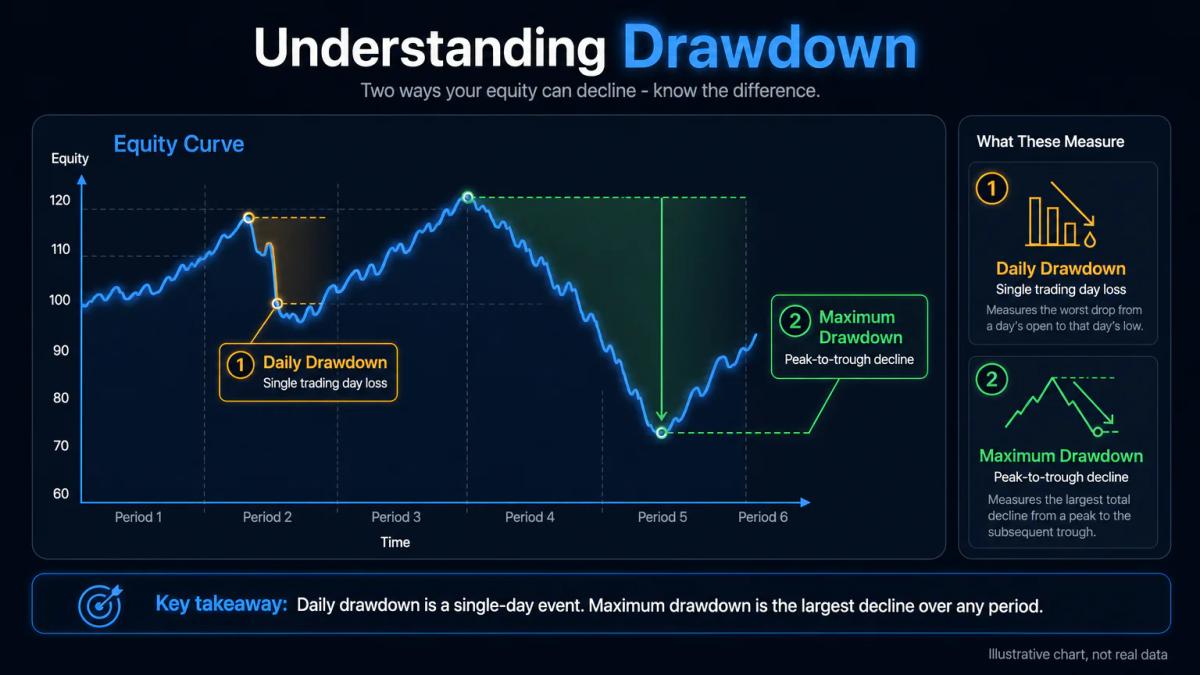
Instant funded accounts enforce the same drawdown caps and position-sizing rules found on evaluation accounts, and those rules bite from the opening trade. There is no settling-in period: if a limit is breached on day one, the account is closed and the fee is generally not refunded.
Two drawdown types dominate the market, and it is worth understanding both before you pay a fee:
- Daily drawdown caps how much equity you can lose in a single trading day, usually measured from the day's starting balance or equity high.
- Maximum drawdown (sometimes called overall or trailing) caps how far your account can fall from its all-time high; if it trails, every new equity peak drags the floor up with you.
Risk rules typically extend beyond drawdown, and the terms you will most often see spelled out in the agreement include:
- A maximum lot size per instrument.
- A ban on holding trades over the weekend.
- Restrictions during high-impact news releases.
- A cap on how much of your account can sit in open risk at any moment.
A lot is a standardised trade size: one standard forex lot is 100,000 units of the base currency.
Because you are trading real firm capital from minute one, a single oversized position or a stop loss set too wide can end the account before any withdrawal has been made. That structural fragility is the defining feature of prop firm trading with no evaluation, and it is why position sizing carries more weight here than in almost any other retail context.
Account sizing and scaling paths for instant traders
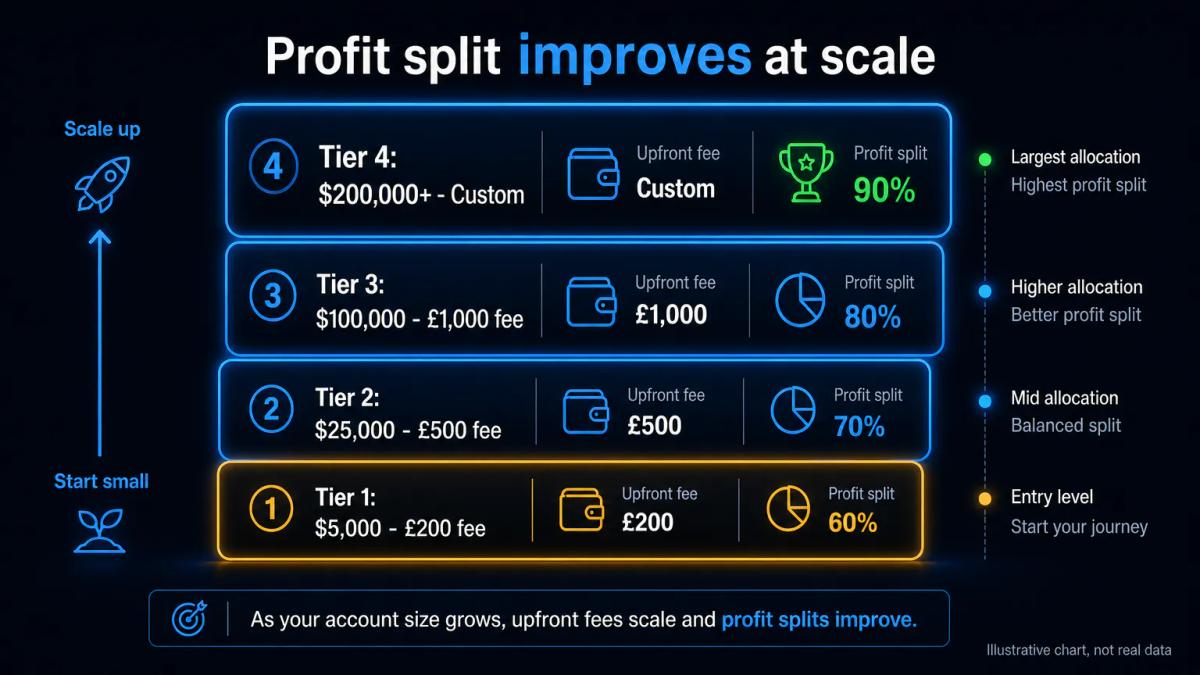
Most no-evaluation firms offer tiered account sizes, typically ranging from around $5,000 to $200,000 or more. You pick the size that matches your budget and the fee scales with it: a larger account means a higher upfront cost and a higher potential payout, but the same percentage drawdown translates into a larger absolute loss you must avoid.
Scaling paths let you grow the allocation over time. A typical structure looks like this:
| Milestone | Requirement | Result |
|---|---|---|
| Initial allocation | Pay upfront fee | Live account at chosen size |
| First scale-up | Meet a profit target (often around 10%) without breaching drawdown, over a set period | Account size increased by a fixed percentage |
| Repeat scaling | Continued profitable months with a clean drawdown record | Further step-ups, sometimes to $500,000 or beyond |
Read the scaling terms before you pay. Some firms scale the account balance but not the drawdown allowance in the same proportion; others require consecutive profitable months, so a single losing month resets the clock. A scaling plan that looks generous on the landing page can be much slower once the fine print is applied.
Profit splits and payout structures explained
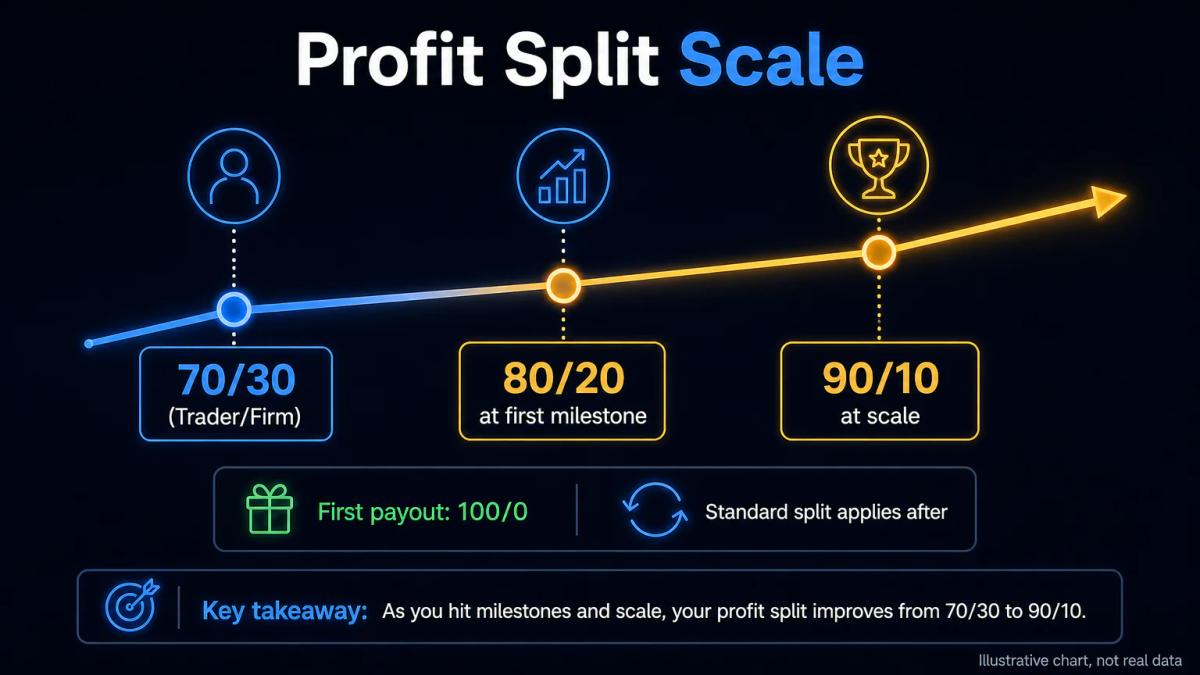
Instant funded accounts split profits between you and the firm on a sliding scale, commonly from 70/30 to 90/10 in your favour. The split often improves as you scale, as a reward for demonstrated consistency. Some firms advertise 100% on the first payout as a promotional structure; the standard split applies from the second payout onward.
Payouts are usually triggered by a minimum profit threshold and a minimum time on the account. A typical structure allows a withdrawal request every 14 or 30 days once you are above the starting balance by a set amount. The payment rail is as important a variable as the split itself: bank transfer, cryptocurrency and specialist payment providers are the common options, each with its own fees, minimums and processing times.
A higher profit split does not automatically make a deal better once the other terms are read together. Split, fee, drawdown rules and payout frequency need to be weighed as a single package. For example, an 80/20 split with a strict trailing drawdown and a 30-day payout cycle can pay you less over a year than a 70/30 split with a static drawdown and weekly payouts, because the second structure lets you compound and withdraw more often.
Regulatory oversight and licensing of no-evaluation firms
Most no-evaluation prop firms operate offshore and are not authorised by the Financial Conduct Authority (FCA) or supervised under the European Securities and Markets Authority (ESMA) rulebook. They typically position themselves as education or technology providers, arguing that because trader activity happens on a simulated environment funded by the firm rather than on a client money account, retail investment rules do not apply.
That framing has practical consequences for a UK trader. FCA-authorised investment firms are covered by conduct rules, complaint handling standards and, where relevant, the Financial Services Compensation Scheme. An offshore prop firm registered in a jurisdiction with light-touch company law offers none of that. If the firm delays a payout, changes rules retroactively, or closes, your recourse is limited to the firm's own dispute process and whatever civil action is realistic across borders.
Before paying a fee, three things are worth pinning down on paper:
- The exact legal entity on the trader agreement and its country of incorporation.
- Whether that entity holds any financial licence at all (many hold none), and what the licence actually covers.
- The terms governing account closure: who decides a rule was breached, and what happens to unpaid profits if the firm terminates the relationship.
UK retail leverage caps set by the FCA (30:1 on major forex pairs, 20:1 on major indices, 5:1 on individual equities, and a prohibition on crypto CFDs for retail clients) do not automatically bind offshore prop firms. You may be offered leverage far in excess of those caps, which magnifies both potential gains and the speed at which a drawdown rule can be breached.
Tax reporting and trader obligations
Profits from instant funded accounts are taxable income in your country of residence, and you are responsible for reporting them, whether or not the prop firm issues any documentation. This section is general information: personal tax positions depend on your circumstances and must be checked with a licensed professional in your jurisdiction.
Because offshore firms typically classify payouts as contractor income or performance fees rather than investment returns, HM Revenue and Customs (HMRC) in the UK will usually treat them as trading or miscellaneous income for tax purposes, sitting outside the capital gains regime. The distinction has real consequences: income tax rates, thresholds and reliefs differ from those on capital gains, and the top marginal income tax rate applies only to income above the relevant band, so your effective rate depends on where each pound of the payout falls in your total income for the year.
A few practical points to work through with an accountant:
- Keep a running log of every payout: date, amount received, currency, exchange rate on the day, fees deducted.
- Keep the trader agreement and the firm's payout confirmations; these are your primary evidence if HMRC asks.
- Ask the firm in writing whether it issues any year-end statement. Many do not, and the absence of a statement does not remove your obligation to report.
- If you trade instant funded accounts as a serious ongoing activity, the classification of that activity (hobby, self-employment, trading business) affects which expenses, if any, are deductible against the income.
Double-taxation treaties, currency conversion timing and the point at which income is deemed to arise all add complexity that a general article cannot resolve. Get the specifics checked before your first tax year closes, not after.
Psychological readiness without an evaluation phase
Skipping evaluation means you trade under real drawdown rules from your first click, and that changes the emotional load. The evaluation phase, whatever its cost, forces a period of disciplined execution before real capital is at stake. Remove it and the pressure to justify the upfront fee can push a beginner toward oversizing, over-trading, or revenge trading after a loss.
Revenge trading is the pattern of entering a new position immediately after a loss, larger than planned, in order to recover the loss quickly. It is the fastest way to breach a daily drawdown limit. Overtrading, taking more setups than your plan allows because you feel you must produce a result, is the slower version of the same problem.
Before you buy an instant funded account, two questions are worth being honest about:
- Whether you have a written trading plan you have followed on a demo or personal account for several months.
- Whether you have ever taken a full loss on a plan without immediately re-entering.
If either answer is no, the discipline that an evaluation forces on you may well be worth more than the time it saves.
Upfront costs versus evaluation time: the trade-off
Instant funded accounts charge a higher upfront fee than evaluation products for the same account size, and that fee is the price of skipping the challenge. Typical instant funding fees for a $10,000 to $25,000 account sit in the £200 to £1,000 range, depending on firm, account size and profit split. A comparable multi-phase evaluation for the same account size usually costs less, sometimes substantially less, because the firm is only exposed to real capital if you pass.
The break-even calculation is straightforward in principle. If a two-phase challenge would take you, on average, 20 to 40 trading days to pass, the value of skipping it depends on how much profit you expect to generate in those days and how confident you are of passing at all. Challenges have failure rates; refunds of the challenge fee usually depend on passing and then reaching the first payout.
A practical decision framework might look like this:
- Lean toward evaluation when the fee difference is meaningful to you, your strategy is still being refined, and the time to pass is not commercially urgent.
- Lean toward instant funding when you have a tested strategy, the fee difference is affordable as a business cost, and immediate access to a payout cycle is worth more to you than the discipline pressure of a challenge.
To compare these rules with a real firm's, the Hola Prime review lays them out.
Frequently Asked Questions
Can you really trade with no evaluation at a prop firm?
Yes. Straight to funded prop firms let you skip the challenge phase and open a live funded account after paying an upfront fee and accepting the trader agreement. You do not have to hit a profit target on a demo first, but you do have to follow the drawdown and risk rules from your very first trade, and a breach closes the account.
What happens if you hit the drawdown limit on an instant funded account?
The account is closed and any unrealised or unpaid profits under the firm's terms are usually forfeited. Some firms offer a paid reset or a discounted new account, others do not. The upfront fee is not typically refunded on a drawdown breach. Read the exact wording on daily and maximum drawdown, and whether the maximum drawdown is static or trailing, before you pay.
Do instant funded prop accounts charge upfront fees?
Yes. The higher upfront fee is how the firm prices the risk of skipping the evaluation. Fees vary by account size, profit split and firm, but a $10,000 to $25,000 instant funded account typically costs several hundred pounds. A traditional multi-phase evaluation for the same account size usually costs less, because the firm only allocates real capital once you have passed.
How quickly can you withdraw profits from a no-evaluation prop account?
Most firms operate on a fixed payout cycle, commonly every 14 or 30 days, provided you are above the starting balance by a minimum amount. Processing times after a request depend on the payment method: bank transfers are typically slower than cryptocurrency. Check the minimum time on the account, minimum profit threshold and the payout method fees before you assume a schedule.
Is instant funding from a prop firm regulated in the UK?
In most cases, no. The majority of prop firms offering no-evaluation accounts operate through offshore entities that are not authorised by the FCA. They usually position themselves as technology or education providers rather than investment firms. You will not have access to the Financial Services Compensation Scheme or the Financial Ombudsman Service for a dispute with an unauthorised offshore entity.
About the authors


Put this into practice
Related articles

Prop Trader Salary: What You Actually Earn at Firms and Funded Accounts
A plain-English breakdown of prop trader pay: base salary, bonuses, profit splits, drawdown rules, tax treatment and how earnings evolve from year one to year ten.

Prop Trading Jobs: Roles, Pay, Hiring, and Career Paths
A plain-English guide to prop trading jobs: what they pay, how firms hire, what background you need, and where the career leads next.

Prop firms that use TradingView: a trader's guide to platforms and accounts
A plain-English guide to prop firms that support TradingView charting, covering integration, challenge terms, regulation and risk management.
0 comments