



Prop Trading · Beginner · 12 min read
Prop Firms That Accept US Clients: What to Check Before You Sign Up
Why US traders face barriers to prop firm access
Open a prop firm's sign-up page from a US IP address and you'll often see the same message: not available in your country.
Prop firms that accept US clients exist, but the roster is shorter than what's available to traders in Europe, Latin America, or Asia. The main reason is regulatory: firms taking on US retail participants often need to register with the Commodity Futures Trading Commission (CFTC) or join the National Futures Association (NFA), and most offshore providers simply block US traffic rather than eat that compliance burden.
A prop firm (short for proprietary trading firm) is a company that lets you trade its capital in exchange for a cut of the profits, usually after you pass an evaluation. For most retail-facing prop firms, the product is a simulated account funded by the firm; profits get paid out as contractor income rather than as market returns. That structure sits in murky regulatory territory in the United States, and it's the main reason firms wall off US sign-ups.
State-level rules pile on top of federal ones. Some US states demand additional registration from any business offering trading-related services to residents, and a handful of firms exclude specific states (often those with stricter money-transmitter or securities rules) even when they accept the rest of the country. Before you pay a challenge fee, check the firm's terms of service for a state exclusion list and confirm your state isn't on it.
The result for you as a US trader is that you're shopping on a narrower shelf, and the firms that do accept you tend to price that exclusivity into their fees. That makes it worth spending an extra hour on due diligence: regulator status, platform, drawdown mechanics, and payout history matter more here than they do on a broader market.
To trade with a firm's capital, compare the best prop firms and how their evaluations work.
What should US traders look for in a prop firm
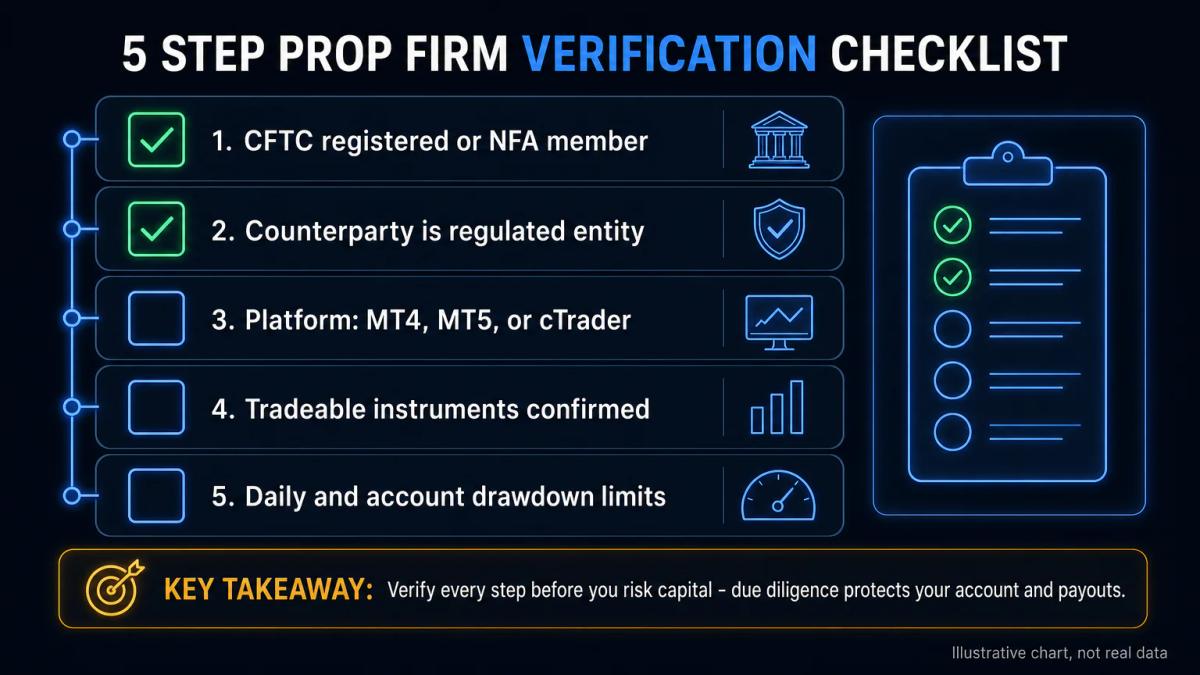
The first check is regulator status. Ask whether the firm operates any CFTC-registered or NFA-member entity, and whether the entity you're actually contracting with is that regulated entity or an offshore affiliate. The NFA maintains a public register called BASIC where you can search a firm's name or NFA ID. If the firm sells itself as "US-friendly" but the counterparty on your contract is an offshore SPV in a jurisdiction with no meaningful oversight, treat the marketing and the legal reality as two separate things.
The second check is the platform. Confirm whether you'll trade on MetaTrader 4 (MT4), MetaTrader 5 (MT5), cTrader, TradingView, or the firm's own platform. MT5 and cTrader give you more asset classes and depth-of-market data; MT4 is older but still widely supported. TradingView-based prop firms suit traders who already build charts there. Make sure the platform is available on the operating system you use and that the data feed matches the instruments you plan to trade.
The third check is the instrument list. Not every firm lets US traders touch every market. Confirm access to major FX pairs (EUR/USD, GBP/USD, USD/JPY), the index CFDs or futures you care about (US 500, Nasdaq 100, Dow), commodities (gold, oil), and, if relevant, crypto. Some firms restrict crypto for US traders because of state-level licensing requirements, and others exclude single-name US equities entirely.
The fourth check is drawdown mechanics and holding period. Read the rulebook, not the landing page: the difference between a static and a trailing drawdown can be the difference between passing and failing the same series of trades. Confirm the minimum holding period per trade and the minimum number of trading days per month, because both rules can invalidate a profit target that you would otherwise have hit.
The fifth check is trader feedback in the US community. Look for payout proofs from named US traders across multiple months, not screenshots from the firm's own marketing. A firm that has paid US traders reliably for two years is a lower risk than one that launched six months ago with aggressive discounts.
Tax reporting and compliance obligations for US traders
US traders must report prop trading income to the Internal Revenue Service, and the mechanics differ from a personal brokerage account. Most prop firms treat you as an independent contractor: profits paid out to you are contractor income, not capital gains. That means the firm typically issues a Form 1099-NEC (for non-employee compensation) if you cross the $600 annual threshold, and you report the amount on Schedule C or as other income on your Form 1040. Understanding how a taxable brokerage account works helps clarify the tax treatment of trading income versus investment returns.
Because the payouts are ordinary income, they're taxed at your marginal federal rate rather than at long-term capital gains rates, and they're also subject to self-employment tax if you're treated as a sole proprietor. State income tax rules apply on top of the federal treatment. Keep every payout confirmation, every fee receipt, and every platform statement in a dated folder from day one: the paperwork is easier to build in real time than to reconstruct in April.
If the prop firm is domiciled outside the United States, additional reporting can apply. The Foreign Account Tax Compliance Act (FATCA) may require you to disclose foreign financial accounts above certain thresholds on Form 8938, and the Bank Secrecy Act's FBAR (FinCEN Form 114) applies to foreign accounts above $10,000 in aggregate at any point in the year. Whether a specific offshore prop firm setup triggers either form depends on the account structure, so this is a question for a tax professional familiar with trading income rather than a generic accountant.
One final compliance point: do not net losing challenge fees against payouts without documenting them separately. Fees paid to fail an evaluation are a business expense; payouts received are gross income. Tracking them apart makes an audit-friendly Schedule C much easier to prepare.
Risk management rules and drawdown limits
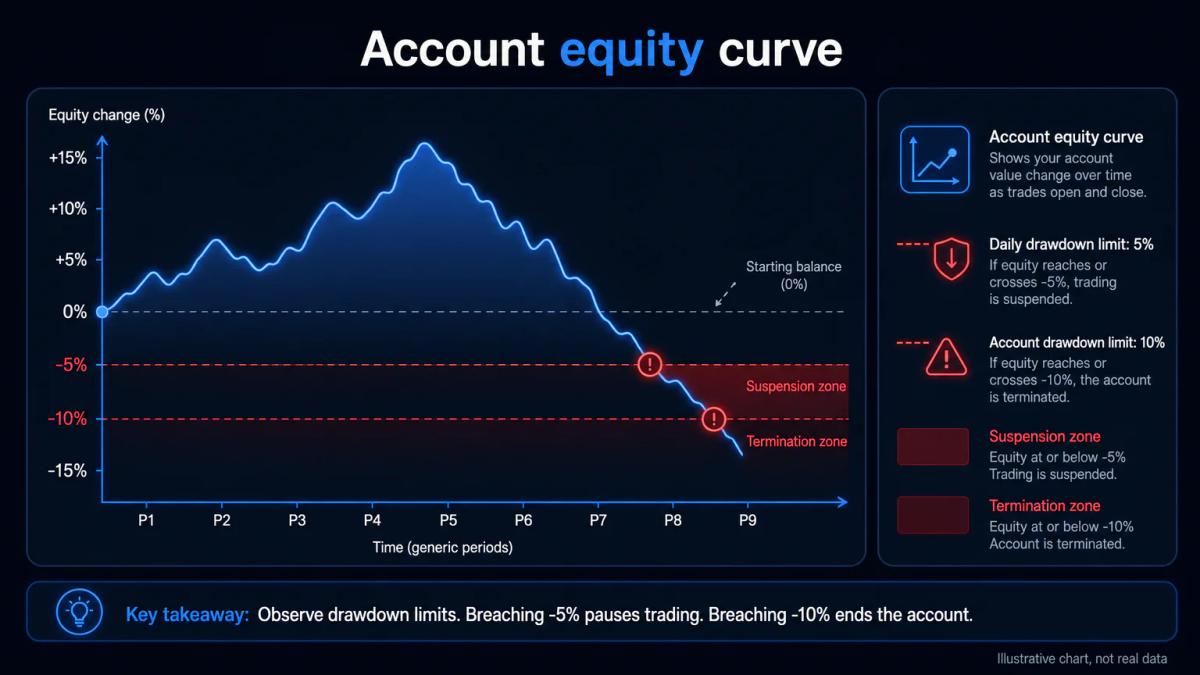
Risk management on a prop account is not a suggestion, it's the contract. Most US-accepting firms enforce a daily drawdown of around 5% of the starting balance and an account-level drawdown of 8% to 10%. Cross either line, even briefly on an intraday equity dip, and the account is either suspended for the day or terminated outright. The firm doesn't owe you a warning; the system enforces the rule automatically.
A stop loss (a pre-set order that closes a losing trade at a defined price) is the primary tool for keeping daily drawdown inside the cap. Combined with a fixed risk-per-trade budget, usually 0.5% to 1% of the account, it caps the number of consecutive losers that can end your evaluation.
Understanding types of trading and their risk profiles helps you align your strategy with the drawdown constraints of a prop account.
On a $50,000 account with a 5% daily drawdown limit, risking 1% per trade means five losing trades in a row take you to the daily cap; risking 0.5% doubles that runway.
Trailing drawdown deserves a separate mention because it catches new traders out.
A trailing drawdown follows your equity peak: if the account reaches $52,000 on a $50,000 balance with a $4,000 trailing rule, the floor becomes $48,000 immediately. Give back the whole $2,000 profit plus $2,000 of the starting balance and the account terminates, even though the balance never fell below the original $50,000.
Firms that use static drawdowns are more forgiving here; check which model your contract uses.
Position sizing ties the rules together. A pip (the smallest standard price move on an FX pair) is worth roughly $10 per standard lot on most USD-quoted pairs, so a 20-pip stop on a one-lot trade risks $200. On a $50,000 account that's 0.4% risk, which fits inside a 1% per-trade budget with room for a spread and slippage.
Build the sizing calculation before the trade. If you need help, you can use MonkeyTrade's free position sizing calculation tool.
Comparing top prop firms for US traders
When you compare US-accepting prop firms, put the four variables that most affect your outcome on a single sheet: minimum account size, funding model, drawdown type, and profit split trajectory. Add platform, payout schedule, and instrument access as tiebreakers. The point of the comparison is not to find the cheapest challenge fee but to find the firm whose rules match the way you actually trade.
| Feature to compare | What to write down | Why it matters |
|---|---|---|
| Regulatory status | CFTC registered, NFA member, or offshore only | Determines dispute options and trader protection |
| Funding model | One-step, two-step, or instant | Sets upfront cost and time to first payout |
| Account sizes | Lowest and highest available | Fits the risk budget you can actually meet |
| Drawdown type | Static, trailing, or hybrid | Trailing is stricter after profits accrue |
| Daily drawdown cap | Percentage of starting balance | Caps consecutive-loss tolerance |
| Profit split | Starting split and scaling schedule | Determines take-home per payout |
| Minimum holding period | Seconds per trade | Blocks or allows short-term strategies |
| Payout speed | Business days after request | Affects cash-flow planning |
| Platform | MT4, MT5, cTrader, TradingView | Must match your workflow |
| Instruments | FX, indices, commodities, crypto | Some firms restrict crypto for US traders |
| Educational resources | Mentorship, community, webinars | Useful for newer traders |
| State exclusions | List of blocked US states | Confirms you can actually sign up |
Educational resources vary widely between firms. Some run active Discord communities with US-time-zone moderators, weekly market-review sessions, and structured mentorship for funded traders. Others offer nothing beyond a written rulebook.
For a beginner, that difference matters more than a five-percentage-point profit split, because the risk of failing the evaluation on a rule you didn't fully understand is higher than the reward of a marginally better split.
Finally, do a small live test before scaling. Buy the smallest available account, trade it exactly as you would a larger one, and go through the full cycle: hit a profit target, request a payout, and confirm the funds land in your US bank account on the timetable the firm promised. If any step of that cycle disappoints, learn it on a $10,000 evaluation, not on a $200,000 one.
Which prop firms actually accept US clients
Names help more than principles when you are building a shortlist, so here are firms that have historically been open to US residents. Treat this as a starting point for your own checks: eligibility changes, and several firms accept most of the country while still excluding a handful of states.
On the futures side, where the regulatory path is clearest because trades route to CME-listed products, the established US-facing names are:
- Topstep
- Apex Trader Funding
- Earn2Trade
- Take Profit Trader
- Bulenox
- MyFundedFutures
- Elite Trader Funding
- Tradeify
Most of these are US-domiciled, run their evaluations on platforms such as NinjaTrader, Tradovate or Rithmic-connected software, and pay out in US dollars to a domestic bank account.
On the forex and CFD side the list is shorter and more volatile, because those firms operate on simulated broker feeds rather than a regulated exchange:
- Funded Trading Plus
- The Funded Trader
- Goat Funded Trader
- FundedNext
These have all taken US sign-ups at various points, sometimes under a separate entity or with reduced instrument access. FTMO, by contrast, stopped onboarding US clients, which is a useful reminder that a firm's status can flip with no notice.
Before you pay any challenge fee, verify three things directly with the firm: that US residents are accepted today, that your state is not on the exclusion list in the terms of service, and which legal entity signs your contract. A support ticket with a written answer is worth more than a marketing page, and it gives you something to point to if the terms change later.
This content is general information and not advice: every situation needs checking with a licensed professional in the relevant jurisdiction.
Frequently Asked Questions
Why is it so hard for United States users to find prop firms?
Most prop firms restrict US sign-ups to avoid the compliance overhead of CFTC and NFA rules, plus state-level requirements that vary across the country. Offshore firms often find it cheaper to block US traffic than to build the legal structure needed to accept it, which shrinks the shortlist available to US traders.
What instruments can US traders access through prop firms?
Most US-accepting firms offer major and minor FX pairs, index CFDs or futures on US 500 and Nasdaq 100, and commodities such as gold and oil. Crypto access is often restricted for US traders because of state licensing rules, and single-name US equities are frequently excluded. Confirm the instrument list in the firm's terms before you pay a challenge fee.
How long does it take to withdraw profits from a US-accepting prop firm?
Payouts to US traders typically arrive 3 to 14 business days after a withdrawal request. The delay depends on the firm's internal approval cycle, its payout calendar (some pay twice a month), and the payment rail used. ACH transfers to US banks are usually faster than international wires; check which rails the firm supports before you commit.
Are there prop firms regulated by the CFTC that accept US retail traders?
Some firms operate a CFTC-registered or NFA-member entity for US clients, while others accept US traders through an offshore affiliate. Search the firm's name on the NFA's BASIC register to confirm the status of the entity you are actually contracting with, not just the group brand shown on the marketing site.
What happens if I exceed the drawdown limit on my prop account?
Breaching the daily drawdown usually suspends the account for the day or fails the evaluation; breaching the account-level drawdown terminates the account. Enforcement is automatic and immediate, so a brief intraday equity dip can end the account even if the balance recovers. Position sizing and a fixed stop loss are the tools that keep you inside both caps.
About the authors


Put this into practice
Prop firms we have reviewed
Scored on the same five dimensions, with the rules that decide payouts. Here are three — the full list is on the prop firms page.



Related articles

Prop Firms That Allow News Trading: Rules, Limits, Splits
A working guide to prop firms that allow news trading: which firms permit it, the position caps and stop rules they enforce, and how splits and fees compare.

Prop Firms with No Evaluation Accounts: How Instant Funding Really Works
A plain-English breakdown of no-evaluation prop firms: how instant funding works, what rules apply from day one, and the trade-offs before you pay a fee.

Prop Trader Salary: What You Actually Earn at Firms and Funded Accounts
A plain-English breakdown of prop trader pay: base salary, bonuses, profit splits, drawdown rules, tax treatment and how earnings evolve from year one to year ten.
0 comments