



Prop Trading · Beginner · 9 min read
Prop Firms That Allow News Trading: Rules, Limits, Splits
What prop firms allow news trading and why the rulebook shapes your strategy
Prop firms that allow news trading are companies that fund traders with their own capital in exchange for a profit share, and permit positions around scheduled economic releases like non-farm payrolls and rate decisions, subject to position size, stop distance, and event-specific caps.
A proprietary trading firm puts up the capital. You pass an evaluation, get a funded account, and split the profits. News trading, the practice of taking positions around scheduled economic releases, tends to attract strategies that depend on the biggest single-session moves in FX and indices, since those moves cluster around scheduled prints. When a strategy leans on those windows, the firm's rulebook effectively decides whether the approach can be run at all.
The rules exist because news events create gap risk. A gap is a jump in price with no trades in between, so your stop loss (a pre-set exit that closes the position at a defined loss) can execute at a worse price than the level you set. Firms cap that exposure through blackout windows, lot limits, and mandatory stops. Reading those clauses before paying the challenge fee is the only way to know whether your intended approach is even permitted.
If a funded account is your goal, our roundup of the best prop firms is the place to start.
Major prop firms that permit news trading
Several well-known prop firms permit news trading on funded accounts, with different combinations of blackout rules, position caps, and instrument restrictions. The list below covers the firms most retail traders in the UK and Europe come across when they shop for a challenge. Terms change frequently: treat this as a starting point and verify each firm's current rulebook before you commit.
| Firm | News trading allowed | Common restrictions | Primary platforms |
|---|---|---|---|
| FTMO | Yes, on most account types | Restrictions on some Swing accounts differ from Normal accounts | MT4, MT5, cTrader, DXtrade |
| The Funded Trader | Yes, subject to plan | Some plans impose a 2 or 5 minute window around high-impact events | MT4, MT5, DXtrade |
| Topstep | Yes, futures focus | Position and daily loss limits apply; no explicit news ban on standard accounts | NinjaTrader, TradingView, TSTrader |
| E8 Markets | Yes on selected accounts | Some account types restrict trading in a window around red-folder events | MT4, MT5, Match-Trader |
| Earn2Trade | Yes, futures focus | Daily loss limit and position size caps apply throughout | Finamark, NinjaTrader, others |
A prop firm's public FAQ is a reasonable starting point, but the binding document is the trader agreement or account rules PDF, which names the events, the windows, and the penalties. If a rule appears only in a support-chat screenshot and not in that written contract, treat it as unenforceable in either direction, because policies are enforced from the signed agreement rather than from informal exchanges.
News trading rules and position limits at prop firms
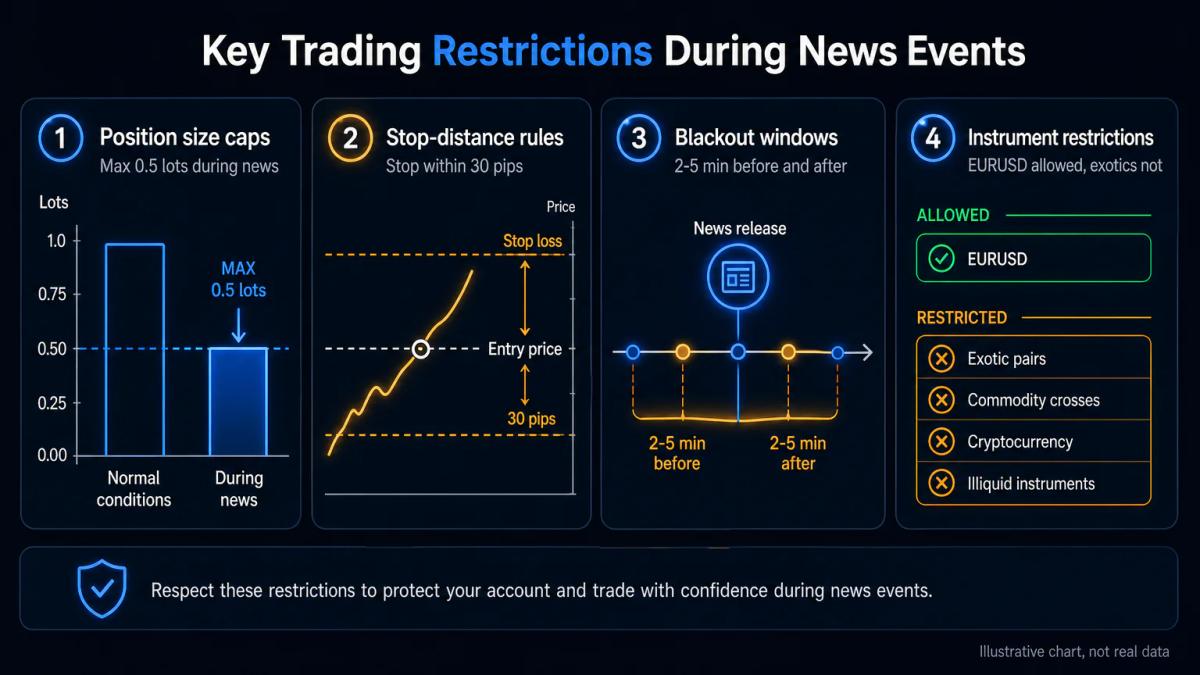
Most prop firms that allow news trading impose strict controls to prevent catastrophic drawdowns when volatility spikes. The typical restrictions fall into a few recognisable categories, each of which appears in some form across the major firms:
- Maximum lot sizes that apply specifically during news events.
- Mandatory stop losses within a set distance from entry.
- Bans on opening or holding positions through the release itself.
- Instrument-level carve-outs for specific pairs, metals or indices.
Position size caps
Firms cap the maximum position around a release, usually expressed in lots. A lot in FX is a standard unit of 100,000 units of the base currency; a mini lot is 10,000 and a micro lot is 1,000. A pip is the smallest standard price move for a pair, usually 0.0001 for pairs like EURUSD. Caps are typically expressed as a maximum lot per instrument or as a maximum aggregate exposure across correlated pairs, and they may be lower during news than during regular sessions.
Stop-distance rules
Some firms require a stop loss placed within a fixed distance of entry, for example 30 pips on a major FX pair, to prevent oversized losses when a candle overshoots. Others simply require a stop to exist on every position from the moment it opens, regardless of distance. Because the wording varies so much between firms, reading the exact clause is essential: a missing or too-wide stop during a red-folder release remains one of the most common causes of a rule breach.
Blackout windows
A blackout window is a period around a release when you cannot open, close or hold positions on the affected instrument. Windows commonly run from two to five minutes before to two to five minutes after the release. It is worth checking which evaluation stage each rule applies to, since some firms enforce blackouts on the challenge only, others on the funded account only, and others across both.
Instrument restrictions
Instruments are treated differently from one another under most rulebooks. A firm may allow news trading on EURUSD while restricting it on exotic pairs, on gold during Federal Open Market Committee decisions, or on indices around European Central Bank statements. It is also worth confirming which events count as high-impact under the firm's calendar, since some firms rely on a specific data provider while others define events by name in the agreement itself.
Profit splits and funding terms for news traders
Profit splits typically range from 50/50 to 90/10 in your favour once funded, and challenge fees are generally scaled to account size, with the intended trading style having little bearing on the price. The table below summarises the shape of the market at the firms listed earlier. Verify the current numbers on each firm's website, since pricing and split tiers change often.
| Firm | Starting profit split | Max profit split | Account size range | Fee model |
|---|---|---|---|---|
| FTMO | 80% | Up to 90% with scaling | $10,000 to $200,000 | One-time challenge fee |
| The Funded Trader | 80% | Up to 90% with add-on | $5,000 to $400,000 | One-time challenge fee |
| Topstep | 100% on first $5,000 profit, then 90% | 90% | $50,000 to $150,000 (Trading Combine) | Monthly subscription |
| E8 Markets | 80% | Up to 95% with scaling | $5,000 to $400,000 | One-time evaluation fee |
| Earn2Trade | 80% | 80% | $25,000 to $400,000 (TCP) | Monthly subscription |
Evaluations usually require a profit target (for example 8% or 10% on the first phase) alongside a maximum daily loss and a maximum overall loss. News trading leaves those targets unchanged while altering the risk taken to reach them, because a single release can clip both loss limits in one candle. Imagine placing a EURUSD position ahead of non-farm payrolls: if the print misses consensus badly, realistic slippage could push the fill well past your stop, so the position should be sized so that the worst plausible outcome still leaves you inside both limits.
Risk management during high-impact news events
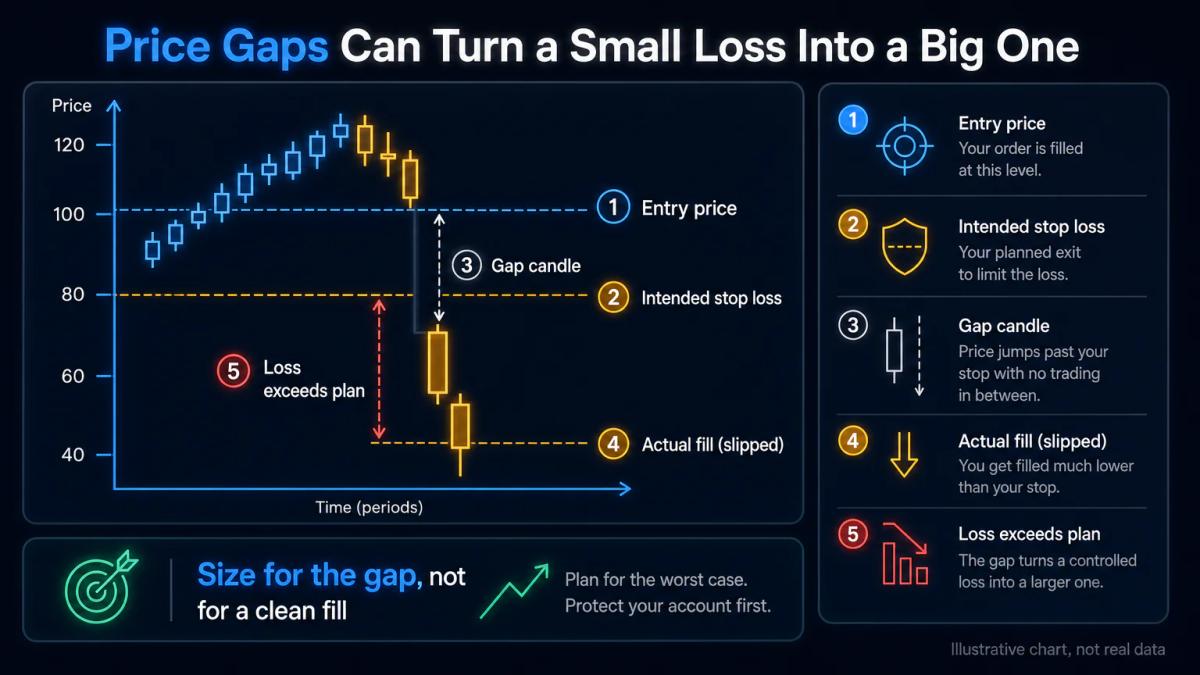
News trading carries outsized risk because price can move faster than a stop can execute. Consider a scenario in which a rate decision surprises the market: price would gap through your stop loss, the fill would land well beyond the level you set, and the realised loss would exceed anything on your original plan. That outcome reflects the mechanics of a thin order book at the moment of the release rather than any failure on the broker's side, so the practical response is to size each position for that possibility rather than for a clean fill.
A workable approach rests on three complementary ideas:
- Worst-case sizing: assume the actual fill is one to three times worse than the stop distance you set, and pick a lot size that keeps that outcome inside the firm's daily loss limit.
- Event selection: releases such as non-farm payrolls, central bank decisions and consumer price index prints move markets in a different league from second-tier data, so the trading calendar can be filtered accordingly.
- Exit discipline: decide in advance whether to close before the release, hold through it, or enter after the print, and follow that decision once the window opens.
The psychological load is separate and equally real. Working a live position through a release compresses hours of normal decision-making into a handful of seconds, and traders who cope well with that pressure tend to reduce their discretion in advance. Written entry and exit rules, a fixed lot size, and a firm ban on adding to a losing position after the print all belong to that pre-commitment. It is that kind of structure, applied consistently over many trades, that keeps risk management around news survivable as a repeated exercise.
Tools and platforms for news trading at prop firms
Most prop firms offer MetaTrader 4 or MetaTrader 5 as the trading platform, with cTrader, DXtrade or NinjaTrader available on selected accounts. An economic calendar is the core tool: it lists releases, their expected impact, and the consensus forecast. Traders commonly cross-reference a broker-integrated calendar with an independent source and treat only red-folder or high-impact events as tradable.
For the definitions of lot and pip, see the Position Size Caps section above. Beyond the calendar itself, three additional tools tend to earn their keep around news events:
- A one-click order interface with pre-set stop and take profit, which reduces execution latency around a print.
- A position-sizing calculator that converts a fixed risk in your account currency into lots for the instrument you are trading, since the pip value of EURUSD differs from the pip value of GBPJPY.
- An alert system, whether native to the platform or a separate app, that gives a countdown you will not miss when the chart is busy.
Some firms provide a proprietary dashboard that flags high-impact events on the calendar, shows your live drawdown against the firm's daily and overall loss limits, and blocks orders that would breach position caps. Where such a dashboard exists, using it as the source of truth removes much of the ambiguity of interpreting written rules under pressure, and it gives traders a defensible record of what the firm's own tool permitted at the moment an order was placed.
Regulatory changes and the future of news trading at prop firms
Regulatory scrutiny of retail prop trading continues to increase. In the UK, the Financial Conduct Authority sets leverage caps for retail clients on contracts for difference, summarised as follows:
- 30:1 on major FX pairs.
- 20:1 on major indices.
- 5:1 on individual equities.
- CFDs on cryptoassets are prohibited for UK retail clients.
These figures come from the FCA Handbook (PROD 11) and the FCA policy statement on the permanent restriction of crypto-derivatives. Prop firm accounts are structured differently from a regulated retail brokerage account, and the trend toward tighter consumer protection continues to shape how firms present their products and where they can accept clients.
Tax treatment varies by jurisdiction and by contract. In the UK, HMRC treats most retail derivatives trading profits as taxable income or capital gains depending on the specific facts, and profit shares paid by an offshore prop firm are not automatically exempt (see HMRC's Business Income Manual and Capital Gains Manual for the general framework). Keep monthly statements, payout invoices, and platform logs: a clean paper trail is what makes the eventual tax return straightforward. For personal advice on your own return, consult a UK-authorised tax adviser.
To compare these rules with a real firm's, the Traders Launch review lays them out.
Frequently Asked Questions
Can you trade news events on a prop trading account?
Yes at most major prop firms, provided you follow the firm's specific rules. Firms including FTMO, The Funded Trader, Topstep, E8 Markets and Earn2Trade allow news trading on at least some of their account types, but each imposes conditions on lot size, stop distance and, in some cases, a blackout window around high-impact releases. The rules that bind you are those printed in the trader agreement or account rules document, not those quoted in support chat.
What is the typical profit split for news traders at prop firms?
Splits usually start at 80/20 in your favour on funded accounts and scale up to 90/10 or higher through performance-based programmes. Topstep pays 100% of the first $5,000 in profit on its funded accounts and 90% thereafter. Splits are not typically reduced for traders who use news strategies: the firm's rulebook may add restrictions, but the payout terms are the same as for any other trading style at that firm.
Which prop firms have the most lenient news trading rules?
Rules change often, but historically FTMO has allowed news trading on most Normal accounts without blackout windows, and Topstep imposes no news-specific ban on standard futures accounts beyond the general loss limits. The Funded Trader and E8 Markets vary by plan and account type, with some plans free of news restrictions and others enforcing a two to five minute window around red-folder events. Verify the exact wording on each firm's current rules page before committing.
Do prop firms allow you to hold positions through economic announcements?
It depends on the firm, the account type and the specific event. Where a firm operates a blackout window, holding a position across the release breaches the rule and can void a trade or the entire account. Where there is no blackout, holding through is permitted, but the daily loss limit and overall drawdown still apply: a large adverse move can breach those limits in seconds. Read the clause on your specific account before you plan the trade.
What happens if you breach news trading rules at a prop firm?
Consequences range from voiding the profit on the offending trade to closing the funded account entirely and forfeiting the pending payout. Some firms give a warning on the first breach during evaluation but not on a funded account; others apply the same penalty at every stage. The specific outcome is listed in the rulebook alongside each rule, so identify the exact clause and the exact penalty before you rely on any interpretation of a grey area.
About the authors


Put this into practice
Related articles

Prop Firms with No Evaluation Accounts: How Instant Funding Really Works
A plain-English breakdown of no-evaluation prop firms: how instant funding works, what rules apply from day one, and the trade-offs before you pay a fee.

Prop Trader Salary: What You Actually Earn at Firms and Funded Accounts
A plain-English breakdown of prop trader pay: base salary, bonuses, profit splits, drawdown rules, tax treatment and how earnings evolve from year one to year ten.

Prop Trading Jobs: Roles, Pay, Hiring, and Career Paths
A plain-English guide to prop trading jobs: what they pay, how firms hire, what background you need, and where the career leads next.
0 comments