



Prop Trading · Beginner · 6 min read
What is a prop firm: how proprietary trading funding works
The core mechanics: how prop firms fund traders
A prop firm, short for proprietary trading firm, is a company that gives traders access to its own capital in exchange for a share of the profits they generate. You trade the firm's money rather than your own, and both sides split the returns according to a written agreement. In practice, you pass an assessment, receive a funded account, follow strict risk rules, and receive periodic payouts.
The model shifts the capital risk from you to the firm, but shifts the performance risk onto you: if you break the rules, the account is closed. Understanding how profit splits and payouts work is essential to evaluating whether the arrangement suits your trading style. Proprietary here means the capital belongs to the firm itself, not to outside investors or client depositors.
See which firms offer the fairest rules in our best prop firms list.
How you access funding: the evaluation process
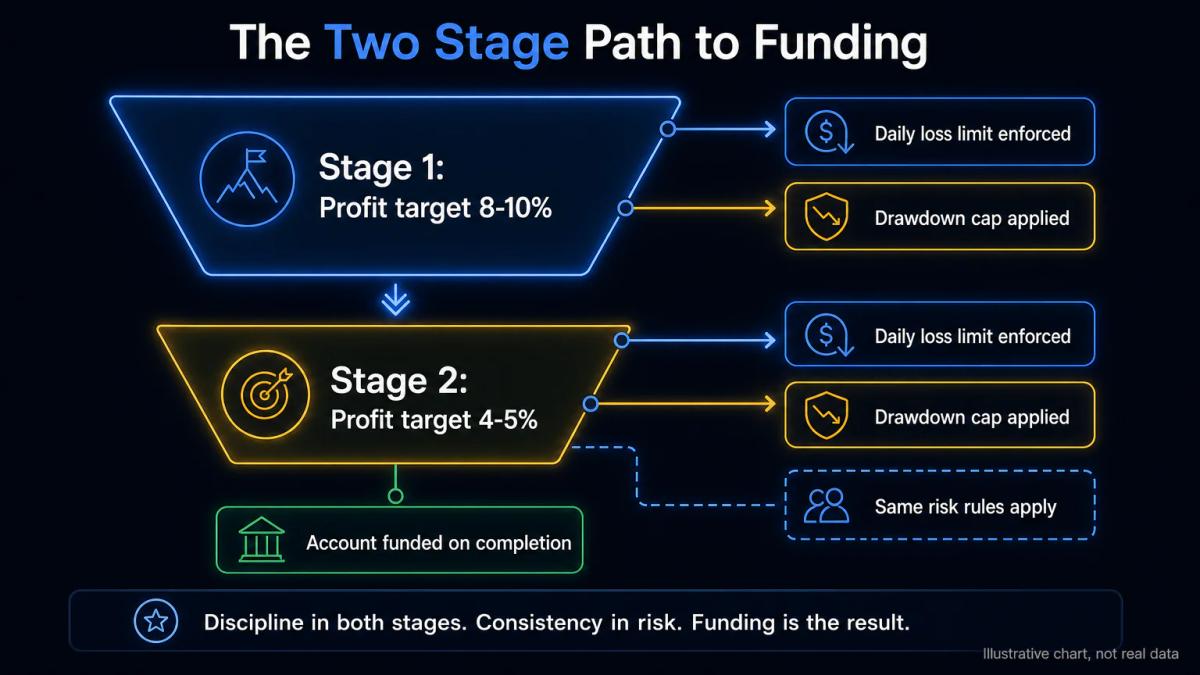
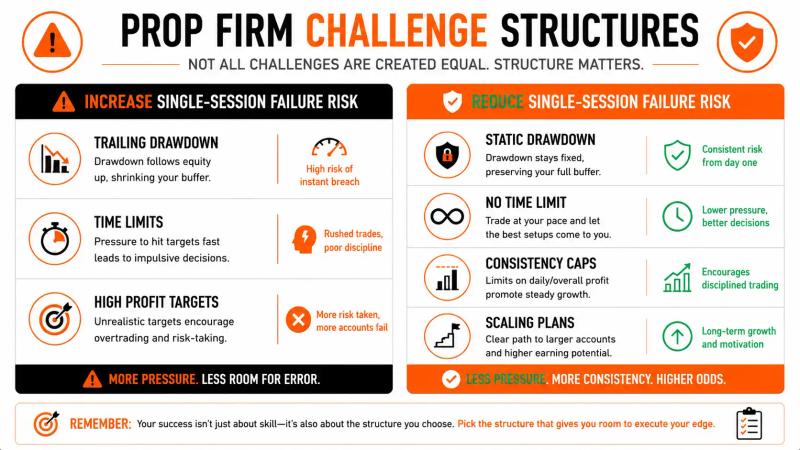
Most prop firms gate funding behind a challenge, an evaluation phase where you demonstrate consistent profitability and risk discipline on a demo or simulated account before real capital is allocated. A typical structure runs in one or two stages.
- Stage one asks you to reach a profit target, often 8% to 10%, without breaching a daily loss limit (a maximum you can lose in a single trading day) or an overall drawdown cap.
- Stage two lowers the profit target, commonly to 4% or 5%, and keeps the same risk rules. You usually have 30 calendar days per stage, though some firms offer unlimited time. How long it takes to get funded depends on your speed through the stages and the firm's processing time.
Once you pass, you sign a trader agreement and receive login credentials to a funded account. The account is still simulated at many firms, with the firm hedging or mirroring your trades in the live market. What matters commercially is that payouts are real money, wired to your bank or e-wallet after you hit a minimum profit threshold.
Profit splits and fee structures
Profit-sharing terms vary widely across the sector. Some firms take 20% to 30% of your gains and let you keep the remainder; others use a tiered model where your share rises from 70% to 80% or 90% as you scale account size or hit consistency targets. Evaluation fees, which you pay upfront to attempt the challenge, typically range from £200 to £2,000 depending on the account size, from a £10,000 nominal account at the low end to £200,000 or more at the top.
Factor in resets (a paid retry after a failed challenge), add-ons such as higher leverage or news-trading permissions, and monthly platform fees at some firms. A realistic total cost of entry for a serious £100,000 evaluation, with one reset, sits between £600 and £1,200. Refund policies differ: several firms reimburse the evaluation fee on your first payout, others do not.
Risk rules and drawdown limits
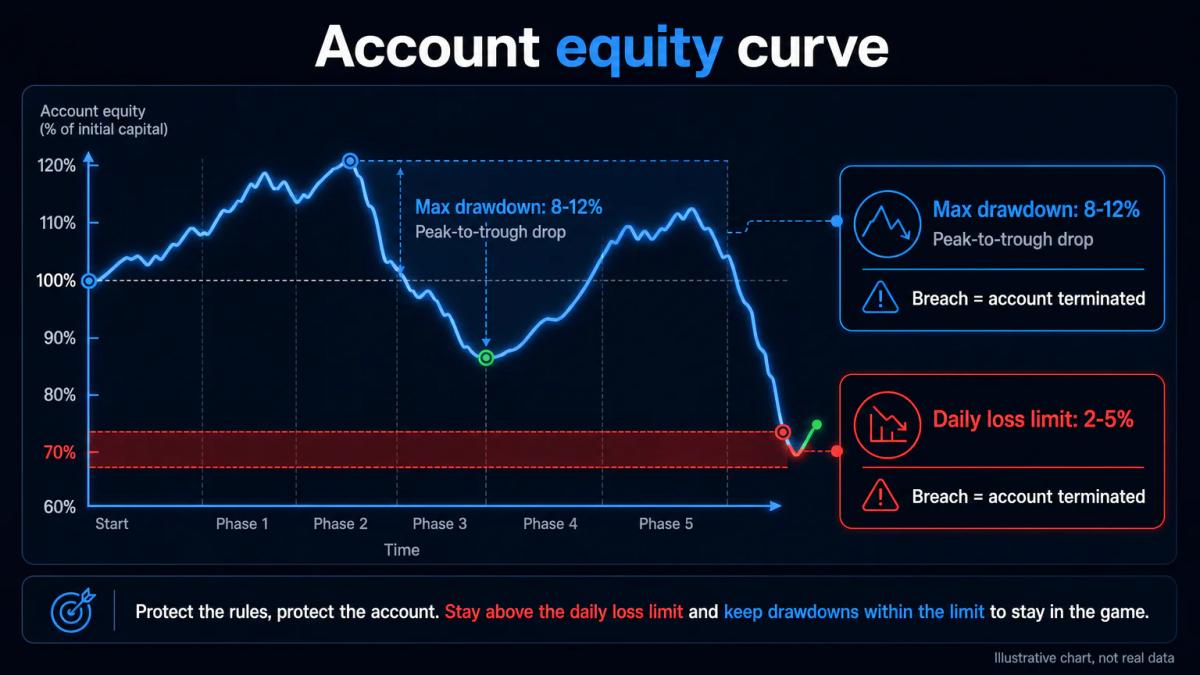
Prop firms enforce hard risk controls to protect the capital pool. The two you must know are the daily loss limit, usually 2% to 5% of the allocated account, and the maximum drawdown, typically 8% to 12% overall (drawdown means the peak-to-trough drop in your account equity). Breach either and the account is terminated immediately, evaluation or funded.
Position-sizing rules cap how much you can risk per trade, and some firms restrict holding trades over the weekend, over major news releases, or beyond a maximum lot size. These rules are non-negotiable and enforced by automated systems, not human discretion. The emotional and psychological demand this creates is real: tight limits force small position sizes and force you to accept losing trades early, which is why most traders fail the challenge.
Asset classes and specialisation
Prop firms specialise by market, and the fit with your existing edge matters more than headline account size. Some focus on spot forex and CFDs on commodities (contracts for difference, derivative products that track an underlying price). Others fund futures traders through exchanges such as the CME, or equity traders on US venues. A smaller subset funds cryptocurrency trading on spot or perpetual futures.
Your choice depends on which instruments you trade and where you live: crypto CFDs are prohibited for UK retail clients by the FCA, so a UK-based trader wanting crypto exposure has to look at spot crypto firms or overseas futures accounts.
Prop firms versus brokers and hedge funds
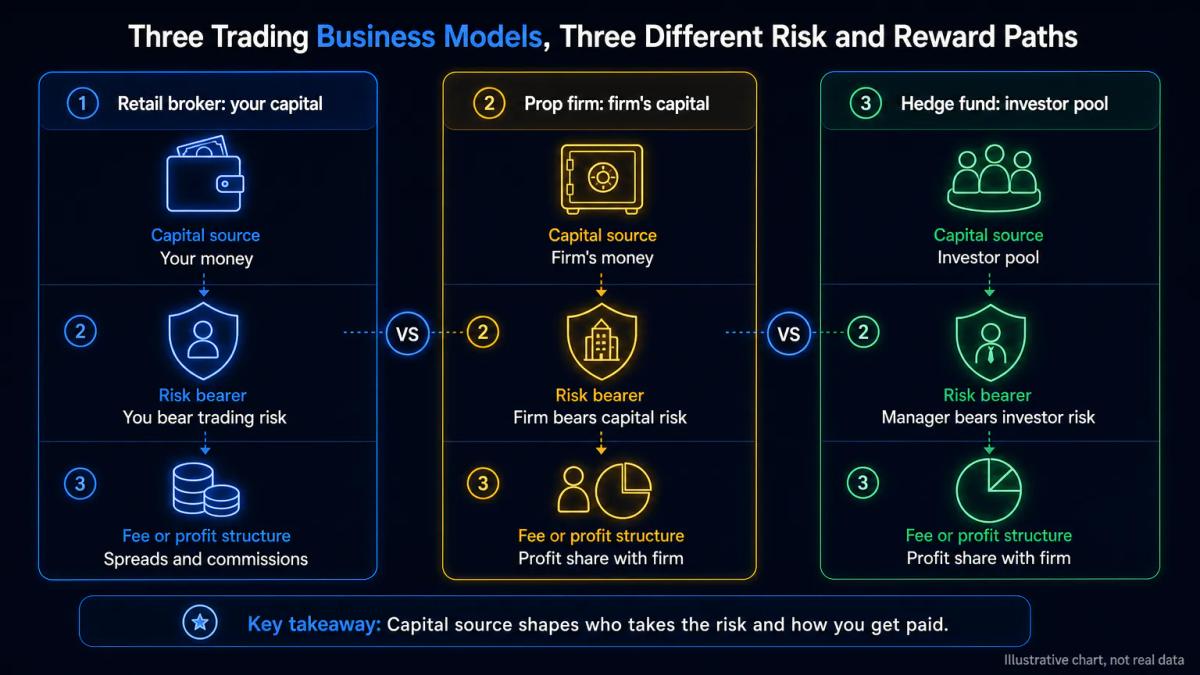
The three models are often confused but sit on different sides of the capital and client relationship. A retail broker executes your trades on your money and earns from spreads or commissions. A hedge fund pools outside investor capital, charges management and performance fees, and the manager rarely trades personal accounts. A prop firm funds individual traders with its own capital and pays them a share of profits.
| Feature | Retail broker | Prop firm | Hedge fund |
|---|---|---|---|
| Whose capital | Yours | The firm's | Investors' |
| Trader income | Personal P&L | Profit split | Salary plus bonus |
| Entry cost | Deposit | Evaluation fee | Institutional hiring |
| Client of the business | You | You (as contractor) | Outside investors |
| Typical regulation | FCA, CySEC, ASIC | Mixed, often lighter | FCA, SEC, AIFMD |
The practical implication: a prop firm is a business-to-trader arrangement, not a brokerage service, so consumer protections that apply to retail brokers, such as segregated client funds or FSCS coverage, generally do not apply. When you are ready to compare options, reviewing available prop firms helps you weigh fee structures and risk models side by side.
Regulatory and compliance considerations
Prop firms operate under uneven regulation compared to the broker sector. In the UK, an entity that markets speculative CFDs to retail consumers falls under the Financial Conduct Authority, but a firm that pays traders under a contractor or profit-share arrangement on simulated accounts often falls outside that perimeter. According to the FCA, unauthorised firms are not covered by the Financial Services Compensation Scheme or the Financial Ombudsman Service, which means if the firm fails, you are an unsecured creditor.
FCA: Unauthorised firms are not covered by the Financial Services Compensation Scheme or the Financial Ombudsman Service, leaving customers as unsecured creditors if the firm fails.
US futures-based prop firms may fall under the CFTC or the NFA. Many well-known prop firms operate from offshore jurisdictions with lighter compliance duties. Before you send funds, check the entity name on the payment invoice, the country of incorporation, and whether it appears on any register. As of 2024, several regulators began reviewing the prop-trading model, so the landscape is moving. Keep records of your payouts: tax authorities in the UK, the US and the EU generally treat prop-firm income as self-employment or miscellaneous income, and you are responsible for reporting it.
Frequently Asked Questions
Do prop firms actually pay out profits to traders, or is it a scam?
Established prop firms do pay out profits, typically on a bi-weekly or monthly cycle once you clear a minimum threshold. Payment risk is real though: unregulated firms have failed and left traders unpaid. Before committing, check the contracting entity, look for evidence of independent audits, read the payout terms in the trader agreement, and start with the smallest account tier so your exposure is limited.
What happens if you fail the prop firm evaluation challenge?
Failing the evaluation means the account is closed and the fee you paid is not refunded. Most firms offer a paid reset that lets you restart the same stage at a discount, typically 30% to 50% of the original fee. If you breach the daily loss limit or the maximum drawdown at any point, the failure is immediate and automated, so risk discipline matters more than raw profit target chasing.
Can you trade multiple asset classes at the same prop firm?
It depends on the firm and the platform. Firms built on MetaTrader 4 or 5, or cTrader, usually offer forex, indices, commodities and sometimes crypto CFDs on one account. Futures-focused firms restrict you to exchange-listed futures. Equity-focused firms restrict you to shares on specific US venues. Read the instrument list on the account specification, not the marketing page, since some symbols are visible on the platform but blocked for prop accounts.
How much capital does a prop firm typically allocate to a single trader?
Starting accounts commonly range from £10,000 to £25,000 nominal size. Standard tiers sit around £50,000 to £100,000, and top tiers reach £200,000 or £400,000. Some firms operate a scaling plan where your allocated capital increases by 25% to 50% each time you meet consistency and profit criteria, capped at £1 million to £2 million at the largest operators. Remember the account is often simulated, with real payouts tied to your performance.
Are prop firms regulated in the UK and what protections do traders have?
Most prop firms operating on the simulated-account, profit-share model fall outside FCA authorisation, because they are not offering a regulated investment service to retail consumers. According to the FCA, unauthorised firms are not covered by the FSCS or the Financial Ombudsman Service. Your protections are contractual, not statutory: the trader agreement, the jurisdiction where it is enforceable, and your ability to pursue a civil claim if payments are withheld.
About the authors


Put this into practice
Related articles
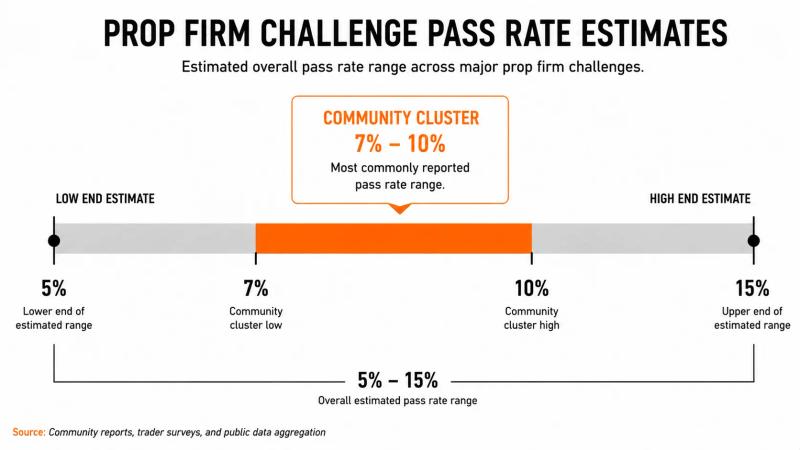
The Real Pass Rate of Prop Firm Challenges: What the Data Shows
Most prop firm challenges have low pass rates - but what does the data actually show? We break down the numbers, the reasons, and what they mean for you.

How Long Does It Take to Get Funded by a Prop Firm?
Realistic timeline breakdown from signup to funded status across FTMO, The5ers, TopStep, FundedNext, and E8 — including challenge phases, minimum trading days, and processing times.
I Passed 3 Prop Firm Challenges Before I Failed One: Here's What I Learned
Passing three prop firm challenges didn't prepare me for failing the fourth. Here's what changed, what broke down, and what I'd do differently now.
0 comments