



Prop Trading · Beginner · 12 min read
No Minimum Trading Days Prop Firm: What It Means and How to Choose
The smallest time commitment, explained
When an evaluation carries no minimum trading days requirement, the firm has stripped out any rule forcing you to complete a set number of trades or stay active for a fixed period. Your setups govern the pace, so a quiet week costs you nothing and a productive one can wrap the challenge in days. That freedom has a cost worth naming early: the same drawdown allowance now has to survive whatever window you end up needing.
A proprietary trading firm, often called a prop firm, is a company that gives traders access to its own capital in exchange for a share of the profits. Before you get the capital, you usually complete an evaluation: a demo account with a profit target and loss limits. The minimum trading days requirement is the rule that forces you to trade on at least a set number of separate days, often five or ten, before the firm accepts your result. When that rule is removed, the pace of the challenge becomes yours to set.
For a beginner, the appeal is easy to see, because you are never punished for waiting out a quiet market or forced into a session where you have no edge. What follows from that freedom is less obvious at first glance, since an evaluation can drag on for weeks and the same drawdown allowance that would normally cap a two-week test now has to survive a two-month test. The rest of this guide walks through what actually changes when the day count disappears, covering the rules that replace it, the platform choices you should test, the regulatory picture, and the self-discipline the format demands.
If a funded account is your goal, our roundup of the best prop firms is the place to start.
How evaluation rules differ without minimum trading days
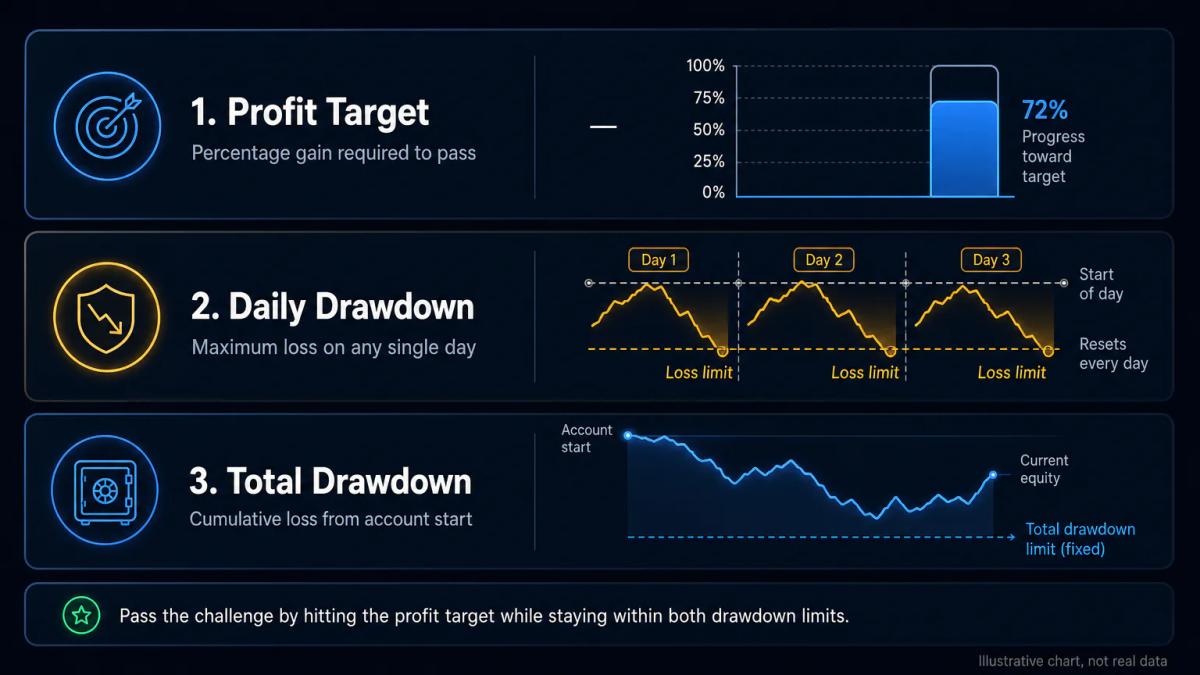
When a firm drops the minimum trading days requirement, the rest of the rulebook takes on more weight, and two rules do most of the anchoring:
- Profit target, the gain you must reach, expressed as a percentage of the starting balance, before you are considered to have passed.
- Drawdown limits, the fall from a capital peak to the trough before a new peak, split into daily drawdown (which caps your loss on any single trading day) and total drawdown (which caps your cumulative loss from account inception).
A typical structure combines three headline numbers:
- A profit target of 8% or 10%.
- A daily loss cap of around 5%.
- A total drawdown of around 10%.
There is no mandate to hit a trade count, no requirement to be active on a set number of days, and no clock running down; reaching the target within those rules passes the evaluation, while breaching either drawdown line ends it.
Other rules often stay in place and are worth reading before you pay for an evaluation. Common examples include:
- Restrictions on news trading, meaning positions opened just before or after a high-impact economic release.
- A ban on holding positions over the weekend, when markets are closed and price can gap on Monday's open.
- A cap on the maximum lot size, where one standard lot in forex equals 100,000 units of the base currency.
- A prohibition on hedging, which is holding a long and a short in the same instrument at once.
- A prohibition on scalping, which is very short-duration trades.
Taken together, these rules produce a clear give-and-take. On one side, you gain the freedom to wait for high-conviction setups instead of forcing trades to satisfy a counter. On the other, you spend longer in a window where a losing strategy can bleed through the drawdown allowance, and the total drawdown line does not reset because you took a week off.
Profit splits and payout structures on no-minimum-day platforms
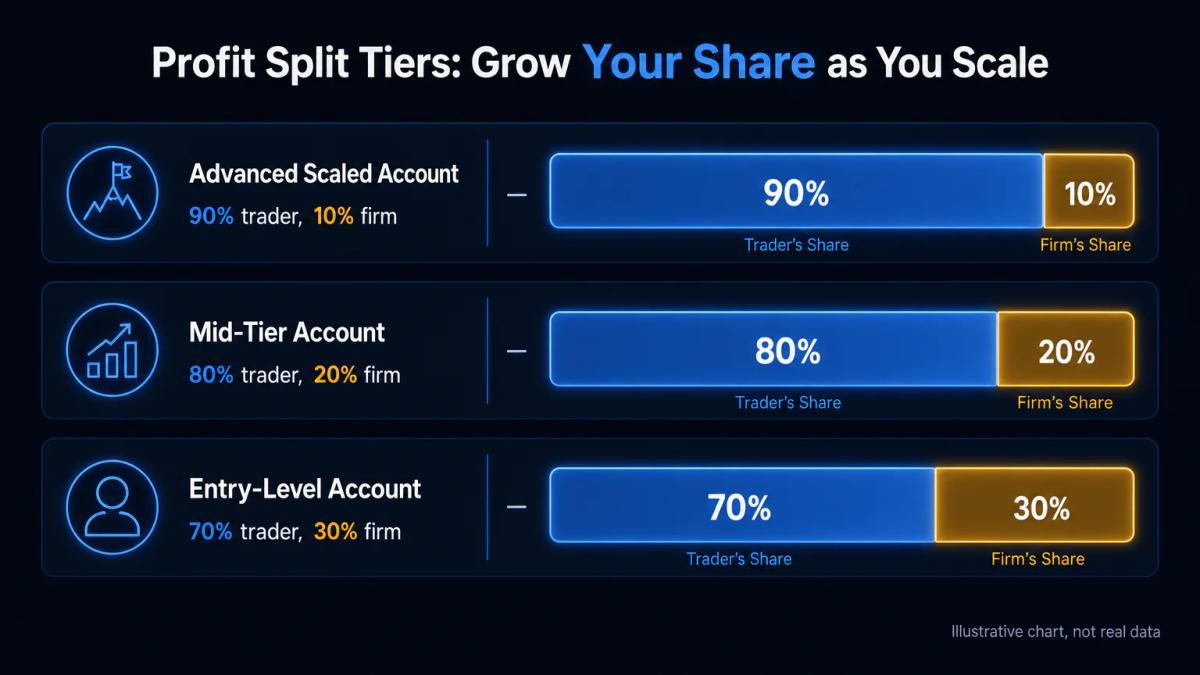
Once you pass the evaluation and reach a funded account, the way profits are divided becomes the central economic question. The profit split is the share of net trading profits the trader keeps, with the rest going to the firm to cover infrastructure, risk capital and the losses of traders who did not pass. Splits on no-minimum-day platforms typically fall in a range from around 70/30 in your favour on entry-level accounts to 90/10 on advanced or scaled accounts. A minority of firms advertise 100% of the first payout as a marketing device before reverting to a standard split.
Payout frequency is the second variable to weigh. Some firms pay on a fixed schedule, weekly or monthly, once you request a withdrawal, while others pay on demand after a minimum holding period on the funded account. A common structure asks for at least a few weeks on the funded account before your first payout, with subsequent payouts on a shorter cycle. This is one place where the absence of a minimum trading days requirement shows up in practice: if you reach the profit target in three days and there is no day-count floor, some firms will still gate the first payout behind a separate holding rule on the funded phase.
Compare the split, the payout cycle and any minimum holding rule as one package, because the headline percentage rarely tells the whole story on its own. For example, a 90% split behind a monthly cycle and a four-week holding rule pays out very differently from a 75% split with weekly withdrawals, and the second can be the better cash-flow option for a beginner still building consistency.
Account sizes and funding levels you can access
No-minimum-day prop firms typically offer a ladder of account sizes, from around $5,000 or £5,000 at the entry tier up to $500,000 or more at the top. You pay a one-off evaluation fee that scales with the account size, and if you pass, you graduate to a funded account at the same nominal size. Removing the day-count rule does not change what is on the ladder; it only changes how quickly or slowly you can climb it.
| Tier | Typical account size | Typical profit target | Typical total drawdown |
|---|---|---|---|
| Entry | $5,000 to $25,000 | 8% to 10% | 8% to 10% |
| Mid | $50,000 to $100,000 | 8% to 10% | 10% |
| Advanced | $200,000 to $500,000+ | 8% to 10% | 6% to 10% |
The figures above describe the shape of the market, not any single firm; each firm publishes its own numbers and you should read them before paying. Larger accounts often carry stricter drawdown percentages in absolute terms, because a 10% drawdown on a $200,000 account is a $20,000 loss the firm is willing to absorb, and firms tighten the rules to compensate.
Many firms also offer a scaling plan, where after a set number of consistent, profitable months on the funded account, your allocation is increased, usually in tranches of 25% to 50% of the original size. For a trader who intends to stay in the seat, that ramp shapes long-term earnings more than the starting tier does. Starting at $25,000 and scaling to $100,000 through documented performance is a very different proposition from paying up-front for a $100,000 account you may not be ready to manage.
Risk management without time pressure constraints
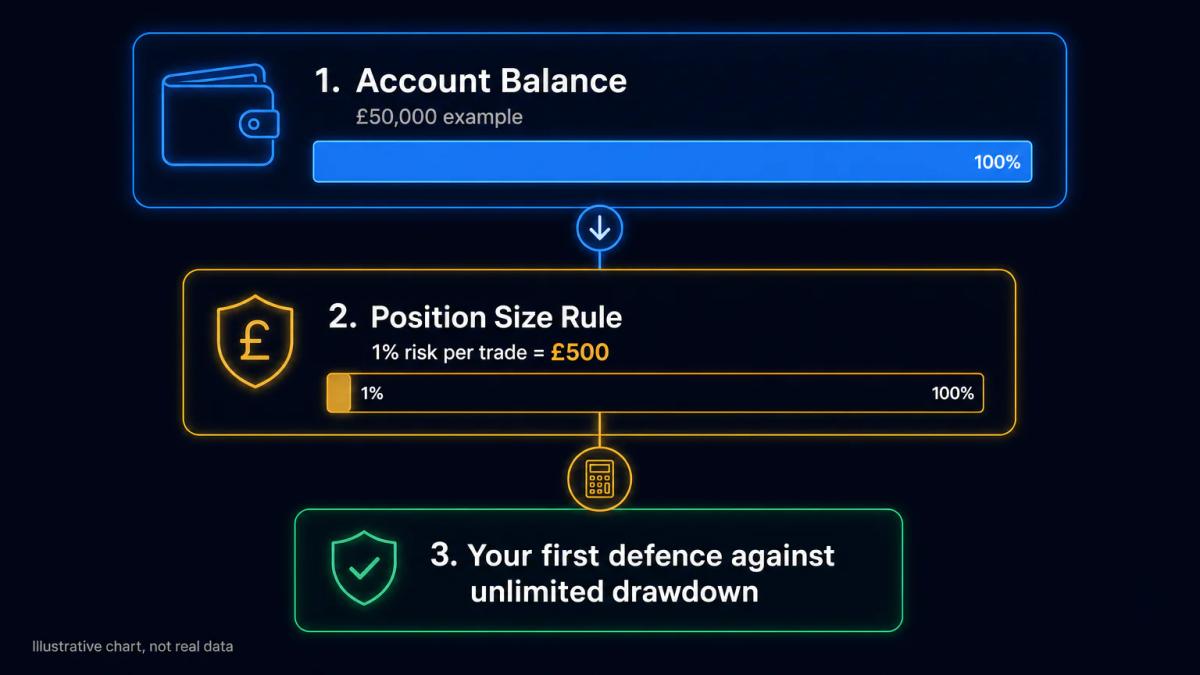
Removing the minimum trading days requirement changes the shape of your risk in a subtle way. A deadline acts as a form of external discipline, because you cannot hold a losing position forever if the challenge closes in fourteen days, and taking that deadline away leaves the discipline to come from you and your own rules.
Three defences do most of the work once the deadline is gone. The first is a position-sizing rule. Position size is how much of the account you risk on a single trade, expressed as a percentage of the balance, and a conventional beginner rule is 1% per trade, calculated from the distance to your stop loss (a pre-set order that closes a position at a defined loss). At 1% risk with a 10% total drawdown, you can absorb ten full losing trades in a row before the account is closed; at 3% risk, three losing trades erase almost the entire allowance. The maths does not care whether the ten losses happen in a week or in two months, though your patience will.
The second defence is a self-imposed daily loss limit that sits tighter than the firm's cap. If the firm's daily drawdown is 5%, you might set your own line at 2% or 3% and stop trading for the day when you reach it, which protects the total drawdown line by preventing any single day from turning catastrophic.
The third defence is a written trading plan you consult before each session, covering:
- The setups you will take.
- The setups you will skip.
- The news events you will sit out.
- The maximum number of trades you will place in a day.
Without a day-count rule, over-trading tends to be the most common failure mode, driven by boredom, the urge to make back a loss, and the illusion that a longer window means more opportunities, all of which push a trader to place setups they would normally reject. A plan on paper turns those decisions into a checklist you can enforce, so you are working from a document rather than negotiating with a mood.
Platform technology and execution quality for minimal-restriction trading
Your choice of platform is part of your trading edge in its own right. No-minimum-day prop firms typically run on MetaTrader 4 or MetaTrader 5, on cTrader, or on a proprietary web platform. MT4 and MT5 are third-party trading platforms widely used in retail forex and CFDs, while cTrader is a competing platform often preferred for depth-of-market visibility and lower typical latency. Latency is the delay between clicking a button and the order reaching the market, and slippage is the difference between the price you expected and the price you got.
When the evaluation has no time constraint, execution quality carries even more weight, because your strategy has more time to be exposed to bad fills. Scalpers will find that high latency and wide spreads erode a real edge before they notice, and swing traders holding across sessions have to fold in overnight funding costs (also called swap, a small daily interest charge on positions held past the daily rollover) and weekend gaps when calculating the total return.
Before you fund an account, test the demo of the platform the firm provides during a scheduled high-impact release, such as a US non-farm payrolls print or a central bank rate decision. Watch for three things in particular:
- Whether spreads widen dramatically for minutes at a time.
- Whether orders are re-quoted or rejected.
- Whether stop losses execute at reasonable prices or slip far past them.
Ask the firm in writing whether news trading, weekend positions and scalping are permitted, and confirm that the risk engine will not close a position at an unexpected level because of an internal margin rule the terms do not spell out.
Regulatory oversight and licensing of no-minimum-day firms
Most prop firms in this segment sit outside the regulatory perimeter that applies to a retail broker. A retail broker onboarding UK clients typically operates through an FCA-authorised entity, which brings conduct rules, capital requirements and, in the event of firm failure for eligible investment business, cover under the Financial Services Compensation Scheme, or FSCS. Prop firm evaluation accounts are usually structured as a paid service or a contract for a simulated demo, and the capital on a funded account remains the firm's property, so the consumer-investor protections that apply to a brokerage account do not extend to this arrangement.
In practice, this has several consequences for a UK retail trader:
- An evaluation fee is not a deposit, so if the firm fails, you have no FSCS route to recover it.
- Disputes over rule interpretation, payout calculation or account closure are governed by the firm's terms of service and the law of the jurisdiction listed in them, not by the UK Financial Ombudsman Service.
- An FCA-authorised group entity is the exception in this segment, since most firms operate through offshore incorporation, in jurisdictions where prop trading is not a licensed activity in its own right.
Before paying an evaluation fee, work through three checks:
- Read the terms of service in full, with attention to the clauses on payout eligibility, rule violations and unilateral account closure.
- Confirm the corporate entity you are contracting with and its country of incorporation.
- Separate your evaluation-fee exposure from your funded capital, treating the fee as the amount at risk of loss if the firm fails or refuses a payout, and sizing it accordingly.
Drawdown types and how they work across no-minimum-day platforms
Drawdown is where the removal of a day-count rule bites hardest, so understanding how each type is calculated is essential.
| Drawdown type | Reference point | Behaviour as you profit | Effect on your buffer |
|---|---|---|---|
| Daily drawdown | Start-of-day equity or balance | Resets every trading day | Caps single-day losses only |
| Static total drawdown | Initial account balance | Does not move | Fixed loss floor for the life of the account |
| Trailing total drawdown, high-water mark | Highest equity or balance reached | Rises with new peaks, then locks | Buffer shrinks after a winning streak, protecting the firm's paid-in profit |
Consider a worked example on an entry-level account with a $10,000 starting balance and a 10% total drawdown. Under a static rule, the account closes if equity ever falls to $9,000, regardless of what you made in between; under a trailing rule that tracks the peak, taking the balance to $10,800 and then retracing means the account can close at $9,720, because the 10% cushion followed the peak upward. Some firms lock the trailing rule once you clear the profit target, freezing it at the initial balance from then on.
Without a minimum trading days requirement, you might hit the drawdown line quickly through a bad day, or slowly through a month of small losses that never trigger the daily cap. Knowing which type applies tells you how many losing trades you can survive, and on a trailing rule it also tells you that a good week can quietly narrow the buffer instead of expanding it.
To compare these rules with a real firm's, the Kraken Prop review lays them out.
Frequently Asked Questions
Do no minimum trading days prop firms charge a fee to start an evaluation?
Yes. The standard structure is a one-off evaluation fee that scales with the account size, from around $50 at the entry tier to several hundred pounds or dollars at larger sizes. The fee is not a deposit and is not recoverable if you fail the evaluation. Some firms refund the fee with your first payout after you pass and reach a funded account, but the terms vary and should be read before you pay.
Can you trade news and hold weekend positions on a no-minimum-day prop firm account?
It depends on the firm rather than on the presence or absence of a day-count rule. Some firms allow news trading, weekend holding and scalping without restriction, while others prohibit one or all three even when there is no minimum trading days requirement. Read the rulebook for the specific evaluation you buy, and note whether the restrictions apply only to the evaluation phase or continue on the funded account.
How long does it typically take to pass a no-minimum-day prop firm evaluation?
There is no typical timeframe, because that is the point of the format. Some traders pass in days by taking a small number of high-conviction setups, while others spend weeks or months waiting for their strategy's conditions to appear. The key point for planning is that your total drawdown allowance has to survive the entire window, however long you take, so a longer evaluation is never free of cost.
What happens if you hit your drawdown limit before reaching the profit target on a no-minimum-day account?
The account is closed and the evaluation ends. Hitting either the daily drawdown or the total drawdown line is treated as a rule violation and is not usually recoverable. To try again you buy a new evaluation, and the fee is not refunded. This is why the position-sizing rule and a self-imposed daily loss limit carry so much weight when there is no day-count rule: the window in which you might breach the line is simply longer.
Are no-minimum-day prop firms regulated by the FCA or other financial authorities?
Most are not. Prop firm evaluations are typically structured as a contract for a simulated account and a paid service, not as regulated investment business, and the firms are commonly incorporated offshore. FCA authorisation is the exception in this segment. UK retail traders should note that evaluation fees and funded accounts are not covered by the FSCS, and disputes are governed by the firm's terms of service under the law of its country of incorporation.
About the authors


Put this into practice
Related articles

Options Prop Firms Explained: Evaluation, Profit Splits, and What to Expect
A plain-English guide to how options prop firms allocate capital, structure evaluations, split profits, and enforce risk rules on funded traders.

Phoenix Instant Challenge at Moneta Funded: What Is It and How It Compares
A breakdown of Moneta Funded's Phoenix Instant challenge, its rules, how it compares to Instant Funding, Instant Pro, and Moneta's other challenges, and how to start one.

Prop Firm Payouts: How Profit Splits, Thresholds and Withdrawals Work
A plain-English guide to prop firm payouts: how profit splits are calculated, when you can withdraw, how long settlement takes, and what to do if a firm holds your funds.
0 comments