



Prop Trading · Beginner · 12 min read
Options Prop Firms Explained: Evaluation, Profit Splits, and What to Expect
The core mechanics: what an options prop firm actually does
An options prop firm works exactly like any other proprietary trading platform. It gives you trading capital to buy and sell listed options contracts. In exchange, it keeps a share of the profits you generate. The firm holds the market access, the clearing relationship and the compliance overhead; you supply the trading decisions and the discipline to stay inside the risk rules.
An option is a contract that gives the buyer the right, but not the obligation, to buy (call) or sell (put) an underlying asset at a fixed price by a set date. A prop firm, short for proprietary trading firm, is a company that trades its own capital, either directly through in-house traders or by funding external traders under a contract. When you combine the two, you get a business model where the firm underwrites the capital and the risk, and the trader supplies the strategy.
The typical flow is straightforward. You pay a one-off or monthly fee for an evaluation account, hit a profit target inside strict loss limits, and then receive access to a funded account where real capital is at work. From that point, every closed trade contributes to a running profit-and-loss balance; when you reach the payout threshold, the firm wires your share of the profits and keeps the rest as its return on providing the capital.
What separates a legitimate options prop firm from a marketing wrapper is the plumbing behind the account: whether it clears through a real broker-dealer, whether the funded stage uses live or simulated capital, and whether the firm can show you the entity name, the regulator and the licence under which it operates. Those three details decide whether you are trading, or paying for a subscription that looks like trading.
To trade with a firm's capital, compare the best prop firms and how their evaluations work.
How options prop firms differ from forex and futures shops
The defining difference is the instrument. Options prop firms trade standardised, exchange-listed contracts on names like SPY, QQQ and IWM, cleared through the Options Clearing Corporation and quoted on regulated venues such as Cboe, NYSE American and Nasdaq ISE. Forex prop firms deal in over-the-counter currency pairs where the firm or its liquidity provider is the counterparty. Futures prop firms route to exchanges like CME Group for leveraged contracts on indices, commodities and rates.
That difference cascades into everything else. Options carry defined risk on the long side: you cannot lose more than the premium you paid. Short strategies carry undefined risk, so firms cap position sizes per contract and often ban naked short calls. Forex operates on leverage ratios set by the retail broker or its regulator. Futures use exchange-set initial and maintenance margin, which is a very different concept from an options premium.
Regulatory treatment splits too.
- In the United States, listed options fall under the Securities and Exchange Commission (SEC) and are executed by broker-dealers registered with FINRA.
- Retail forex sits under the Commodity Futures Trading Commission (CFTC) and the National Futures Association (NFA).
- Futures fall under the CFTC alone. According to the SEC, a broker-dealer that offers options to retail clients must be registered with the Commission and a member of a self-regulatory organisation such as FINRA.
A firm claiming to fund options traders in the US without a broker-dealer relationship is a red flag.
The last practical difference is volatility profile. Options embed implied volatility, the market's forecast of future price swings, directly into their price. You have to manage vega and theta. Forex and futures have volatility, but you do not pay for it in a premium that decays every day. Prop firms that specialise in options tend to build rules and platforms around that reality.
| Feature | Options prop firm | Forex prop firm | Futures prop firm |
|---|---|---|---|
| Instrument | Exchange-listed options | OTC currency pairs | Exchange-listed futures |
| US regulator | SEC, FINRA | CFTC, NFA | CFTC, NFA |
| Counterparty | Options Clearing Corp | Broker or liquidity provider | Exchange clearing house |
| Risk framing | Premium, greeks, spreads | Leverage on notional | Initial and maintenance margin |
| Typical platforms | thinkorswim, Tastytrade, Lightspeed | MT4, MT5, cTrader | NinjaTrader, Rithmic, CQG |
The evaluation and challenge process
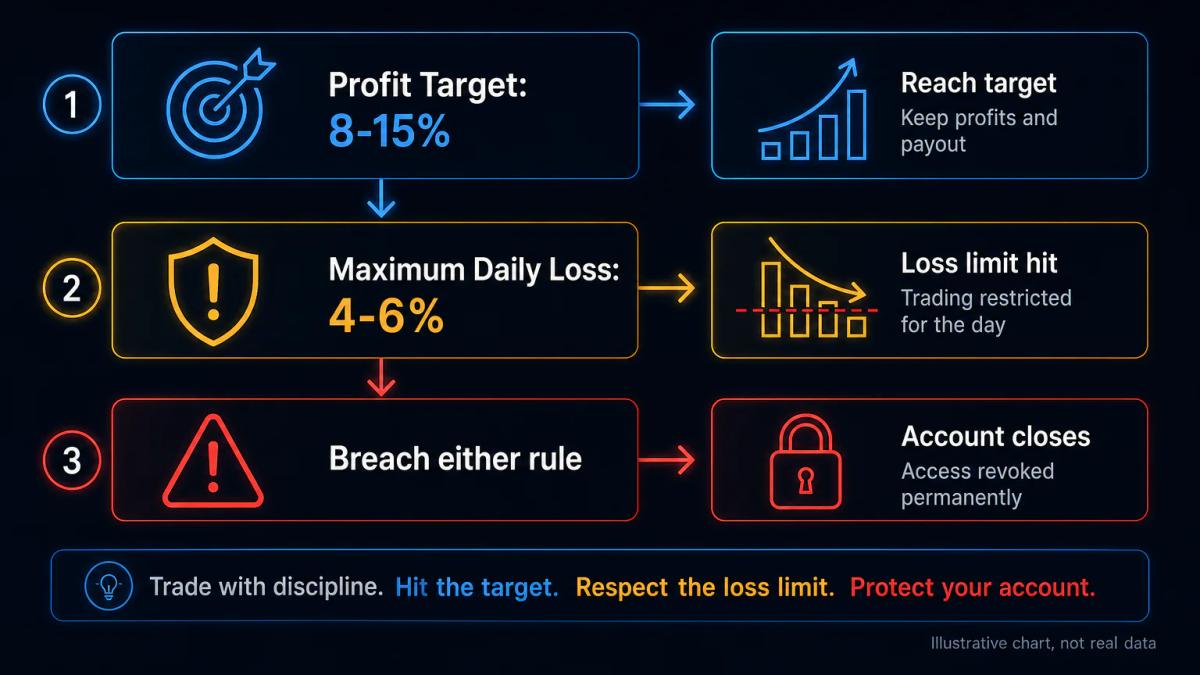
Most options prop firms gate the funded account behind an evaluation, sometimes called a challenge. You pay a fee, receive a demo or small live account with a target and a set of hard rules, and you either hit the target inside the rules or you fail and reset. The evaluation is the firm's audition and its main source of upfront revenue.
The rules are boringly consistent across firms. A profit target between 8% and 15% of the starting balance. A maximum daily loss between 4% and 6%. A maximum trailing drawdown, the biggest allowed fall from a peak in account equity, between 8% and 12%. A minimum number of trading days so a lucky earnings play cannot pass you in one session. Break any rule once and the account terminates.
Evaluation lengths vary. Some firms run a two-step model: a first phase where you must reach the profit target, then a second phase with a lower target to prove consistency. Others use a single phase. A growing number offer instant funding where you skip the evaluation entirely in exchange for a higher fee and stricter payout rules. Each model shifts the balance between how much you pay upfront and how quickly you reach a live payout.
The part rarely discussed openly is the psychology of the evaluation itself. Passing is not the same skill as trading well over a year. The daily loss limit forces you to close positions on days when your normal plan would say to hold. The profit target pushes you to size up during quiet weeks. Many traders who are profitable on their own retail accounts fail evaluations because they oversize into the target, then breach the drawdown recovering the losses. The rules reward small, repeatable trades and punish swing-for-the-fence sizing. That is a specific behavioural filter, not a general test of trading skill.
Capital allocation, profit splits, and payout mechanics
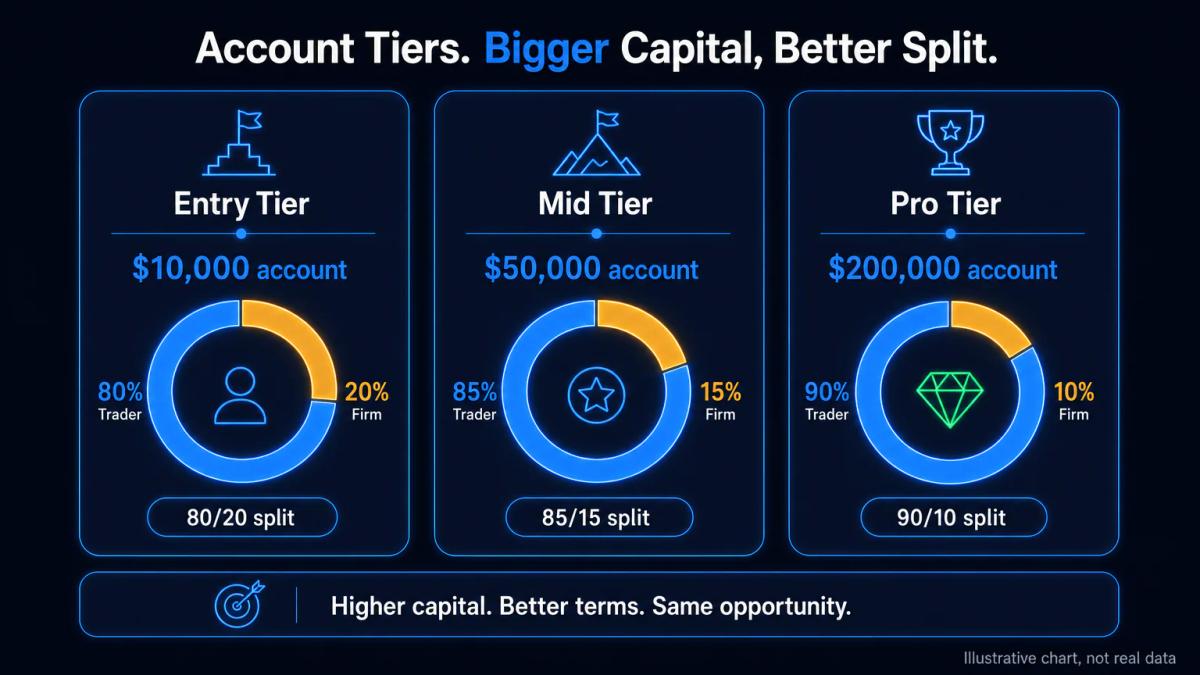
Funded account sizes at options prop firms usually start at $5,000 and scale to $500,000, with common tiers at $10,000, $25,000, $50,000, $100,000 and $200,000. The size you unlock depends on the evaluation tier you paid for, not on your personal net worth or trading history. That is what differentiates this model from a traditional prop desk that hires salaried traders.
Profit splits sit between 50/50 and 90/10 in the trader's favour. A common structure is 80/20 at the entry tier, rising to 90/10 once you have completed a set number of consistent payouts, or once the firm scales your account. The split applies to net realised profits after any monthly platform, data or subscription fees that the firm charges on top of the initial evaluation cost.
Payouts follow a calendar. Weekly, bi-weekly and monthly cycles are all common. Most firms require a minimum profit balance, often $100 to $500, before they will process a withdrawal. The first payout usually has a longer waiting period, sometimes 14 to 30 days after the account goes live. Some firms cap the first withdrawal at a percentage of the balance to prevent traders from taking one lucky trade and cashing out.
| Tier | Typical account size | Common profit split | Payout cadence |
|---|---|---|---|
| Entry | $5,000 to $25,000 | 70/30 to 80/20 | Monthly |
| Mid | $50,000 to $100,000 | 80/20 | Bi-weekly |
| Scaled | $200,000 to $500,000 | 85/15 to 90/10 | Weekly or on-demand |
One detail worth confirming in writing before you fund an evaluation: whether the firm scales the account after consistent performance, and on what schedule. Some firms double the account size every three profitable months up to a cap. Others promise scaling in the marketing copy and bury discretionary language in the contract. Read the agreement, not the landing page.
Trading rules, position limits, and risk constraints
The rulebook is where funded options accounts live or die. Daily loss limits typically sit between 4% and 6% of account equity for evaluations and 5% and 10% for funded accounts; hit that floor on any single calendar day and the account closes. Maximum trailing drawdown, calculated intraday or on closed equity depending on the firm, is the other line you cannot cross without losing the account.
Position-level rules are where options prop firms diverge from forex and futures shops. Common constraints include a maximum number of contracts per underlying, a hard ban on holding short naked calls, restrictions on assignment risk over expiry weekends, and sometimes a rule that no single trade can risk more than 1% or 2% of account equity. Multi-leg strategies, spreads, iron condors, calendars, are generally allowed and often encouraged because their defined risk fits the firm's own risk framework.
Earnings, Federal Open Market Committee (FOMC) meetings and other scheduled volatility events are treated differently at every firm. Some prohibit holding positions through the announcement. Some allow it but reduce your maximum size. Some are silent, which usually means the compliance team decides after the fact whether your trade was reasonable. If a firm refuses to answer that question in writing, that silence is itself information.
Behind the rules sits the reason they exist. The firm is putting real capital at risk with clearing members and counterparties; a single trader taking a naked short position into an earnings gap can wipe out a slice of the firm's book. According to the FINRA rulebook, broker-dealers that carry customer accounts must maintain risk-based margin systems and monitor concentrated positions. The trading limits you see on a funded account are usually a translation of the firm's own margin obligations to its clearing broker. Understanding that chain helps you read the rules as engineering, not arbitrary bureaucracy.
Platforms, tools, and execution infrastructure
The platform you get depends on how the prop firm is plumbed into the market. Firms that route through a US broker-dealer typically offer thinkorswim, Tastytrade, Lightspeed or Interactive Brokers Trader Workstation. Each handles multi-leg options orders, real-time greeks and complex order types out of the box. Firms that run proprietary infrastructure build their own front-end and connect it to a clearing broker in the background.
Real-time market data is the hidden cost most beginners miss. Level 1 quotes are usually included. Level 2 depth, options chains with implied volatility surfaces, and exchange-direct feeds often carry monthly fees that the firm passes on. According to the SEC's guidance on market data, exchange fees are set by the exchanges themselves and passed through by broker-dealers. A firm quoting a low monthly platform cost may still charge $50 to $200 a month once you enable the data feeds a working options trader needs.
Order routing matters more in options than in stocks. A market order on a wide options spread can slip several dollars per contract. A smart-routed limit order across multiple exchanges can save the same amount. Ask whether the platform supports price improvement auctions, and whether the firm allows algorithmic or automated strategies. Some prop firms restrict application programming interface (API) access to prevent traders running third-party systems on the firm's capital.
Getting started: what you need to know before applying
Before you send money to any options prop firm, run a short due-diligence checklist. Confirm the legal entity name and the country it is registered in; check whether it operates under an SEC-registered broker-dealer, a FINRA-member firm or an equivalent local regulator; and search that entity in the regulator's public database. A firm that cannot produce a licence number is either using a partner broker-dealer, in which case the partner's licence should be disclosed, or operating outside the perimeter.
Read the fee structure line by line. The evaluation fee is only the entry ticket. Monthly platform fees, market data pass-through, reset fees if you breach a rule, and withdrawal processing fees all subtract from the profit split. Total annual cost of running an evaluation and one funded account can easily reach $1,000 to $2,000 before you generate a dollar of profit.
Tax treatment is the topic almost no marketing page covers. In most jurisdictions, payouts from a prop firm are treated as self-employment or independent contractor income, not as capital gains, because you are being paid for a service, trading, rather than realising gains on your own capital. According to HM Revenue and Customs guidance on self-employment, income from a trade or profession is reported on the self-assessment return and is subject to income tax and, above the relevant threshold, National Insurance. US-based traders should expect a Form 1099 from the firm and self-employment tax treatment. Consult a tax professional in your country before your first payout, not after.
Finally, test the platform. Most firms offer a free demo of the evaluation environment; use it to place the exact trades you plan to run, at the exact times you plan to run them, and watch how fills, greeks and account equity update in real time. If the demo is slow, glitchy or missing order types you need, the funded account will be too. A prop firm relationship is a two-year decision at minimum; a week of testing before you pay is a rounding error against that timeline.
Frequently Asked Questions
What is the difference between an options prop firm and a retail options broker?
A retail options broker holds your capital and lets you trade your own money for a commission or spread. An options prop firm provides its own capital, sets rules on how you may trade it, and keeps a share of the profits. You take a smaller cut of larger sums, and you do not risk personal capital beyond the evaluation fee.
How long does it typically take to pass an options prop firm evaluation?
Evaluations usually require a minimum number of trading days, often between 5 and 30, before you can request funding. In practice, traders who pass on the first attempt tend to take between two weeks and three months, depending on the profit target, the drawdown rules and how the market cooperates. Many first attempts fail and require a reset.
Can you trade options strategies like spreads and iron condors at a prop firm?
Yes, and defined-risk multi-leg strategies are usually preferred by the firm. Vertical spreads, iron condors, calendars and butterflies fit inside the firm's own risk framework because the maximum loss is known at the point of entry. Naked short calls are commonly banned, and short puts are often restricted to cash-secured or spread structures.
What happens to your funded account if you breach the daily loss limit?
The account is terminated in almost all cases. Some firms allow a one-time reset for an additional fee, and a few offer a soft-breach process where trading is paused for the rest of the day and resumes at the next session. Read the specific clause in the trader agreement, because policies vary and marketing copy tends to be optimistic.
Do options prop firms report your trading activity to tax authorities?
US-based firms typically issue a Form 1099 for payouts made to US traders, and payouts are treated as self-employment income rather than capital gains. Firms in other jurisdictions may or may not issue local tax forms, but the reporting obligation falls on you regardless. Keep records of every payout and consult a tax professional before the first withdrawal.
About the authors


Put this into practice
Related articles

Phoenix Instant Challenge at Moneta Funded: What Is It and How It Compares
A breakdown of Moneta Funded's Phoenix Instant challenge, its rules, how it compares to Instant Funding, Instant Pro, and Moneta's other challenges, and how to start one.

Prop Firm Payouts: How Profit Splits, Thresholds and Withdrawals Work
A plain-English guide to prop firm payouts: how profit splits are calculated, when you can withdraw, how long settlement takes, and what to do if a firm holds your funds.

Prop Firms That Accept US Clients: What to Check Before You Sign Up
US traders face a narrower shortlist of prop firms than European peers. Here is how to read funding models, drawdown caps, tax reporting, and payout terms before you commit.
0 comments