



Prop Trading · Beginner · 8 min read
What Is a Funded Trading Account: Definition, Mechanics, and Realistic Expectations
The core mechanism: how funded accounts give you capital to trade
A funded trading account is an arrangement where a proprietary trading firm (a prop firm: a company that trades with its own money) tests your skill over an evaluation period, then hands you a live or simulated account to trade if you meet its profit target and stay inside its risk limits. You keep a percentage of the profits you generate; the firm keeps the rest.
The structure exists because two problems meet.
- Retail traders often have skill but limited capital.
- Firms have capital but need vetted operators.
The evaluation is the filter. Your entry fee, plus the firm's share of profits later, is how the firm gets paid. In practice, most programmes trade on simulated accounts that mirror live prices, and the firm hedges or ignores your flow depending on its model.
Ready for a funded account? Compare the best prop firms.
The evaluation phase: passing the trial to unlock funding
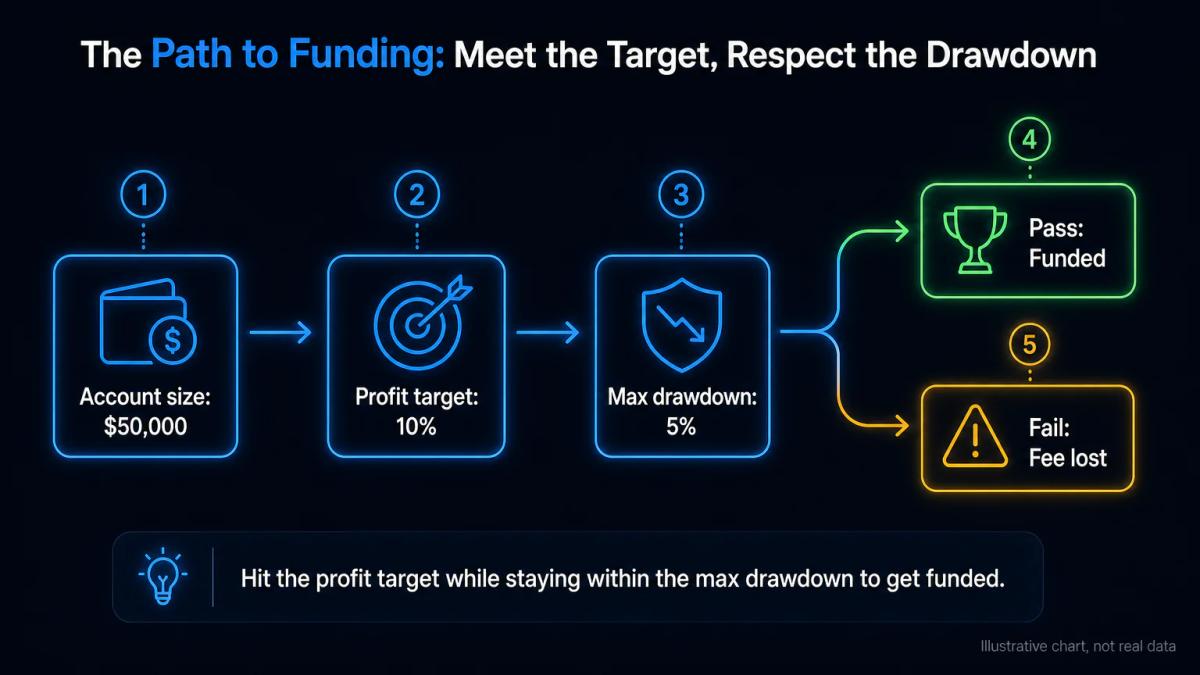
The evaluation is a paid trial with a specific structure. You buy access to a demo account of a stated size (commonly $10,000 to $200,000 of notional capital), and you must hit a profit target while respecting drawdown limits. A drawdown is the fall from your account's highest balance down to a later low point before a new high is made.
Typical rules across the major programmes look like this:
| Rule | Typical range | What it means |
|---|---|---|
| Profit target | 8% to 12% of account size | The amount you must gain to pass |
| Daily loss limit | 4% to 5% | Total loss allowed in a single trading day |
| Maximum drawdown | 6% to 12% | Total loss allowed across the whole account |
| Minimum trading days | 0 to 10 | Days you must place at least one trade |
| Time limit | 30 days or unlimited | How long you have to hit the target |
Break any hard rule (a daily loss limit, a maximum drawdown, a banned instrument) and the account closes. Many firms run a two-step structure: a first stage with an aggressive target, then a second stage with a softer target to prove consistency. Only after both stages do you reach a funded account.
Profit splits and payouts: how you get paid
Once funded, your profit split typically sits between 70% and 90% in your favour, with the firm taking the rest. Larger accounts and longer track records push the split towards 90/10. Some firms advertise 100% on your first payout as a marketing hook, then revert to the standard split.
Payouts run on a cycle. The two common models are a fixed monthly payout window and an on-demand model where you request a withdrawal after a minimum number of trading days. Many firms hold a buffer, meaning a portion of profits stays in the account to absorb future losses before you can withdraw everything. Payments arrive by bank transfer, PayPal, Wise or, at some firms, cryptocurrency stablecoins.
One detail beginners miss: the split applies to net profits from your funded phase only. The evaluation fee, if not refunded, is a sunk cost. Some firms refund the fee with your first payout, others do not refund it at all, and a few keep it against future losses. Read the payout policy in full before you deposit.
Risk rules and account restrictions you must follow
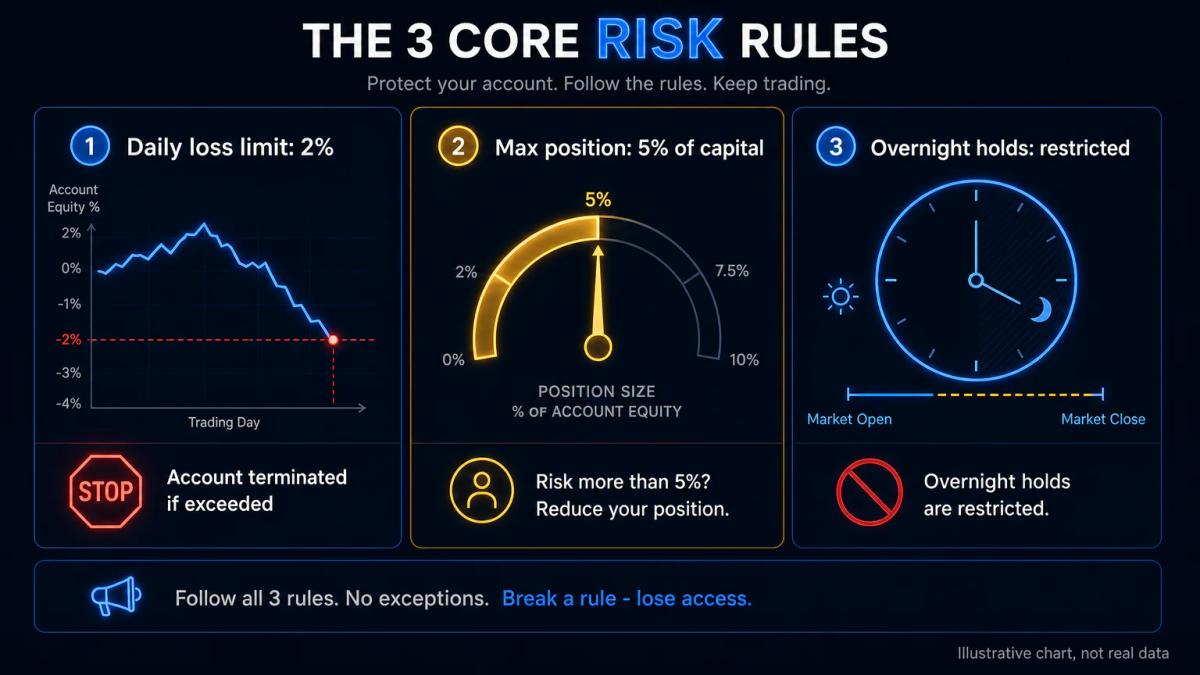
Funded accounts carry strict guardrails, and the account terminates if you break one. The daily loss limit is the sharpest: cross it, even briefly, and access is revoked. Overnight and weekend holding rules restrict when you can carry positions. Some firms ban trading during high-impact news releases (interest rate decisions, non-farm payrolls) because spreads widen and slippage grows.
Common restrictions in a single view:
| Restriction | Typical form |
|---|---|
| Maximum lot size | Capped per trade or per symbol |
| Instrument list | Forex, indices, metals allowed; crypto often restricted |
| News trading | Blackout window around scheduled releases |
| Weekend holds | Positions must close by Friday market end |
| Copy trading | Prohibited across multiple accounts at the same firm |
| Minimum holding time | Some firms require trades to be held for at least one minute |
The psychological weight of these rules is real. A 4% daily loss limit on a $100,000 account means a $4,000 buffer, which two losing trades at normal position sizes can consume. Traders often report tightening stops, cutting winners early and skipping valid setups to avoid a breach. That behaviour is the opposite of what made them profitable in their own accounts, and it is a common reason capable traders fail the evaluation twice or three times.
Funded accounts versus trading your own capital: trade-offs
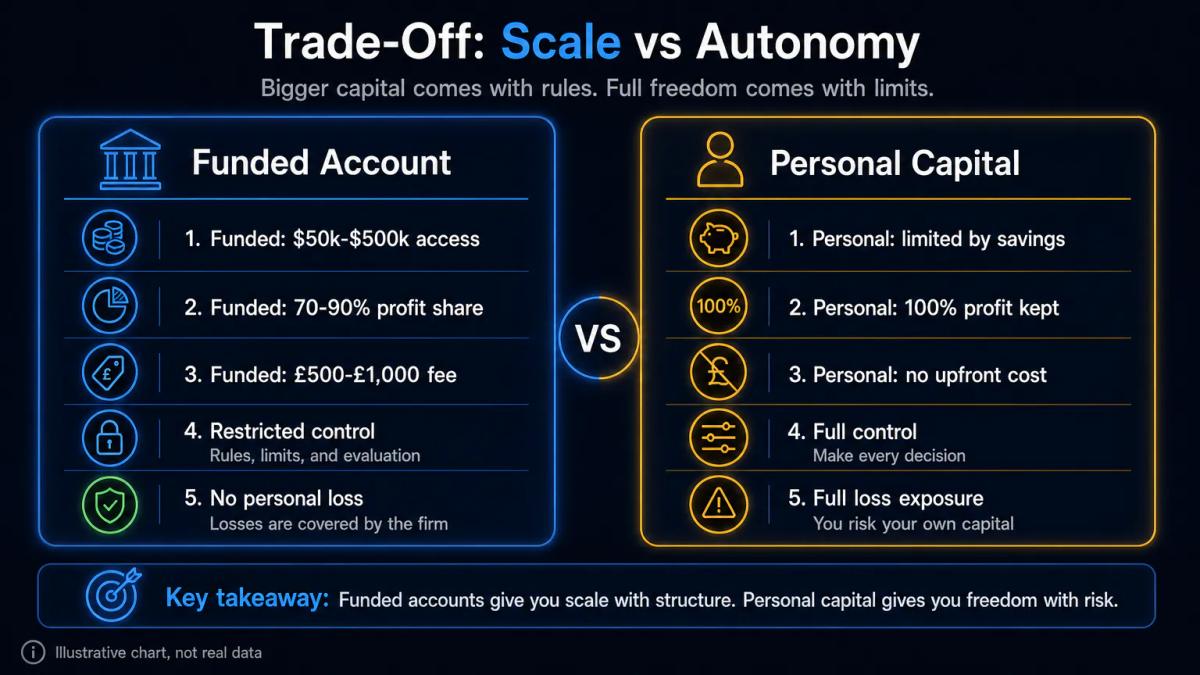
A funded account trades scale for control. You get access to a larger notional balance without depositing that balance yourself, but you accept the firm's rules, its instrument list, its holding rules and its share of your profits. If you blow the account, you lose the evaluation fee, not your savings. If you succeed, the firm keeps 10% to 30% of every payout.
Compared with the alternatives:
| Route | Capital you access | You keep | Loss you bear | Fixed cost |
|---|---|---|---|---|
| Own capital | Your deposit | 100% | Full deposit | Broker spread and commission |
| Funded account | Firm's notional balance | 70% to 90% | Evaluation fee only | Evaluation fee, repeated on failure |
| Angel investor | Investor's capital | Negotiated share | Reputational, contractual | Legal and reporting costs |
| Small trading fund | Pooled capital from a few backers | Management and performance fee | Regulatory liability | Set-up and compliance costs |
| Bank loan for trading | Loan principal | 100% of profits | Full loan plus interest | Interest, and personal guarantee |
For most retail traders without professional credentials, angel investors and structured funds are not realistic; a funded account is the only route to scale without personal capital.
Costs, fees, and realistic pass rates
Most programmes charge an upfront fee, generally £50 for the smallest evaluations up to around £1,000 for a $200,000 account. Some firms refund this fee with your first payout, others do not. Reset fees (paying to restart a failed evaluation without buying a new one) are usually 30% to 50% of the original.
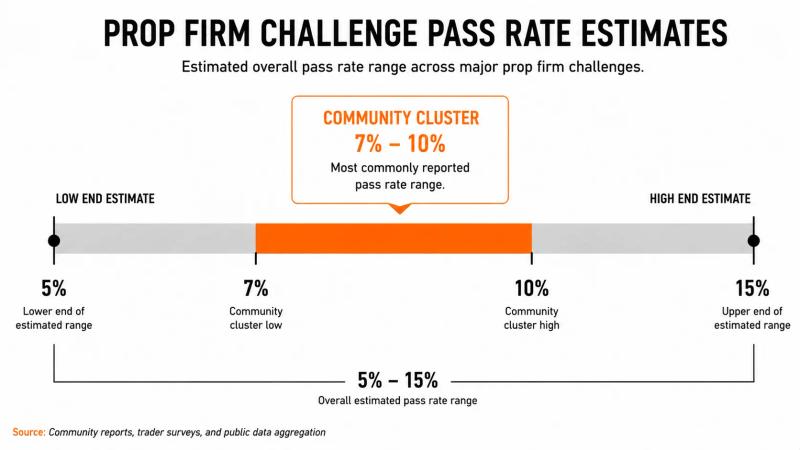
Pass rates are the least advertised number in the industry. Firms rarely publish audited figures, and independent verification is thin. The consistent picture across the firms that do disclose data is that a single-digit to low double-digit percentage of buyers reach a funded account, and a smaller share receive a payout. Budget for two or three attempts, not one.
Regulatory oversight is uneven. Prop firms operating on simulated accounts are generally not treated as investment firms under the FCA (Financial Conduct Authority, the UK regulator) or ESMA (the European securities regulator), so client-money protections that apply to a regulated broker do not apply here. A minority of prop firms are FCA-authorised for related activities; most operate through offshore entities in jurisdictions such as the UAE, Saint Lucia or the British Virgin Islands. Treat the evaluation fee as money at risk, not a deposit.
Who benefits most from funded accounts
Funded accounts suit a specific profile: a trader who has already produced consistent results on a personal account, understands position sizing, tolerates rule-based constraints and lacks the capital to scale. If you have traded profitably for six to twelve months on your own money and want a larger balance without borrowing, the maths can work.
They suit others less well. Traders still learning tend to struggle because the daily loss limit punishes normal drawdown swings and pushes decision-making towards fear. Discretionary traders who trade news, hold positions over weekends or size aggressively will find the rules incompatible. In high-tax jurisdictions, payouts are typically treated as self-employment income or miscellaneous income rather than capital gains, and they must be reported: HMRC in the UK, the IRS in the US, and the ATO in Australia all expect prop-firm payouts on your annual return.
Check whether a funded account is realistic for your situation before your first payout, not after.
Frequently Asked Questions
What is the difference between a funding account and a funded trading account?
A funding account is a generic term for any account used to hold cash you intend to deploy elsewhere, for example a broker's funding wallet. A funded trading account is specific: capital provided by a proprietary trading firm after you pass its evaluation, subject to profit splits and risk rules.
How do funded futures accounts work compared to forex or stock funded accounts?
Funded futures accounts follow the same evaluation and drawdown model but trade contracts on regulated exchanges such as the CME. Position sizing is set in contracts (for example micro E-mini S&P 500 futures) rather than lots, and margin requirements are exchange-defined. Forex and index CFD funded accounts trade off-exchange, so the firm sets margin, spreads and instrument availability internally.
Can you lose money on a funded trading account, and what happens if you breach the drawdown limit?
You cannot lose more than your evaluation fee, because the capital is the firm's, usually on a simulated account. If you breach the daily loss limit or the maximum drawdown, the account is closed immediately. Most firms offer a reset fee (30% to 50% of the original price) or require you to buy a new evaluation to try again.
How long does it take to get funded, and what happens after you pass the evaluation?
Two-stage evaluations typically take four to eight weeks if you trade steadily, though some firms allow unlimited time. After you pass, the firm issues a contract, KYC (know-your-customer identity checks) is completed, and the funded account is created within a few business days. From there you trade under the same rules and request payouts on the firm's schedule.
Are funded trading accounts regulated, and what protections do you have as a trader?
Most prop firms operating on simulated accounts are not treated as regulated investment firms, so FCA, ESMA and ASIC client-money protections do not apply. Your protection is the contract you sign and the firm's payout track record. A minority of firms hold FCA authorisation for related activities; the majority operate through offshore entities.
About the authors


Put this into practice
Related articles

What is a prop firm: how proprietary trading funding works
Prop firms fund traders who pass an evaluation, then split profits. Here is how the model works: fees, risk rules, asset coverage and regulatory context.
The Real Pass Rate of Prop Firm Challenges: What the Data Shows
Most prop firm challenges have low pass rates - but what does the data actually show? We break down the numbers, the reasons, and what they mean for you.

How Long Does It Take to Get Funded by a Prop Firm?
Realistic timeline breakdown from signup to funded status across FTMO, The5ers, TopStep, FundedNext, and E8 — including challenge phases, minimum trading days, and processing times.
0 comments