



Prop Trading · Beginner · 18 min read
How to Become a Proprietary Trader: Path, Requirements, and Reality
What proprietary trading is and how entry works today
If you're wondering how to become a proprietary trader, this article is for you.
Prop trading means you trade capital owned by a firm, not your own money, and you keep a contractual share of the net profits after fees, spreads and drawdown limits. Modern retail-facing prop firms use evaluation accounts with fixed rules to test traders before funding them, while institutional desks hire through formal recruiting and place you on a live book from day one.
The industry has two very different faces. Institutional proprietary trading sits inside investment banks, hedge funds and specialist market makers, where the firm risks its own balance sheet and you become an employee on salary plus a discretionary bonus. Online prop firms, by contrast, sell you a paid evaluation: you demonstrate profitability on a simulated account under strict rules, and if you pass you receive a funded account with a profit split, commonly between 70% and 90% to the trader.
A funded account is not a promise of easy money. Every prop firm, institutional or online, enforces a drawdown, which is the fall from a capital peak to the trough before a new peak. Breach a daily or overall drawdown limit and the account closes, regardless of how profitable you were the day before. The route in is therefore less about market prediction and more about consistent execution inside a defined risk envelope.
Ready for a funded account? Compare the best prop firms.
The two main routes: institutional firms versus online prop platforms
The institutional route runs through recruiting. Firms such as bank trading desks, market makers and quantitative hedge funds hire graduates from targeted universities, plus lateral hires with a verified track record. Selection is heavy on quantitative aptitude tests, technical interviews on probability and market microstructure (the mechanics of how orders reach the book and how prices form), and cultural fit. You are paid a base salary from day one, trained on the firm's systems, and given size gradually as the desk builds confidence in you.
The online prop firm route is faster to access but shifts the risk to you. You pay an evaluation fee, typically between $100 and $2,000 depending on the account size, and trade a simulated account under a rulebook in a free prop firm challenge. Pass the profit target without breaching drawdown limits and you receive a funded account, keep a share of profits, and pay no further fees unless you fail.
| Feature | Institutional desk | Online prop firm |
|---|---|---|
| Entry cost | None, salaried role | $100 to $2,000 evaluation fee |
| Selection | Interviews, tests, degree | Trading challenge, no CV needed |
| Capital | Firm balance sheet, real book | Simulated then funded account |
| Payout | Base salary plus bonus | Profit split, typically 70% to 90% |
| Time to trade | 3 to 12 months of training | 10 to 90 days if you pass first attempt |
| Rules | Desk risk mandate | Fixed daily and overall drawdown |
| Downside | Bonus cut, dismissal | Lose fee, account closed on breach |
The two routes attract different profiles. If you have a strong academic record in mathematics, finance, computer science or physics, and you are early in your career, the institutional route offers deeper training and a salary while you learn. If you already trade retail with a documented edge, or you are switching careers and cannot spend a year in graduate recruiting, an online prop firm gives you a live test and, if you pass, capital in weeks rather than years.
A third hybrid is worth naming: proprietary trading arcades and remote prop groups that combine training, mentorship and a funded seat, sometimes with a small monthly fee. These sit between the two extremes. You do not get an institutional salary, but you get supervision that pure online firms do not provide.
Skills and qualifications you need before applying
Before you apply anywhere, you need three things: risk management discipline, a working knowledge of the markets and instruments you plan to trade, and either a relevant qualification or a documented retail track record. The weighting differs by route. Institutional desks weight formal education heavily; online prop firms weight your ability to trade within rules and ignore the rest.
For the institutional route, a bachelor's degree in a quantitative field is the practical minimum: mathematics, statistics, physics, engineering, computer science, economics or finance. A master's degree or PhD is common for quantitative desks. The Chartered Financial Analyst designation, awarded by the CFA Institute, signals seriousness for discretionary macro or equity roles. In the United States, if you trade on behalf of a broker-dealer, you must pass the Financial Industry Regulatory Authority's Series 7 and Series 57 exams; in the United Kingdom, an FCA-authorised firm will register you under the Senior Managers and Certification Regime and require you to hold, or work toward, a qualification from the FCA's appropriate qualification list.
For the online prop firm route, no certification is required. What matters is a trading journal that shows consistent behaviour: entries and exits by rule, position sizes proportional to account equity (position size is the number of units or lots per trade), a stable maximum drawdown, and a strategy you can articulate in one paragraph. If you cannot describe your edge in one paragraph, you do not have one yet.
| Requirement | Institutional | Online prop firm |
|---|---|---|
| Degree | Quantitative bachelor's, often master's | None required |
| Certification | CFA, Series 7/57, FCA qualifications | None required |
| Trading history | Not required, training provided | Journal helpful, not mandatory |
| Technical skills | Python, statistics, order-book mechanics | Platform proficiency, rule discipline |
| Interview | Multi-round, quantitative | None, only the trading test |
Whichever route you choose, three underlying skills sit beneath the paperwork.
- You need to size positions based on account equity.
- You need to accept losses at your predefined stop loss (the exit price that caps the loss on a trade) without re-entering out of frustration.
- You need to keep records that you would show to an auditor: broker statements, tax filings, and a trade log.
How evaluation accounts and funded accounts work
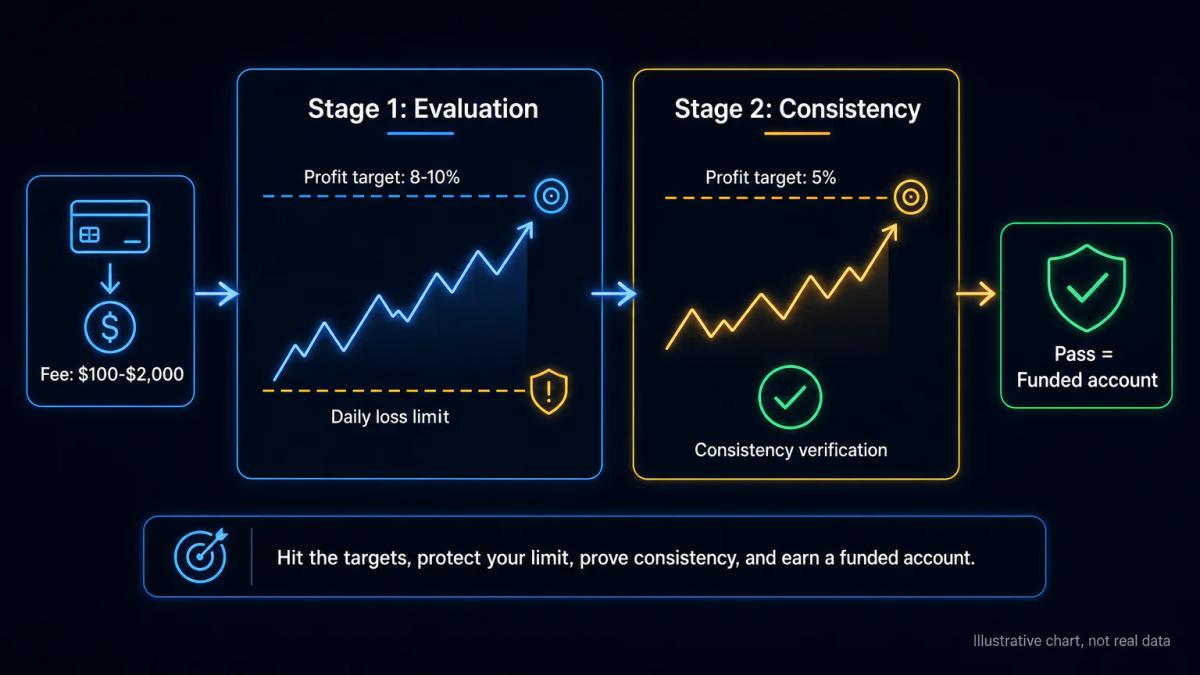
The online prop firm model is a two-stage test.
In stage one, you pay an evaluation fee, typically ranging from $100 for a $10,000 simulated account to $2,000 for a $200,000 simulated account, and trade under a fixed rulebook. Most firms require you to reach a profit target of 8% to 10% within a set period, often 30 days, without breaching a daily loss limit and an overall drawdown limit. Some firms run a second stage with a lower profit target, commonly 5%, to confirm consistency before funding.
Once you pass, you receive a funded account. Some firms fund a live account with real capital; others fund a simulated account and pay you from a pool. Either way, the rulebook stays. You keep a share of the net profits, typically between 70% and 90%, and the firm keeps the rest with payouts running monthly or biweekly, with a minimum withdrawal threshold.
The economics only work if you understand the rulebook in detail before you pay. Consider a representative $100,000 evaluation account:
| Rule | Typical value | What it means |
|---|---|---|
| Evaluation fee | $500 | Non-refundable unless you pass |
| Profit target stage 1 | 8% ($8,000) | Must reach to progress |
| Profit target stage 2 | 5% ($5,000) | Lower bar, confirms consistency |
| Daily loss limit | 5% ($5,000) | Breach ends the account that day |
| Overall drawdown | 10% ($10,000) | Breach ends the account permanently |
| Minimum trading days | 5 to 10 | Prevents one-trade luck |
| Profit split (funded) | 80% to trader | Applies from first payout |
The daily loss limit is measured from the highest equity of the day, or from the starting balance, depending on the firm; the wording matters. The overall drawdown is either static, measured from the starting balance, or trailing, measured from the highest equity ever reached. A trailing drawdown is harder because it tightens as you profit. Before you pay a fee, read the definition of drawdown in the firm's contract, not on the marketing page.
Three traps recur. First, some firms restrict news trading, meaning you cannot hold positions across scheduled economic releases; break this and the account is closed. Second, minimum trading days force you to trade even when there is no setup, which is a common cause of unnecessary losses. Third, weekend holding rules may forbid open positions on Friday close; if you swing trade, this rules the firm out.
According to the FCA, most retail investor accounts lose money when trading CFDs, which is the instrument many prop firms use. Treat the evaluation fee as risk capital you can afford to lose. If passing depends on a lucky streak rather than a repeatable process, the funded account will not survive either.
Risk management rules that separate funded traders from failures
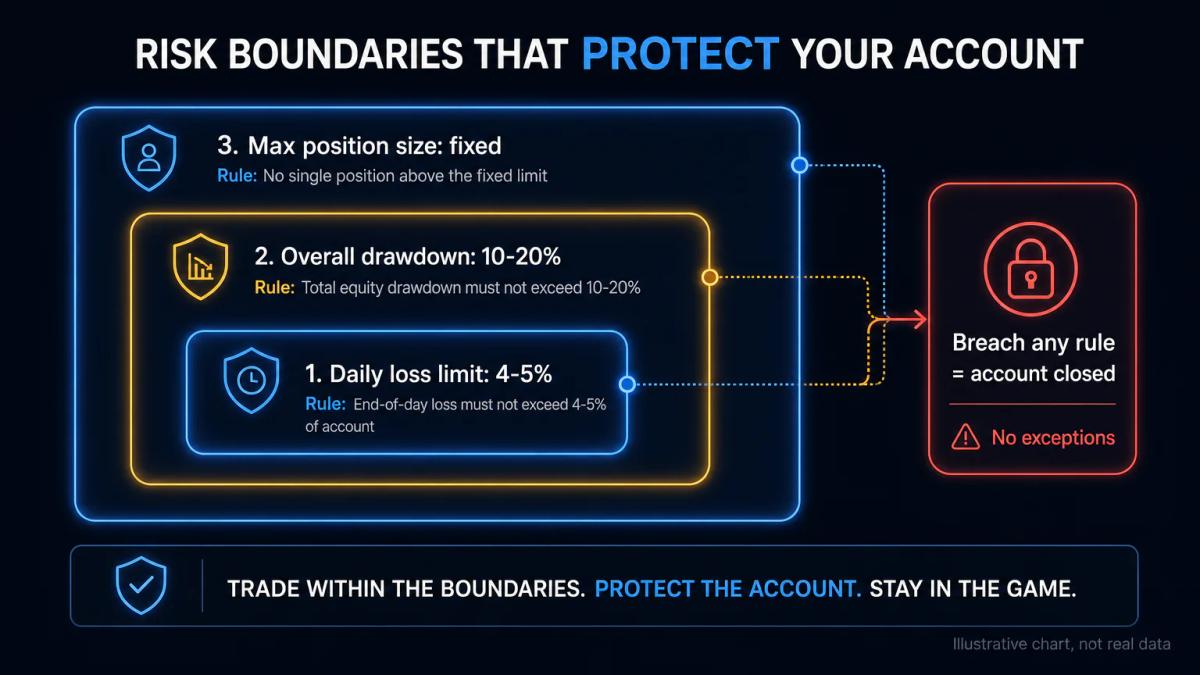
Risk management inside a prop firm is a contractual condition. Breach it once and the account is closed, even if your equity is above the starting balance. The three rules that matter most are the daily loss limit, the overall drawdown limit, and the maximum position size. Every rule has a number attached, and that number is the boundary of your job.
Start with the daily loss limit. Most firms set it at 4% to 5% of the account. On a $100,000 account, that is $4,000 to $5,000. The rule caps how much you can lose from a defined starting equity each day; once you hit it, the platform locks you out. To trade inside this rule you have to size positions so that no single stop loss risks more than a fraction of the daily limit. A common working rule is to risk 0.5% to 1% per trade: on a $100,000 account with a 5% daily limit, risking 0.5% ($500) per trade gives you room for ten losers before the day ends, which is more than enough for a rules-based strategy.
Overall drawdown is the second boundary. It ranges from 6% to 12% on most firms. Because breaching it closes the account permanently, it is the rule that determines whether you have a career or an anecdote. If you risk 1% per trade and enter a losing streak of eight trades, you are at 8% down, which breaches many overall drawdown limits. The practical response is to cut position size after two or three consecutive losers, not to add risk to recover.
| Risk metric | Typical prop firm setting | Practical implication |
|---|---|---|
| Daily loss limit | 4% to 5% of account | Cap risk at 0.5% to 1% per trade |
| Overall drawdown | 6% to 12% of account | Cut size after 2 to 3 losses in a row |
| Max position size | 1 to 5 lots per instrument | Aligned with account size |
| Max open trades | 3 to 10 | Prevents correlated overexposure |
| Stop loss required | Yes, on most firms | Every entry needs a defined exit |
Position size limits are the third boundary. On a $100,000 account, a firm might cap you at 5 standard lots on major forex pairs. A standard lot is 100,000 units of the base currency, so 5 lots on EUR/USD is €500,000 of exposure, which is five times account equity. That is already aggressive; the cap exists to stop you doubling it. Correlated positions count: three long trades on EUR/USD, GBP/USD and AUD/USD are effectively one long-dollar trade with triple the size.
A daily journal is not optional under these rules. Log each trade with entry price, stop loss, position size, risk in dollars, and outcome. Review at the end of every session. If you notice risk creeping above your written maximum, you have a process problem, and it will cost you the account before the market does. According to the FCA, a majority of retail CFD accounts lose money; the funded traders who survive are the ones who treat the rulebook as a system of hard stops rather than a set of guidelines.
Psychological preparation and emotional discipline
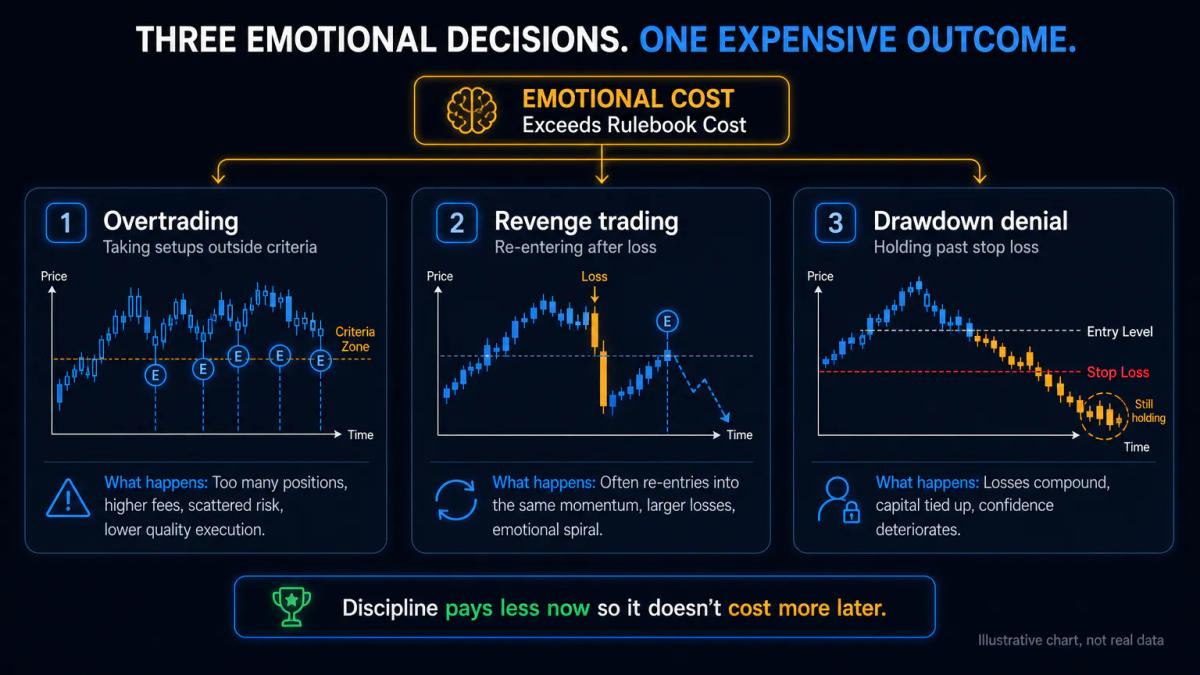
Prop trading fails on psychology far more often than on strategy. The three recurring failure patterns are overtrading (taking setups that do not meet your written criteria to make up for a slow day), revenge trading (entering immediately after a loss to recover it), and drawdown denial (holding a losing position past the stop loss because closing it feels like admitting defeat). All three come from the same source: the emotional cost of the loss feels bigger than the rulebook cost of the breach, right up until the account closes.
The first framework that helps is process versus outcome. On any single trade, a good process can lose money and a bad process can make money. What you control is the process: the setup you took, the size you used, and the stop you honoured. Evaluate yourself by the process for the day, not the profit and loss. Over a large enough sample, the process converges to the P&L, but only if you keep the process constant.
The second framework is a pre-mortem. Before the trading day, write down what could go wrong and how you will respond. For example: 'If I lose two trades in a row, I halve my size. If I lose three, I stop for the day.' Written before the emotion arrives, this rule is easy to follow; invented during a losing streak, it will be renegotiated on the spot. Prop firms enforce a daily loss limit precisely because most traders will not enforce their own.
The third framework is a physical and cognitive routine. Sleep, screen breaks, and a fixed end time reduce the chance that fatigue leads to a rule breach in the last hour. Set an alarm for the last trade of the day. When it rings, close the platform whether or not you are up. The single most useful habit for funded traders is boredom tolerance: sitting through hours without a valid setup, without inventing one.
Expect to fail an evaluation at least once. The value of failure is diagnostic: it exposes which rule you cannot yet respect. Track which rule closed the account, not just the P&L, and address that specific weakness before the next attempt.
Tax, legal structure, and money management for prop traders
Profits from prop trading are taxed in almost every jurisdiction, though the category matters. In the United Kingdom, profits from an online prop firm are generally treated as trading income by HMRC, taxable as self-employment earnings under income tax and Class 2/4 National Insurance if you trade in your own name, and as corporation tax if you route them through a limited company. Losses can be offset against trading profits within the same trade under HMRC rules. If in doubt, get a written opinion from a UK tax adviser before your first payout.
In the United States, the tax treatment depends on the instrument and the firm's structure. According to the Internal Revenue Service, gains on futures contracts under Section 1256 are taxed 60% at long-term rates and 40% at short-term rates, regardless of holding period. Gains on forex spot may fall under Section 988 as ordinary income unless you elect out. Prop firm payouts structured as independent contractor income are reported on Form 1099-NEC and are subject to self-employment tax. A CPA who understands trader taxation, including trader tax status and the mark-to-market election under Section 475(f), is a small annual cost against a large upside.
| Jurisdiction | Common tax treatment | Common legal structure |
|---|---|---|
| United Kingdom | Trading income, income tax and NIC | Sole trader or limited company |
| United States | 1099-NEC ordinary income; futures under Section 1256 | Sole proprietor or LLC |
| Australia | Ordinary income under ATO rules | Sole trader or company |
| Canada | Business income per CRA guidance | Sole proprietor or corporation |
Money management outside the trading account is the second half of the job. Withdraw profits on a schedule and separate trading capital from living expenses. A working rule is to keep six months of living costs in a separate cash account before you rely on prop payouts as income. Reinvest into larger evaluations only after you have paid taxes owed and set aside operating cash.
Recordkeeping is non-negotiable. Save every broker statement, every payout confirmation, every evaluation fee receipt, and every trade log. Tax authorities want the paper trail if they audit, and prop firms are obliged to report payouts to some tax authorities directly.
Your first 90 days: a practical action plan
A structured 90 days beats a year of undirected effort. The goal for the first three months is not to be funded; it is to build a process that could pass any reasonable evaluation. If funding arrives inside 90 days, that is a bonus. If it does not, the process is still the asset.
Days 1 to 15
Choose the firm and the account size. Read the rulebook of two or three prop firms in detail by comparing them, focusing on drawdown definitions, news trading rules, weekend holding rules, minimum trading days, and payout terms. Pick one. Start with the smallest evaluation account they offer, even if you can afford larger. The purpose is to test the rulebook, not to maximise the payout.
Days 16 to 45
Paper trade the rulebook. Trade a demo account under the exact rules of the evaluation, including the daily loss limit and overall drawdown, for a full month. Keep a journal with entry, stop, size, risk in dollars, and rule check for each trade. If you would have breached any rule, note it. The metric to watch is not P&L; it is rule breaches per week. When breaches reach zero for two consecutive weeks, you are ready to pay the fee.
Days 46 to 75
Start the evaluation. Pay the fee, take the evaluation, and trade exactly as you did in paper trading. Do not add size, do not add setups, do not skip the journal. Aim for the profit target on the firm's terms, not the fastest possible timeline. Most firms allow at least 30 days for stage one, and many now offer unlimited time; use it. If you breach a rule, note which one and take the same evaluation again with that specific weakness addressed. If you fail twice on the same rule, the process is not fixed yet; go back to paper trading.
| Phase | Days | Focus | Success metric |
|---|---|---|---|
| Setup | 1 to 15 | Choose firm, read rulebook | Written rulebook summary |
| Paper | 16 to 45 | Trade demo under real rules | Zero rule breaches for 2 weeks |
| Live evaluation | 46 to 75 | Pay fee, trade to target | Pass without breach |
| Funded | 76 to 90 | Trade smaller, journal harder | First payout received |
Days 76 to 90
Trade with your funded account. When you graduate, halve your risk per trade for the first two weeks. The psychological shift from evaluation to real payout capital is bigger than most traders expect, and reducing size buys the time to adjust. Set a written payout target for the first month, request the payout on the firm's minimum threshold rather than waiting to compound, and confirm the payment mechanics work.
One discipline holds the plan together: a daily review of no more than 15 minutes, covering trades taken, rules followed, and one adjustment for the next session. Retail traders skip this step; funded traders do not.
This content is general information and not advice: every situation needs checking with a licensed professional in the relevant jurisdiction.
Frequently Asked Questions
Do I need a finance degree or trading certification to become a prop trader?
For an institutional desk, yes in practice: firms recruit from quantitative bachelor's and master's programmes and value the CFA, Series 7 in the United States, or FCA-recognised qualifications in the United Kingdom. For an online prop firm, no. You need to pass the trading challenge under the rulebook; no employer verifies your CV. What you do need in both cases is a documented, rule-based approach to sizing and stops.
How much does it cost to get started with an online prop trading firm?
Evaluation fees typically range from $100 for a $10,000 simulated account to $2,000 for a $200,000 account. The fee is generally non-refundable unless you pass and reach a funded payout; some firms refund it with the first withdrawal. Budget as if it is lost. Also budget for repeat attempts: passing on the first try is uncommon, and a realistic plan allows for two to three evaluations before the first payout.
What is the most common reason traders fail the evaluation phase?
Breaching the daily loss limit or the overall drawdown, usually after a losing streak triggers oversizing or revenge trading. The strategy is rarely the primary cause. Most failed evaluations show a valid setup abandoned under pressure, position sizes doubled after two losers, or stops moved to avoid closing a losing trade. The rulebook, not the market, closes these accounts.
Can I transition from retail trading directly to a funded prop account?
Yes, if your retail process already respects a fixed risk-per-trade rule and a stop discipline. The transition is smoothest when your retail journal shows consistent sizing, honoured stops, and a maximum drawdown below the prop firm's limit. If your retail trading currently uses variable size or no stops, address that before paying an evaluation fee, because the rules that a prop firm enforces are the same ones you would need to enforce on yourself anyway.
How long does it typically take to reach a funded account after paying the evaluation fee?
Firms usually require a minimum of 5 to 10 trading days and allow 30 days or more for the first stage. In practice, traders who pass the first attempt do so in 20 to 60 days. Those who need a retake commonly reach a funded account in 60 to 120 days from the first fee. Rushing shortens the timeline in theory and extends it in practice, because rule breaches force restarts.
About the authors


Put this into practice
Related articles

Kraken Crypto Prop Trading Explained: How It Works and How to Get Started
A plain-English explanation of Kraken's funded trader model, plus the five steps to getting started: verify your account, pick a tier that fits your risk, rehearse the rules, pass the evaluation, then trade funded.

No Minimum Trading Days Prop Firm: What It Means and How to Choose
A no minimum trading days prop firm lets you pass the challenge on your own schedule. Here is what changes: drawdown mechanics, regulation, execution and self-discipline.

Options Prop Firms Explained: Evaluation, Profit Splits, and What to Expect
A plain-English guide to how options prop firms allocate capital, structure evaluations, split profits, and enforce risk rules on funded traders.
0 comments