



Prop Trading · Beginner · 8 min read
Trading Stocks and ETFs Under a Funded Account: How It Differs From Futures
What prop firm stocks are and how they differ from retail trading
Prop firm stocks are equity and ETF positions you trade using a proprietary trading firm's capital instead of your own money. You first pass an evaluation, then trade a funded account (live or simulated) under fixed rules: profit targets, maximum drawdown (the fall from a capital peak to the trough), and daily loss caps. In return, you keep a share of profits, typically 70% to 90%.
The practical difference from a retail brokerage account is who bears the loss and who sets the rules. At a retail broker you fund the account, you own the P&L, and margin calls are the only hard constraint. On a stock market prop firm account, the firm funds the account, sets consistency rules, and can close your access if you breach a limit. This shifts personal capital risk to evaluation fees ($50 to $600 for most tiers) and trades freedom for structure. It suits traders who have a repeatable edge but limited capital.
One more distinction: retail leverage is capped by your regulator, while prop firms design their own risk envelope inside that legal frame.
If a funded account is your goal, our roundup of the best prop firms is the place to start.
Evaluation process and qualification requirements
Most prop trading firms for stocks run a two-stage evaluation before releasing a funded account. Stage one, often called the challenge, asks you to reach a profit target (commonly 8% to 12% of the starting balance) inside 30 calendar days without breaching drawdown limits. Stage two, the verification, uses a lower target (typically 4% to 6%) and confirms the result was not a one-off. Some firms now offer single-phase or instant-funding routes at higher cost.
Core rules you will meet across almost every firm:
| Requirement | Typical range | What it means for you |
|---|---|---|
| Profit target stage 1 | 8%-12% | Reach this without breaching any loss cap |
| Profit target stage 2 | 4%-6% | Confirms consistency, lower pressure |
| Minimum trading days | 3-10 days | Prevents one-lucky-trade passes |
| Maximum trading period | 30-60 days | Some firms are now unlimited |
| Consistency rule | 20%-50% cap | No single day may exceed this share of total profit |
| Evaluation fee | $50-$600 | Refunded on first payout by many firms |
A beginner mistake is chasing the profit target on day one. Firms design consistency rules precisely to filter that pattern, so pacing matters as much as edge. Understanding how many trades per day should you make helps you avoid overtrading and stay within the consistency window that prop firms enforce.
Capital allocation, profit splits, and payout structures
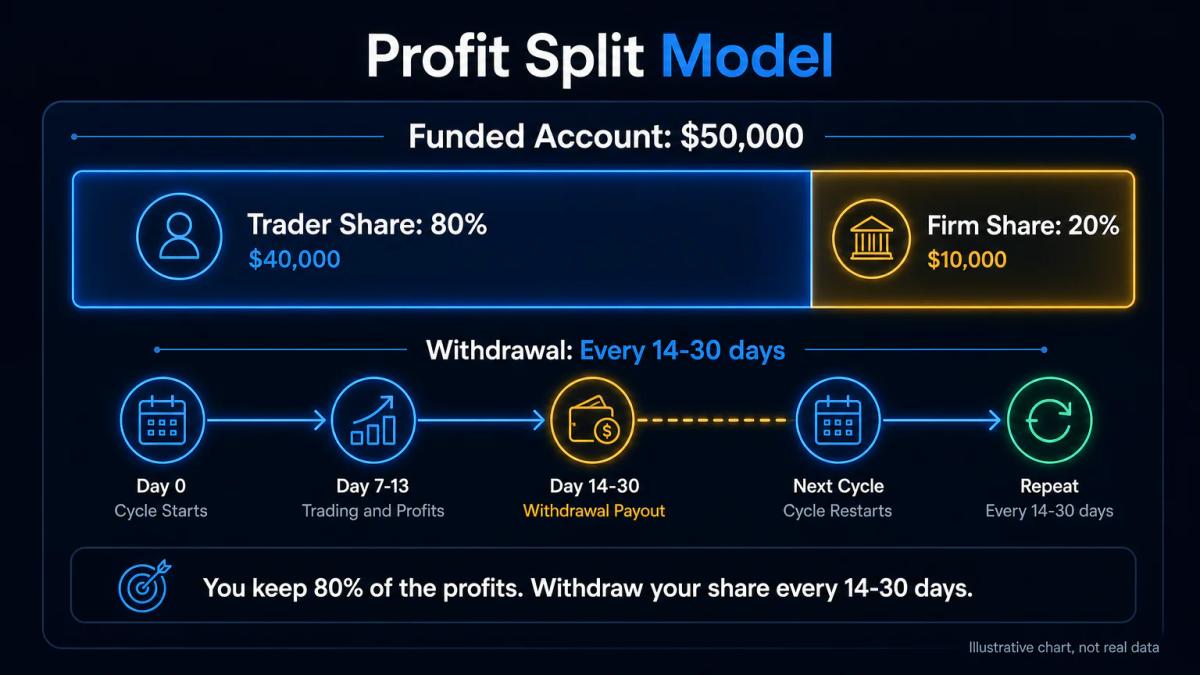
Funded account sizes for equity traders typically range from $10,000 to $500,000, with $25,000, $50,000 and $100,000 the most common starting tiers. Your evaluation fee scales with account size, and some firms let you scale up (double the account after several profitable months) if you keep hitting targets. Profit splits usually start at 70% to the trader and rise to 80% or 90% as you scale.
Payouts fall into three models.
- In the classic model you request withdrawals every 14 to 30 days once you clear a minimum profit (often 1% of account size).
- In the on-demand model, popular with newer firms, you can request a payout any day after an initial holding period.
- In the subscription model, you pay a flat monthly fee ($99 to $299) and keep 100% of profits.
The right model depends on how consistently you trade and whether you value predictability of costs over upside.
Risk management rules: drawdowns, loss limits, and daily stops
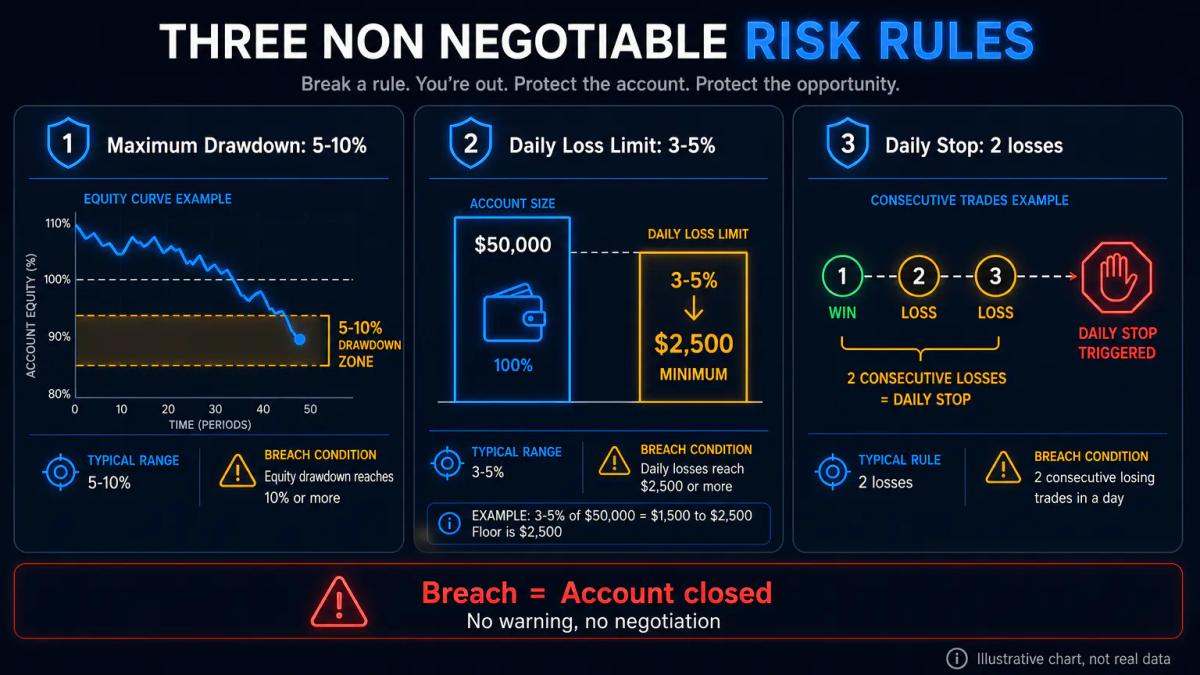
Risk rules are the spine of any funded account, and breaching them ends the account immediately. There is no warning, no margin call, no negotiation. The three limits you must know before you place a single trade:
| Rule | Typical range | How it is measured | What triggers a breach |
|---|---|---|---|
| Maximum drawdown | 5%-10% of starting balance | Trailing (from equity high) or static (from starting balance) | Equity touches the floor, even intraday |
| Daily loss limit | 3%-5% of starting balance | Reset at the firm's daily cutoff, often 5pm New York | Closed and floating losses combined exceed the cap |
| Daily stop or session cap | 2%-4% of equity | Some firms enforce, others recommend | Optional lock-out until the next session |
A worked example on a $50,000 account with a 5% daily loss limit and 10% maximum drawdown: you can lose up to $2,500 in one day and up to $5,000 in total before the account terminates.
If you are down $2,000 by lunch, most experienced funded traders stop, because a further $500 loss ends the day and a bad opening the next morning can end the account.
Difference between proprietary trading and futures trading
Equity prop accounts and futures prop accounts look similar on the surface but behave differently in three areas: leverage, product structure and holding costs. Under FCA rules for UK retail clients, single-stock CFD leverage is capped at 1:5 and indices at 1:20, and most equity prop firms sit inside that envelope.
Futures accounts use contract-based margin set by the exchange, which effectively delivers higher leverage on capital deployed. That changes position sizing, stop distance and how quickly a bad trade eats your daily loss limit.
Learning about E-mini futures explained will help you understand the contract mechanics and margin model that differentiate futures prop accounts from equity ones.
Product choice differs too. An ETF prop firm gives you exposure to broad baskets (SPY, QQQ, sector ETFs) with lower single-name risk, while futures desks focus on index, energy and rates contracts with 23-hour sessions. Overnight risk is another split: stock accounts often bar or restrict overnight holds, while futures traders manage session gaps as part of the strategy. Neither is better; they suit different edges.
Best approaches to trade stocks and ETFs under a funded account
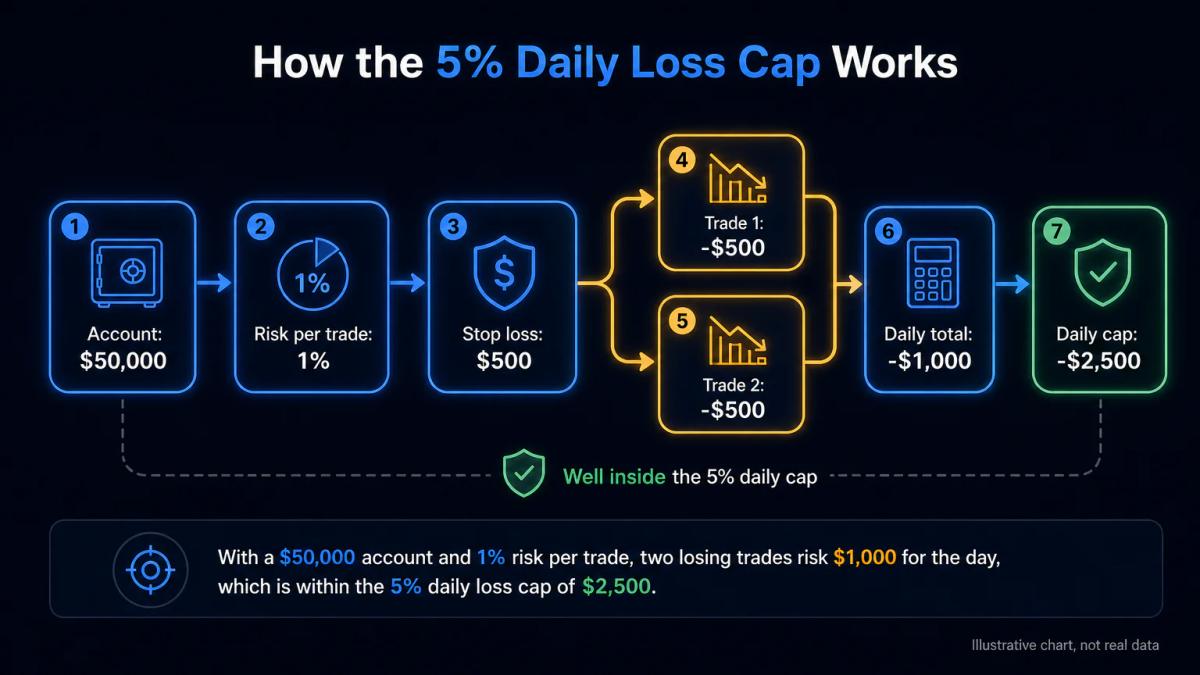
Consistent funded traders share a boring profile: small, repeatable setups, tight position sizing, and short screen time. A workable frame for a beginner is to risk 0.5% to 1% of the account per trade, set the stop before entering, and cap the day at two losing trades. On a $50,000 account that means risking $250 to $500 per trade and stopping for the day at roughly $1,000 down, well inside a 5% daily cap of $2,500.
Time of day matters as much as setup. The first 90 minutes after the New York open (14:30 to 16:00 UK time) and the closing hour concentrate volume in US equities and ETFs. Trading the low-volume midday drift is where many funded accounts die by a thousand cuts.
How to trade momentum stocks covers entry, exit and risk rules that align with the tight position sizing discipline required in funded accounts.
Two more habits protect the account:
- Journal every trade with entry, stop, target and reason.
- Avoid earnings dates unless the firm explicitly allows event trading. Slippage on earnings gaps has ended more funded accounts than bad analysis.
Platforms, tools, educational support and the costs behind them
Stock-focused prop firms usually offer MetaTrader 5 (a multi-asset trading platform), cTrader, TradingView integration, or a proprietary web terminal such as DXtrade or Match-Trader. MT4 is now rarer for equities because it was built around forex.
Beyond the platform, check three cost lines that sit outside the profit split: commissions per share or per lot, overnight swap or financing charges on CFD positions, and real-time data feeds for US exchanges (NYSE and Nasdaq feeds cost roughly $10 to $25 per month for non-professional users, set by the exchanges themselves).
If you prefer TradingView as your charting and analysis tool, prop firms that use TradingView provides a guide to which firms integrate it into their funded accounts.
Regulation of prop firms is uneven. Firms that trade on behalf of clients with client capital fall under investment-firm rules in the UK and EU; firms that only run simulated evaluations and pay out from their own balance sheet often sit outside that perimeter.
The FCA has published statements clarifying that many prop firm arrangements are not regulated investment services, which means the standard investor protections (FSCS cover, ombudsman access) do not apply. Check the entity, its licence and its jurisdiction before you pay any evaluation fee.
On tax, HMRC treats funded-account profits paid to a UK resident as self-employment or miscellaneous income in most cases, not as capital gains, because you are trading the firm's capital under a contract. Keep monthly payout statements, evaluation invoices and platform fees; the exact treatment depends on your contract and your wider situation, so a qualified accountant is the right call before your first big payout.
Frequently Asked Questions
What is the typical profit split at a stock prop firm?
Splits usually start at 70% to the trader and 30% to the firm, rising to 80% or 90% as you pass scaling milestones. A minority of firms offer 100% to the trader in exchange for a flat monthly subscription of $99 to $299 instead of taking a cut.
How long does it take to pass a prop firm evaluation and start trading live?
A two-stage evaluation typically takes four to eight weeks: 30 days maximum for stage one, then a shorter verification stage. Instant-funding and one-step programs compress this to a few days, but they cost more upfront and often carry stricter consistency rules.
Can you trade prop firm stocks from any country, or are there geographic restrictions?
Restrictions vary by firm and by product. Most firms exclude a short sanctions list, and some do not accept US residents for CFD-based products because of local rules. UK, EU and most non-US countries are widely accepted; always confirm on the firm's terms page before paying.
What happens if you breach the daily loss limit or maximum drawdown at a prop firm?
Breaching either limit ends the account immediately. There is no margin call and no negotiation. To trade again you must buy a new evaluation or, at some firms, pay a reset fee that restores the account to its starting balance under the original rules.
Do prop firms charge commissions on top of the profit split?
Yes, most do. Commissions on equities and ETFs run from a few dollars per hundred shares to a percentage of trade value. Overnight financing on CFD positions and real-time US exchange data feeds are often billed separately from the split, so read the pricing page in full.
About the authors


Put this into practice
Prop firms we have reviewed
Scored on the same five dimensions, with the rules that decide payouts. Here are three — the full list is on the prop firms page.



Related articles

What Is a Funded Trading Account: Definition, Mechanics, and Realistic Expectations
Funded trading accounts let you trade a prop firm's capital after passing an evaluation. Here is how the mechanics, splits, rules and costs really work.

What is a prop firm: how proprietary trading funding works
Prop firms fund traders who pass an evaluation, then split profits. Here is how the model works: fees, risk rules, asset coverage and regulatory context.
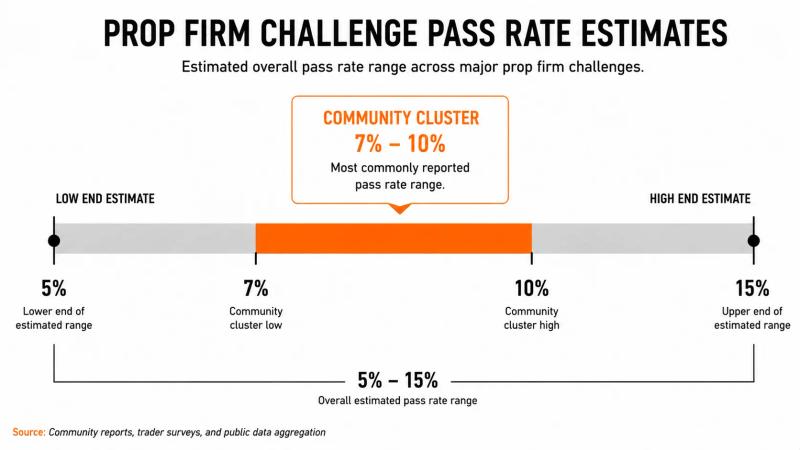
The Real Pass Rate of Prop Firm Challenges: What the Data Shows
Most prop firm challenges have low pass rates - but what does the data actually show? We break down the numbers, the reasons, and what they mean for you.
0 comments