



Futures Trading · Intermediate · 5 min read
E-mini futures explained: contracts, costs, and how to start
The smallest S&P 500 contract, explained
Futures trading E-mini contracts means buying or selling the CME's ES contract, a smaller version of the standard S&P 500 future built for accessible position sizing. Each ES tracks 50 times the S&P 500 index level, so a one-point move is worth $50 per contract. Liquidity is deep and margin sits well below the notional exposure.
The E-mini S&P 500 launched on the Chicago Mercantile Exchange in 1997 and has since become the reference equity index future for retail and institutional flow alike. One contract on an index level near 5,000 controls roughly $250,000 in notional value (index level times the $50 multiplier), so leverage is embedded in the product.
Treat that leverage as the first risk to manage: leverage trading mistakes should be studied before you size positions against your account, not against the margin requirement.
What margin and capital do you actually need
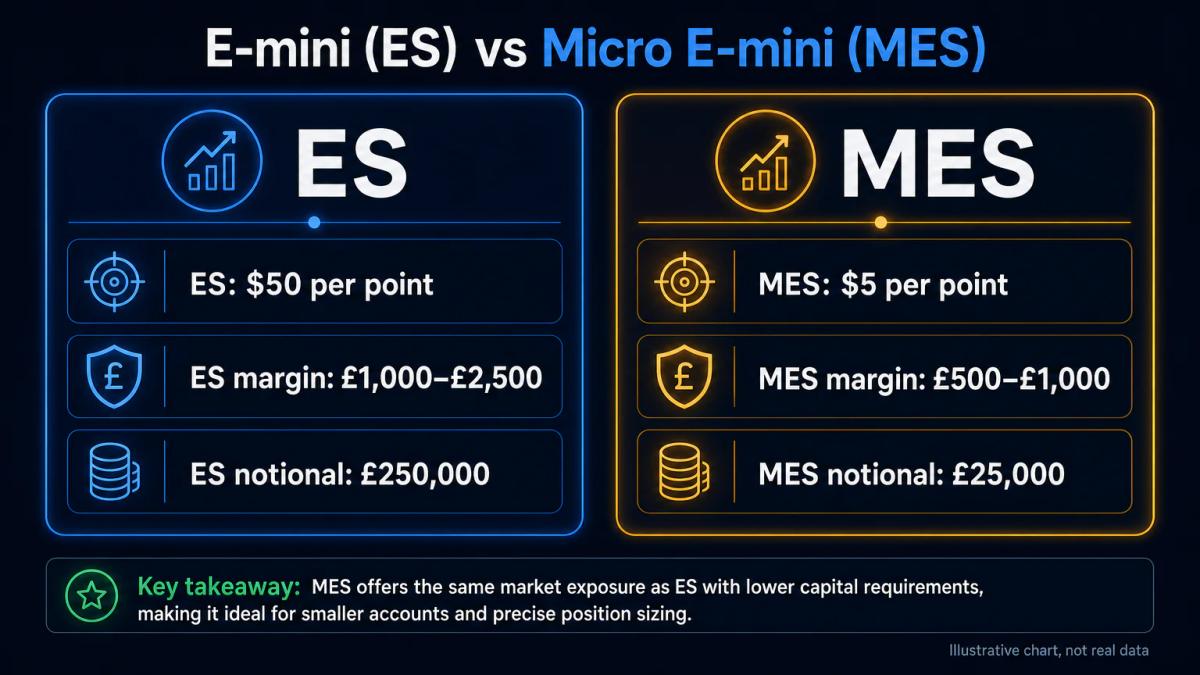
Margin on the E-mini S&P 500 (ES) typically sits between $1,000 and $2,500 per contract for day trading, and higher for positions held overnight.
Margin is collateral: the contract itself controls a much larger notional amount. A working retail account for a single ES contract usually starts around $10,000 to $15,000, which gives you room to absorb a normal drawdown (the fall from a capital peak to the trough before a new peak) without breaching maintenance margin.
Position sizing follows from that maths. If you cap risk at 1% per trade on a $15,000 account, that is $150, or three ES points; a stop wider than three points means you should be looking at the Micro E-mini instead.
How E-mini contracts trade and settle
E-mini futures trade nearly 24 hours a day, Sunday evening through Friday afternoon US time, on the CME Globex electronic venue, with a short daily maintenance halt.
Day trading, swing trading, and scalping are all viable on ES, though each requires different margin and session timing. Contracts expire quarterly in March, June, September and December; you either close before expiry or roll to the next contract month. Daily settlement marks your open position to the exchange's settlement price each evening, so profit or loss lands in your account overnight rather than at exit.
Rollover volume concentrates in the eight trading days before expiry, and liquidity migrates to the new front month within a session or two. Trading the wrong month after rollover is a common early mistake: check the contract code (for example ESZ5 for the December 2025 contract) before you click.
E-mini versus Micro E-mini: which is right for you
Micro E-mini S&P 500 (MES) contracts are one-tenth the size of the standard ES, with a $5 per point multiplier instead of $50. Margin usually runs $500 to $1,000 per Micro contract, and one point of movement is $5 rather than $50.
| Feature | E-mini (ES) | Micro E-mini (MES) |
|---|---|---|
| Multiplier per point | $50 | $5 |
| Typical day-trade margin | $1,000 to $2,500 | $500 to $1,000 |
| Notional at index 5,000 | $250,000 | $25,000 |
| Best for | Larger accounts, fewer contracts | Learning, small accounts, fine sizing |
Choose MES if you are testing a strategy or your account is under about $10,000; step up to ES once your risk per trade justifies the larger tick value.
Why liquidity matters in E-mini trading
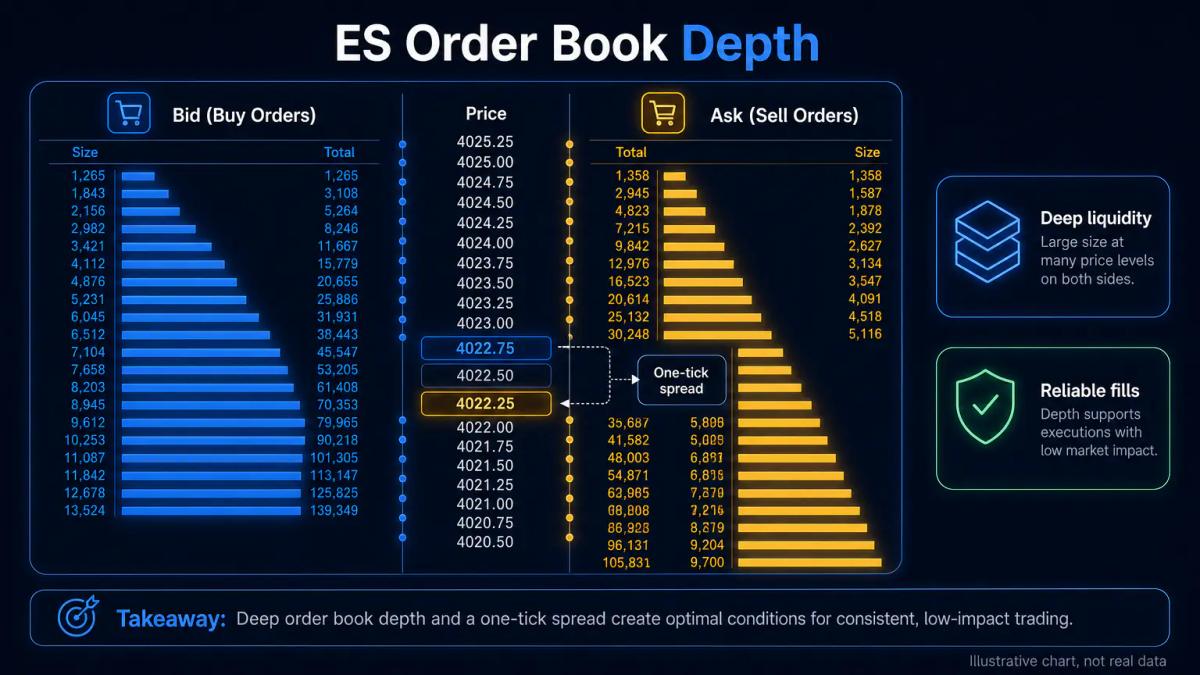
The ES is the deepest equity index future in the world, and that depth translates directly into execution quality: liquidity in trading determines your bid-ask spread, slippage, and fill reliability.
A one-tick bid-ask spread during regular US hours, minimal slippage on market orders of a few contracts, and reliable fills at both stop and limit prices are the norm.
For a day trader working intraday breakouts or a swing trader scaling out of a position, that difference between a one-tick and a two-tick spread compounds quickly across a month of trades.
Liquidity thins outside US cash hours and around major economic releases. If you trade the London morning or the Asia session, expect wider spreads and use limit orders rather than market orders to control entry cost.
Getting started: platform and broker essentials
You need a futures-enabled broker: many stock brokers do not clear CME products, so check before you fund.
Platforms commonly used for E-mini trading include NinjaTrader, TradingView with a futures data feed, Interactive Brokers' Trader Workstation, and CQG-based front ends.
For a UK retail client, the account is typically opened with the broker's futures-clearing entity; the FCA-authorised UK entity may introduce the client, but the futures account itself usually sits with a US or group affiliate registered with the CFTC and NFA.
Use the MonkeyTrade broker comparison tool to confirm which entity holds your money and under which licence.
| Selection criterion | What to check |
|---|---|
| Regulation | FCA-authorised introducer plus CFTC/NFA-registered clearer |
| Commissions | Round-turn cost per ES and MES contract |
| Margin | Day-trade and overnight margin per contract |
| Data fees | CME real-time data subscription cost |
| Platform | Charting, DOM, order types, API |
On tax, UK residents should note that futures profits and a taxable brokerage account may fall under capital gains or, for frequent traders, may be treated as trading income by HMRC; the treatment depends on your circumstances and is worth confirming with a qualified accountant before you scale up.
Common early mistakes are predictable: sizing off margin rather than account risk, holding through a major US release without a stop, and trading the expiring contract after volume has already rolled. Each of those is avoidable with a written plan and a checklist before the session.
Frequently Asked Questions
What are E-mini futures and how do they differ from standard index futures?
E-mini futures are electronically traded index contracts on the CME that are a fraction of the size of the older 'big' S&P 500 pit-traded future. The E-mini S&P 500 (ES) has a $50 per point multiplier, versus $250 on the discontinued standard contract, which made the index accessible to retail-scale accounts.
How much money do I need to start trading E-mini futures?
Day-trade margin on the ES is often $1,000 to $2,500 per contract, but that is collateral, not risk capital. A realistic starting account for one ES contract is $10,000 to $15,000; for the Micro E-mini (MES), an account of $2,000 to $5,000 is more appropriate.
What are the main risks of trading E-mini futures for retail traders?
The embedded leverage is the primary risk: one ES point is $50, so a ten-point move against a single contract is $500. Overnight gaps, thin liquidity outside US hours, and holding through economic releases without a stop are the fastest ways to turn a small mistake into a large loss.
Can I trade E-mini futures outside US market hours?
Yes. E-minis trade nearly 24 hours a day on CME Globex, from Sunday evening to Friday afternoon US time, with a short daily maintenance halt. Liquidity is deepest during US cash hours; expect wider spreads and thinner order books in the Asia and early London sessions.
What is the difference between E-mini and Micro E-mini contracts?
The Micro E-mini S&P 500 (MES) is one-tenth the size of the E-mini S&P 500 (ES). One MES point is $5 versus $50 on ES, and margin is roughly one-tenth as large. The mechanics, hours and expiries are otherwise identical, which makes MES a natural stepping stone before scaling into ES.
About the authors


Put this into practice
Brokers we have reviewed
Scored on the same five dimensions. Here are three of them — the full list is on the brokers page.



0 comments