



Prop Trading · Intermediate · 12 min read
Best Prop Firm Forex EAs: Rules, Platforms and Real Performance
What makes a forex EA suitable for prop firm trading
The best prop firm forex EAs are automated algorithms that respect three hard boundaries at once: the funding firm's daily loss cap, the trailing or static maximum drawdown, and the platform's execution rules on strategies such as scalping, hedging or news trading.
A suitable EA (Expert Advisor, a program that places orders inside MetaTrader or cTrader based on pre-coded rules) keeps per-trade risk small, produces auditable forward-test data, and behaves the same on a funded account as it did during evaluation.
Suitability is not the same as profitability. An EA that returns 60% a year in a backtest is useless on a funded account if its equity curve dips 12% intraday, because most challenge rulebooks kill the account at a 5% daily loss or 10% total drawdown.
You are optimising for two objectives at once:
- A return that clears the profit target.
- A shape of drawdown that never touches the trip wires.
The EAs that survive on funded capital tend to trade fewer setups, size positions in fractions of a percent, and stop themselves before the risk desk does.
Before you buy a licence or upload a strategy, compare prop firms and read the funded programme's rules line by line. The clauses that end accounts are rarely about profit: they concern how the profit was made. Grid stacking during a news release, holding positions across the weekend on a swing-restricted plan, or copying trades across accounts inside the same group, each triggers a review. Choose the EA that fits the rulebook, not the rulebook that fits the EA.
To trade with a firm's capital, compare the best prop firms and how their evaluations work.
How Expert Advisors work in forex trading
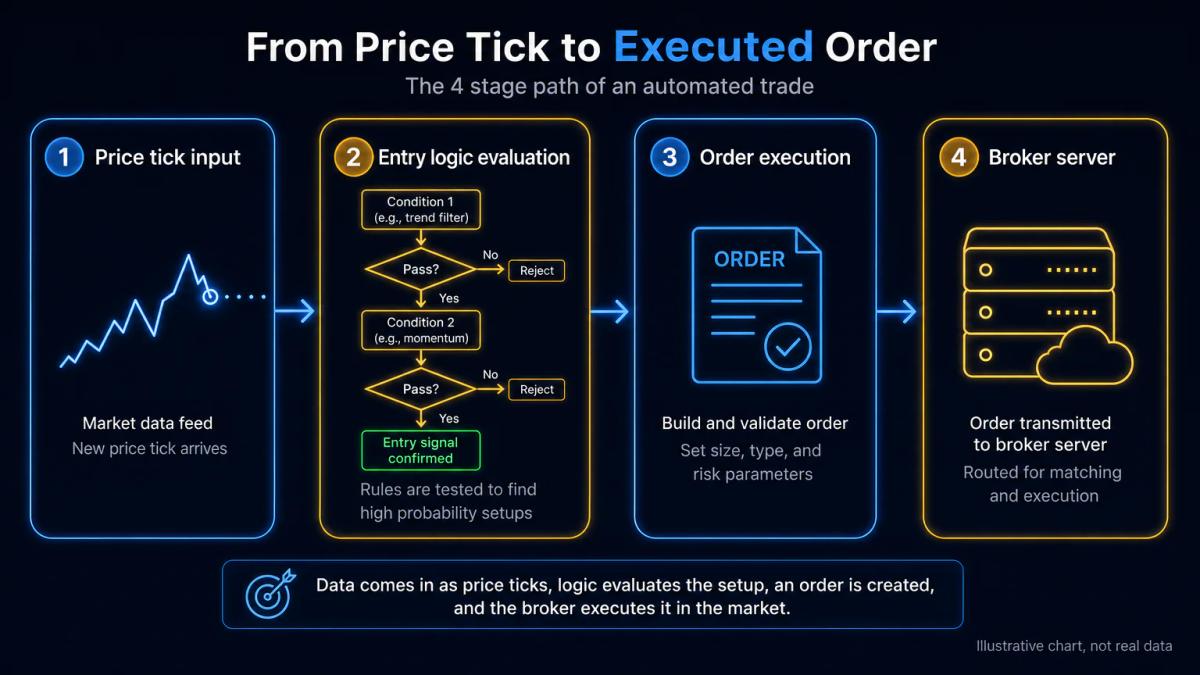
An Expert Advisor is a compiled script that runs inside MetaTrader 4, MetaTrader 5 or, in cTrader's case, a cBot written in C#. Once attached to a chart, it reads price ticks, evaluates its entry logic, and if the conditions match, it fires an order through the broker's server. The EA can size the position from account equity, set stop loss and take profit (the price at which the trade closes for a fixed loss or a fixed gain), trail the stop as price moves, and log every action.
EAs do three jobs a human cannot do reliably: they watch every tick without fatigue, they act in milliseconds, and they never override the plan on a bad morning. That last point matters most on funded accounts, where a single revenge trade violates the daily loss cap in one candle. The trade-off is that an EA does exactly what you coded, including the mistakes: a stop that references the wrong symbol, a lot-size formula that ignores account currency, or a filter that fails on daylight saving day. The infrastructure is only as disciplined as its author.
Prop firm rules that block or terminate EA accounts
Prop firms tolerate EAs to different degrees, and the fastest way to lose a funded account is to violate a rule you did not read. The recurring blockers fall into four groups: hard risk limits, strategy restrictions, execution rules and infrastructure rules.
Hard risk limits include the maximum daily loss (commonly 4% to 5% of the starting balance) and the maximum drawdown (commonly 8% to 10%, sometimes measured on equity rather than balance). Hitting either instantly closes the account. An EA that spreads risk across ten simultaneous positions can trip the daily limit through unrealised losses alone, even if none of the trades has closed.
Strategy restrictions are the second family. Some programmes ban tick scalping and other types of trading (holding trades for less than 60 seconds), high-frequency grid systems, latency arbitrage between two feeds, and trading two minutes either side of a red-folder news release. Martingale logic (doubling position size after a loss) breaches drawdown caps by design and is filtered in the post-trade review, not blocked at execution. Copy-trading across multiple funded accounts owned by the same person is the third common breach: firms detect it through IP, VPS fingerprint and correlation of trade timestamps.
Execution and infrastructure rules cover the mechanics. Several firms require you to declare the EA before deployment, block third-party signal services, and reserve the right to disqualify trades taken outside declared server hours. Others require that the account is human-attended: an EA left running through a weekend gap can be judged non-compliant. The safest reading is defensive: assume the risk desk will inspect your trade log if you clear the target quickly, and make sure every entry has a clean, coded justification.
Comparing prop firms with EA-friendly policies
Prop firms publish their EA policies with different levels of transparency. The table below summarises the categories you will encounter when shopping for a funded programme, based on the structural features documented on monkeytrade.com/prop-firms. Compare the categories, not just individual brand names, because rulebooks change between challenge versions.
| Feature | Full-automation friendly | Restricted automation | Manual-only |
|---|---|---|---|
| EA declaration | Not required | Required before funded stage | N/A, EAs banned |
| News trading | Allowed with normal risk caps | Blocked ±2 min around red news | N/A |
| Scalping | Allowed, minimum hold varies | Minimum hold 60 seconds | N/A |
| Grid or martingale | Allowed if within drawdown | Explicitly banned | N/A |
| Copy trading across accounts | Case by case | Banned | Banned |
| Platforms | MT4, MT5, cTrader | MT4, MT5 | Proprietary web platform |
| VPS | Recommended, self-hosted | Firm-approved VPS list | N/A |
The most EA-tolerant category is not always the best commercial deal. Full-automation friendly firms often have tighter drawdown limits (5% daily, 8% total) because they price the risk of algorithmic accounts differently. Restricted automation firms give you 10% total drawdown and a wider profit target but force you to file EA source code or a signed declaration. Manual-only firms are simplest to compare but useless if your edge is coded.
Costs matter as much as rules. The typical challenge fee for a $100,000 account sits in a $400 to $600 range across the mainstream EA-friendly firms, but refund policies differ: some refund the fee on first payout, others amortise it across three months. Read the small print on scaling plans too, because an EA that clears 8% a month becomes far more valuable on a programme that doubles the account after two payouts than on one that caps at the original balance.
UK residents who trade on funded challenges should note where the funding entity is domiciled. Most global prop firms operate through offshore vehicles and do not hold FCA authorisation. That changes your recourse if a dispute arises: the FCA's Financial Ombudsman Service and Financial Services Compensation Scheme do not apply. Where a UK-authorised entity is involved, it is usually the introducing broker, not the funding programme itself.
Compare forex brokers and verify the entity name on the contract before you pay.
Backtesting and configuration best practices for prop firm EAs
A backtest is only useful if it simulates the conditions the funded account will actually see. In MetaTrader 5, run the strategy tester in 'every tick based on real ticks' mode, load at least three years of tick data from the broker whose feed matches the prop firm, and set spreads to the current typical spread plus a slippage buffer of one to two points on majors. If the EA still clears the profit target after those frictions, you have a candidate. If it only clears with zero slippage and fixed one-pip spreads, you have a curve fit.
Forward testing is the second gate. Run the EA on a demo account funded to the same size as the challenge, for at least 60 trading days, and compare the equity curve to the backtest over the same window. Deviations larger than 30% in trade count, average trade duration or maximum consecutive losses mean the backtest was optimistic. Only then move to a paid challenge. This sequence saves the fee more often than it wastes it.
Position sizing is where most funded accounts die. A common configuration mistake is to size trades as a percentage of equity without capping the number of concurrent positions.
If the EA can open six trades simultaneously, each risking 1% of equity, and correlated pairs all move against you, the unrealised loss hits 6% before any stop triggers, which breaches a 5% daily cap. Avoid leverage trading mistakes by capping concurrent risk at the account level, not the trade level. Set a hard portfolio stop at 3% intraday, well inside the daily loss limit, and pause new entries until the next trading day when it triggers.
A short configuration checklist that survives most rulebooks:
| Parameter | Suggested setting | Rationale |
|---|---|---|
| Risk per trade | 0.25% to 0.50% of balance | Keeps ten losing trades inside a 5% daily cap |
| Concurrent positions | Maximum 3 correlated, 5 total | Limits unrealised drawdown from correlation |
| Hard daily stop | 3% intraday equity loss | Sits inside a 5% firm limit with buffer |
| News filter | Off ±2 min around red-folder events | Aligns with restricted-automation rulebooks |
| Weekend exposure | Flat by Friday 21:00 server time | Avoids gap risk and swing restrictions |
| Execution slippage tolerance | 3 points on majors | Rejects fills that break the risk model |
Platform compatibility and EA execution infrastructure
MetaTrader 4 is still the most widely supported platform for EA licensing, but MetaTrader 5 has overtaken it inside newer prop firm programmes because it supports true position netting, richer order types and a faster strategy tester. cTrader is available on a smaller subset of firms and requires cBots written in C#, which narrows the marketplace of ready-made algorithms. Before buying an EA licence, confirm which platform the funded account provides and whether the EA is offered natively on that platform: converted builds often behave differently on execution edge cases.
Latency is the second axis. Retail EAs that trade the London and New York sessions do not need co-location, but they do need a stable connection that does not drop during high-impact minutes. A virtual private server (a remote machine that runs your terminal 24/5 without depending on your home internet) hosted in the same data centre region as the broker's price server typically cuts round-trip latency to under 10 milliseconds, versus 40 to 80 milliseconds from a home router in a different country.
For strategies that trade breakouts and enter within seconds of a signal, that gap is the difference between the modelled fill and a two-point requote.
A basic Windows VPS from a mainstream broker-adjacent provider runs between $20 and $40 per month for a single EA, and $50 to $100 for a specification that can run three or four instances alongside a browser.
Some prop firms subsidise this cost through a partner arrangement, others provide a free VPS above a certain account size, and a few require you to use their approved list. Factor VPS cost into the total cost of running the EA, because a $30 monthly bill on a $500 challenge that pays back over three months materially changes the break-even.
Set the VPS to auto-restart the terminal after a Windows update, install a monitoring script that pings you if the terminal disconnects for more than five minutes, and back up the EA settings file weekly. The most avoidable funded-account losses come from an unnoticed disconnect at the open of the London session, not from a strategy edge that decayed.
Evaluating EA performance claims and forward-test results
EA marketing pages routinely publish backtest results that do not survive real execution. Two red flags recur:
- The first is a Sharpe ratio (a measure of return per unit of volatility) above three on a backtest longer than five years without an explanation of how the parameters were selected. Any strategy that stable, at that scale, would not be sold for $200.
- The second is a maximum drawdown reported as a single percentage without a chart of the underlying equity curve. A 6% max drawdown that occurred as five consecutive 1.2% days is qualitatively different from the same 6% concentrated in a single afternoon, and only the second breaches a daily loss cap.
Demand three artefacts before licensing an EA for a funded account: a full strategy-tester report exported from MetaTrader with tick-level data and realistic spreads, a live or verified forward-test record covering at least three months on a myfxbook-style tracker with a broker feed identified, and a written statement of the parameter set used in both.
Understand why most broker review sites can't be trusted when evaluating vendor claims; if the vendor cannot provide any one of the three artefacts, walk away. The cost of a challenge fee is higher than the cost of a licence, and a vendor who cannot document a strategy has not tested it either.
An EA that averages a 65% win rate with a 1:1 risk-reward looks robust in isolation, but a five-loss streak, statistically expected within a month at that hit rate, produces a 2.5% drawdown at 0.5% risk per trade. That is inside a 5% daily cap only if the streak spans multiple days. Reject EAs whose worst historical week would breach the rulebook, even if the average month is comfortable.
Risk management parameters that keep you funded
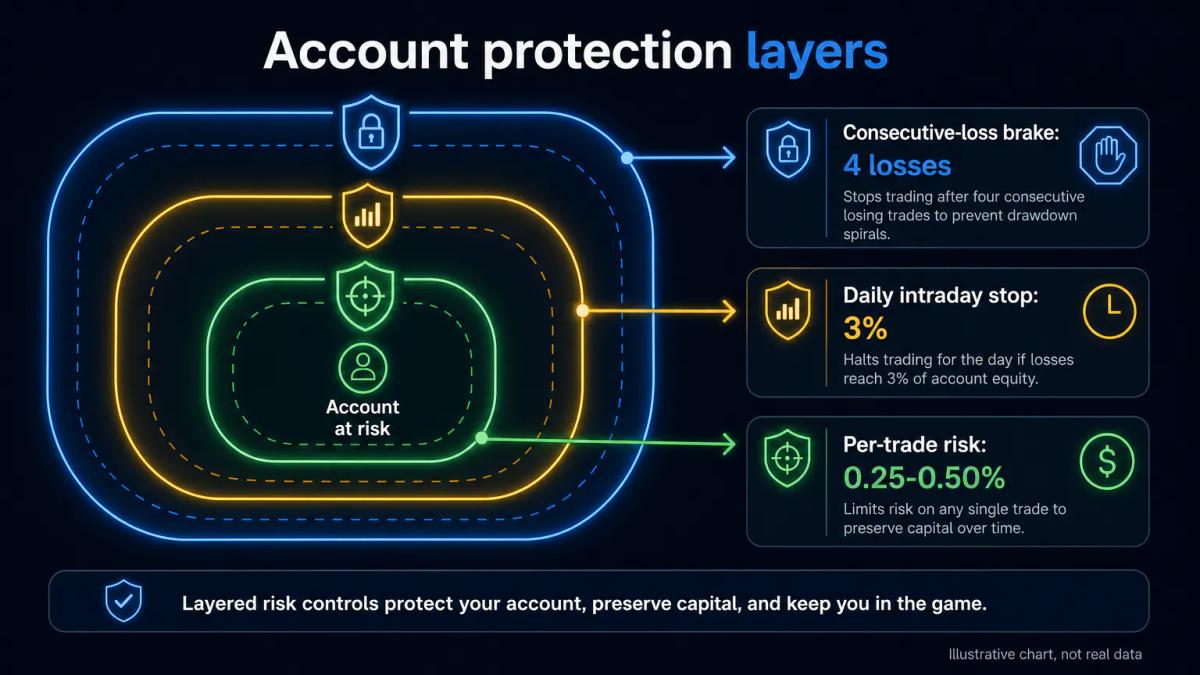
Staying funded is a discipline of hard limits, not soft targets. Set the EA's per-trade risk at 0.25% to 0.50% of the starting balance, code a portfolio-level intraday stop at 3% that halts new entries, and force a flat book by the weekend close on any programme with swing restrictions. Add a consecutive-loss brake that suspends the EA after four losing trades in a row until you review the log.
Treat these as non-negotiable parameters that the EA cannot override, not as suggestions the algorithm evaluates alongside its edge. A funded account is a subscription to a rulebook: the trader who keeps it is the one who priced the rules into the code before the first live trade.
Frequently Asked Questions
What is the difference between a scalping EA and a swing-trading EA for prop firms?
A scalping EA opens and closes trades within seconds or minutes, targeting a few pips per trade at high frequency, and needs low latency plus a firm that permits short holding times. A swing-trading EA holds positions for hours or days, sits inside wider stops, and needs a programme that allows overnight and weekend exposure. Scalping EAs are more sensitive to spread and slippage; swing EAs are more sensitive to gap risk and swap costs.
Can I use multiple EAs on the same prop firm account at the same time?
Most firms allow it, but the risk math changes. If EA A and EA B both open trades on EURUSD, the combined exposure counts against a single daily loss cap. Use a coordinator script or a magic-number filter to prevent overlapping positions, cap the total simultaneous risk across all EAs at your intraday portfolio limit, and confirm that the firm treats the combined trade log as a single account, which is the usual reading.
How do I know if a prop firm's EA approval process is legitimate or a scam?
Check three things: whether the firm names the operating entity and its jurisdiction on the contract, whether payouts are documented publicly with trader-verifiable evidence, and whether the EA rulebook is published in full before you pay. A legitimate approval process asks for a code review or a written declaration and gives a written response. A programme that only communicates through a support chat, changes rules retroactively, or blocks payouts citing 'suspicious algorithmic activity' after a clean trade log is not one to fund.
What happens if my EA hits the daily loss limit mid-trade on a prop firm account?
The firm's risk system usually flattens open positions at market and locks the account. Any unrealised loss becomes realised at the current bid or offer, which can be worse than the cap if the market gaps. The account is then marked as failed on the challenge or paused on the funded stage, depending on the rulebook. This is why a coded portfolio stop at 3%, well inside a 5% firm cap, is worth more than any edge the EA claims.
Do prop firms charge licensing fees for EAs, or is it included in the challenge cost?
The challenge fee covers access to the evaluation account. The EA licence is a separate cost paid to the algorithm's developer, ranging from a one-off $100 to $500 for a personal-use licence up to a monthly subscription of $50 to $200 for an actively maintained EA. Some firms bundle a small library of pre-vetted EAs for account holders, but most leave sourcing to the trader. Factor the licence into your break-even calculation alongside the VPS and the challenge fee.
About the authors


Put this into practice
Prop firms we have reviewed
Scored on the same five dimensions, with the rules that decide payouts. Here are three — the full list is on the prop firms page.



Related articles

EA Prop Trading: How Automated Systems Work in Funded Accounts
A practical guide to running Expert Advisors on prop firm accounts: rules, MT5 configuration, backtesting, instruments, fees, tax, and pitfalls.

Failed a Prop Firm Challenge? What to Do Next
A practical recovery plan after a failed prop firm evaluation: identify the breach, cost the retry, test the fix and choose the right firm for your next attempt.

Forex Prop Firms for US Traders: CFTC Rules, Capital Tiers and Payouts
A plain-English guide to how forex prop firms serve US traders: CFTC leverage caps, NFA registration, evaluation challenges, drawdown rules and tax reporting.
0 comments