



Prop Trading · Beginner · 12 min read
Same Day Payout Prop Firm: How Fast Withdrawals Actually Work
How same-day payouts work in prop trading
Speed in a same-day payout prop firm comes from a specific piece of plumbing. The firm already sits on the trading capital, so the only money that has to travel when you close a winning trade is your profit share, which the payments team can push out to a bank account or a crypto wallet within hours of your request. There is no settlement cycle in the middle, no broker holding funds on a weekly clock, and nothing to reconcile across a chain of counterparties.
A prop firm, short for proprietary trading firm, is a company that funds traders with its own capital and keeps a slice of the profits. In the same-day model, the firm treats withdrawals as an on-demand operation rather than a scheduled one. You close a position, the platform books the profit and loss, and once your account clears the firm's risk checks, you request the cash. The trading account itself is a simulated or funded environment the firm controls, so payouts flow from the firm's own treasury instead of a broker's settlement pipeline.
Two effects follow for a retail trader. The first is capital efficiency, because money sitting in a payout queue is money you cannot redeploy, and faster payouts free up your personal cash flow to run other trades or cover living costs. The second is psychological: knowing you can withdraw the same day quietly changes how you size positions and when you close them, an effect that cuts in both directions and comes back later in this guide. Speed is real, and it arrives packaged with tighter drawdown rules and a specific fee and split structure that repay a careful reading before you fund anything.
If a funded account is your goal, our roundup of the best prop firms is the place to start.
Instant funding versus evaluation accounts
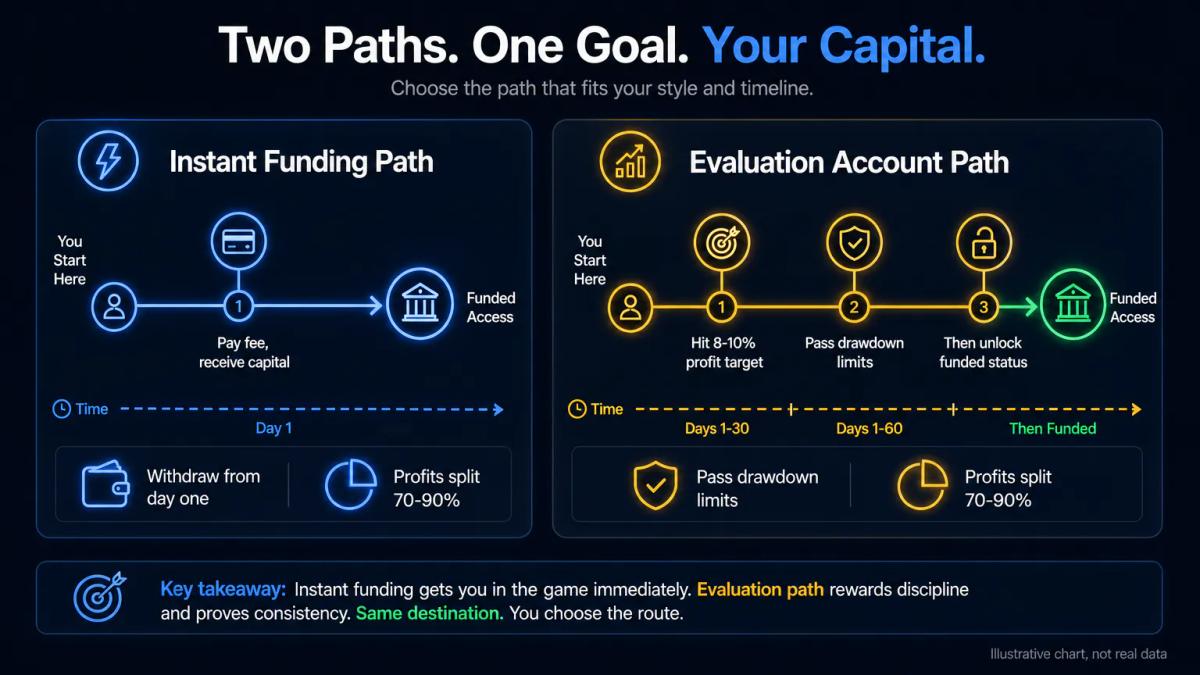
Instant funding accounts skip the challenge phase: you pay a fee, receive allocated capital, and can withdraw profits from your first winning day, subject to the firm's rules. Evaluation accounts ask you to hit a profit target, typically 8 to 10 percent, without breaching drawdown limits, before the firm hands you a funded account. Same-day payout firms, sometimes marketed as instant payout prop firms, offer both routes, and the choice reshapes your economics from day one.
The evaluation path is cheaper at the door. Fees for a challenge on a $10,000 account often run $50 to $100, and if you pass, part of the fee is refunded with your first payout. What you give up is time and calm: an evaluation can eat two to four weeks of screen time, and a single breach of the daily loss cap ends the attempt, forcing you to write off the fee and buy a new challenge to try again.
Instant funding removes that gate. You pay more up front, sometimes several hundred dollars for the same $10,000 allocation, and start trading real or simulated size on day one. Because there is no evaluation, the firm compensates for its higher risk with tighter drawdowns, a lower initial profit split, or a longer minimum holding period before your first withdrawal. Some instant funding programmes also cap your first payout at a smaller amount than later ones, to filter out one-off lucky trades.
Which path fits comes down to your bankroll and your track record. A trader who can already produce a consistent 5 to 10 percent monthly return in a demo will usually find the evaluation the cheaper way to reach real capital, because the refunded fee and the lower entry cost stack in their favour. A trader who cannot afford weeks of unpaid evaluation trading is often better served by instant funding, which buys time at the price of a heavier upfront fee.
Profit splits and payout frequency
Most same-day payout prop firms split profits with the trader on a sliding scale, with 70 to 90 percent going to you and 10 to 30 percent retained by the firm. The exact number depends on the account tier, the length of your track record with the firm, and whether you paid for a higher-split add-on at signup. Some firms advertise 100 percent to the trader on the first payout as an onboarding incentive, then revert to the standard split.
Payout frequency is where firms differentiate. Three patterns are common:
| Payout model | How it works | Typical minimum |
|---|---|---|
| On-demand | Withdraw any time after a cooldown, often 24 hours from account funding or last payout | $50 to $100 |
| Daily batch | Requests submitted before a cutoff are processed the same business day | $100 |
| Weekly | Requests batched every seven or fourteen days | $100 to $200 |
On-demand and daily-batch models are what most firms mean when they market a same-day payout. Weekly is closer to a traditional prop schedule and is included above for comparison.
The split ladder usually improves with performance. A common structure starts at 70 or 75 percent, moves to 80 percent after your account is scaled once, and reaches 90 percent at the top tier. Some firms tie the split to consistency instead of absolute profit, rewarding traders whose largest single day is a modest share of total profits, and that kind of clause quietly discourages one-shot trades. It is worth reading before you commit.
Account scaling and maximum capital limits
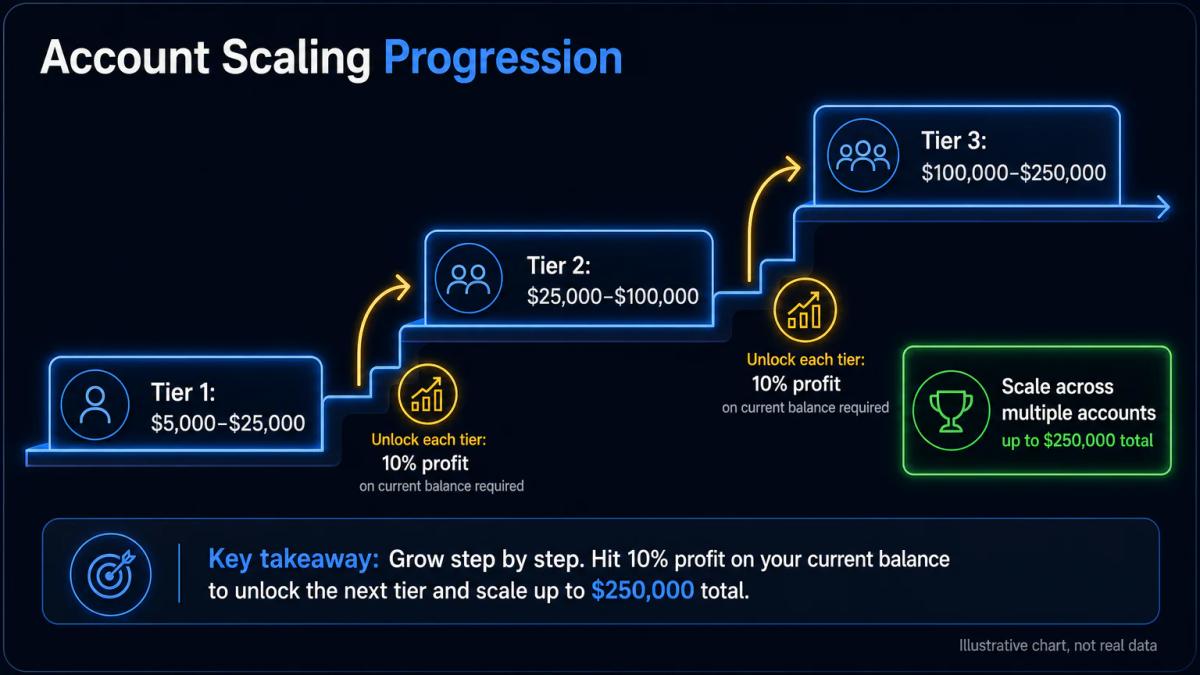
Same-day payout firms scale your account capital based on profitability, letting you grow from an initial allocation, often $5,000 to $25,000, up to $250,000 or more across multiple accounts. Scaling is the mechanism a prop firm uses to reward consistent traders without underwriting an untested one at full size on day one.
Scaling rules vary, but three conditions turn up in most programmes:
- A minimum profit threshold, commonly 10 percent of the current account balance.
- A minimum number of profitable trading days, often four to eight.
- No breach of daily or overall drawdown during that period.
Meet the three and the firm typically raises your allocation by 25 to 50 percent. The step-up repeats until you hit the per-account ceiling, at which point some firms open a second account instead of stretching the first further.
Maximum capital is capped per account and across your total portfolio. A representative structure is an account cap of $200,000 paired with a portfolio cap of $600,000, which lets a trader hold up to three accounts at maximum size but no further. The portfolio cap sets the upper bound of what you can extract from the firm in a single payout cycle, so if you are trading toward a specific income target, work the arithmetic before signing up rather than after.
One detail traders miss is that scaling is optional. A trader who is comfortable at $25,000 and does not want the drawdown volatility of a $100,000 account can simply stay at the smaller size. The firm's requirement is that you trade within the rules; accepting the next tier is your call, not theirs.
Drawdown rules and trading day requirements
Drawdown limits define how much of your account balance you can lose before the firm closes your positions or resets your account. A drawdown is simply the fall from a capital peak to the trough before a new peak. Same-day payout firms enforce these limits strictly because their cash-flow model depends on cutting losers early.
Two caps do most of the work:
| Cap type | Typical range | What triggers it |
|---|---|---|
| Daily drawdown | 4 to 5 percent of starting balance | Realised plus unrealised losses in one trading day |
| Overall drawdown | 8 to 12 percent, trailing or static | Total account equity below the threshold |
A trailing overall drawdown moves up with your profits, locking in gains but tightening as you succeed, while a static drawdown stays anchored to the starting balance for the life of the account. Trailing caps are the stricter of the two and tend to appear at instant funding firms, whereas static caps are more typical of evaluation accounts.
Trading day requirements sit on the other side of the same coin. Some firms require a minimum of four or five trading days per week or per payout cycle to keep the account active, defined as at least one position opened and closed. Others drop the requirement entirely and let you trade as few sessions as you want, provided you stay inside drawdowns. If your strategy naturally trades three or four setups a week, a minimum-day rule can push you into trades you would not otherwise take, which is exactly the behaviour a disciplined trader is trying to avoid.
Withdrawal methods and processing times
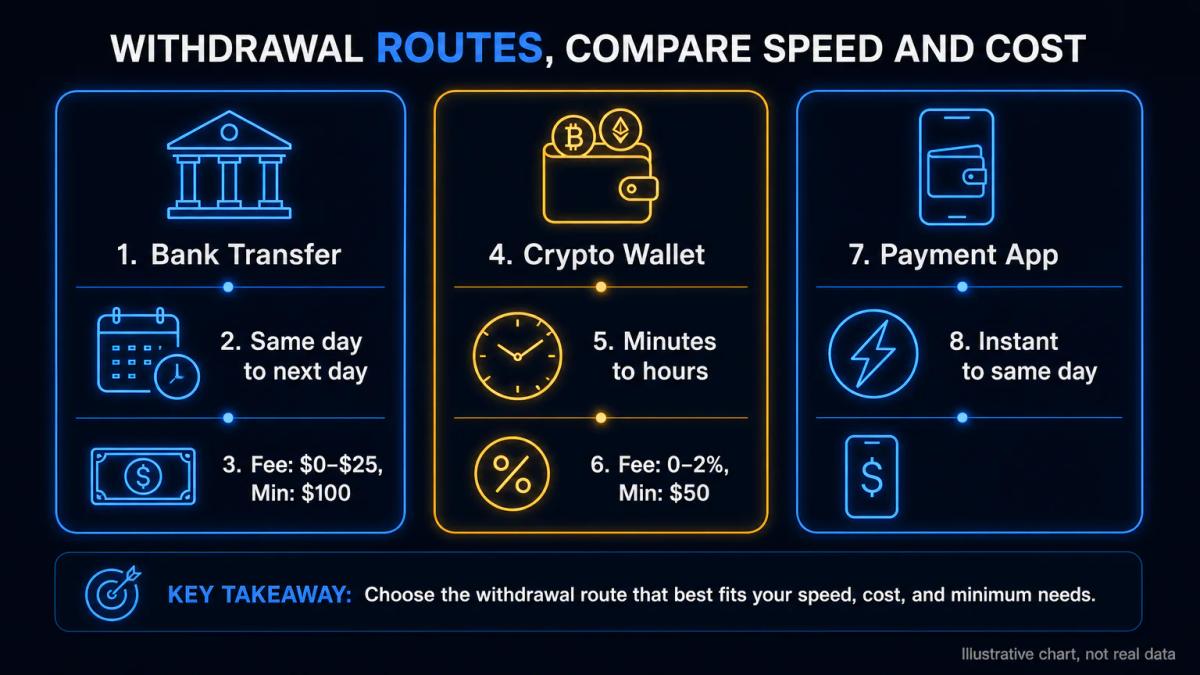
Same-day payout firms typically offer three withdrawal routes: bank transfer, cryptocurrency wallet, and payment apps or e-wallets. Each has a different processing profile, and the fine print on fees and minimums is where the marketing speed can quietly disappear.
| Method | Typical processing | Common fee | Minimum |
|---|---|---|---|
| SEPA or ACH bank transfer | Same day to next business day | $0 to $25 | $100 |
| SWIFT wire | 1 to 3 business days | $25 to $50 | $200 |
| USDT or USDC on-chain | Minutes to 1 hour | Network gas fee | $50 to $100 |
| Payment apps (Wise, Revolut, Skrill) | Minutes to hours | 0.5 to 2 percent | $50 |
Crypto is the fastest route and is why same-day payout firms lean on stablecoins in their marketing. It also introduces a currency step: if the payout is in USDT and you want pounds or euros in your bank, you convert on an exchange and pay a spread on top of the network fee. Bank transfers are slower but land in fiat directly. Payment apps sit between the two on speed and cost, and are useful if you do not want to hold crypto.
Comparing same-day payout firms to traditional prop shops
Where traditional prop shops batch payouts on a weekly or monthly cycle and put traders through longer evaluation periods, same-day payout firms build their whole proposition around speed and quick access to your profit share. The compromise is that same-day firms usually run tighter drawdown rules, ask for higher upfront fees, or accept a slightly lower starting profit split to keep that faster cash flow sustainable.
| Feature | Same-day payout firm | Traditional prop firm |
|---|---|---|
| Payout frequency | Same day to daily | Weekly or monthly |
| Evaluation | Optional or skippable | Usually required, 1 to 2 phases |
| Daily drawdown | 4 to 5 percent | 5 to 10 percent |
| Profit split (starting) | 70 to 80 percent | 50 to 80 percent |
| Signup fee, $10k account | $100 to $300 | $50 to $150 |
| Scaling ceiling | $200,000 to $600,000 | Often uncapped for top traders |
The choice comes down to your cash-flow needs and your trading style. A trader who relies on monthly withdrawals to cover living costs gains a lot from the same-day model, though at the price of stricter risk rules. A trader who can leave profits with the firm and wants the highest possible scaling ceiling may see more capital in a year from a traditional shop with a longer evaluation. Both models solve real problems, and neither is objectively better than the other.
Key risks and considerations before joining
Same-day payout models can encourage overtrading, because cash feels immediately accessible and small profits are easier to lock in than to compound. That tempts traders to close winners early, chase losses to recover the drawdown before the daily cap, and take setups outside their plan. The behavioural cost is often higher than the fee cost.
A practical risk framework for this model has four parameters:
- Fix a maximum loss per day at half the firm's cap, so a bad session ends with room to spare, not with the account frozen.
- Cap position size at a fixed percentage of account equity, 0.5 to 1 percent risk per trade is standard, not at a fixed lot size that scales with your capital.
- Set a minimum holding period per trade for yourself, independent of the firm's rule, to break the reflex of scalping every green candle.
- Withdraw on a schedule you decide in advance, weekly say, not every time a payout button lights up.
Regulatory oversight is the other flag on this model. Prop firms funding retail traders often operate outside the FCA, CFTC or ASIC perimeter, because they use simulated accounts and treat the trader relationship as a service contract rather than a brokerage one. Retail investor protections you would expect from an FCA-authorised broker, such as segregated client funds, FSCS cover and access to the Financial Ombudsman, generally do not extend to a prop firm. Before you fund an account, work through a short due-diligence list on the firm itself:
- The legal entity that would take your money and its country of registration.
- Whether that entity is registered with any financial authority at all.
- What the terms say about dispute resolution, including any arbitration venue.
A firm registered in an offshore jurisdiction with arbitration clauses in a foreign court is operating legally, but your practical recourse if a withdrawal is denied will be limited.
Customer support quality is worth testing before you pay. A live chat that answers a pre-sales question in ten minutes but takes three days to touch a withdrawal ticket tells you something useful. Read independent trader forums for repeat patterns of withdrawal delays, sudden rule changes or accounts closed on technicalities, and give more weight to a story that shows up across many months than to any single complaint.
Tax reporting is your responsibility. In the UK, HMRC generally treats prop firm payouts as trading or miscellaneous income rather than capital gains, because you are trading the firm's capital under a contract, not your own assets; the exact classification depends on the contract structure and your circumstances. In the United States, payouts are typically reported as self-employment or contractor income on a 1099 form if the firm is US-based, and as foreign-source income if it is not. In the EU, treatment varies by country. Keep every payout confirmation, every fee receipt and every account statement, and speak to an accountant familiar with online trading income before your first tax return that includes prop payouts. Getting the classification wrong costs more than the accountant's fee.
Long-term profitability data on prop firm accounts is thin, because most firms do not publish trader retention or success rates and the ones that do have every incentive to flatter the numbers. Any headline pass-rate or profitable-trader percentage you see in marketing material should be treated as unverified. A realistic working assumption is that only a minority of accounts stay funded for more than a few months, which is why fees should be budgeted as a real cost of running the strategy rather than as a deposit you expect to see again.
To compare these rules with a real firm's, the FundedFast review lays them out.
Frequently Asked Questions
How quickly can I withdraw profits from a same-day payout prop firm?
Once your account is eligible, most same-day payout firms process crypto withdrawals within minutes to an hour and bank transfers within the same business day or by the next morning. Eligibility typically requires a cooldown period after account funding (often 24 hours to 14 days depending on the firm) and no active rule breach. Marketing timelines are best-case; check the terms for cutoff times and public holiday exceptions.
Do I have to pass an evaluation before I can access same-day payouts?
No, not necessarily. Instant funding accounts, sometimes called instant payout prop firm accounts, let you skip the evaluation for a higher upfront fee. Evaluation accounts require you to hit a profit target of typically 8 to 10 percent without breaching drawdown limits before you receive a funded account. Both routes can then access same-day payouts, subject to the firm's cooldown and minimum profit rules.
What happens to my account if I hit the drawdown limit?
Breaching a daily or overall drawdown limit almost always closes the account. Some firms offer a paid reset, letting you restore the account to its starting balance for a fee, typically 10 to 30 percent of the original signup cost. Others require you to buy a new account. Any profits withdrawn before the breach are yours to keep; any unpaid pending payouts are usually forfeited under the terms.
Can I scale my account capital with a same-day payout prop firm?
Yes. Most firms scale accounts once you meet a set of conditions: typically a minimum profit of around 10 percent of the current balance, a minimum number of profitable trading days, and no drawdown breaches. Scaling steps of 25 to 50 percent per tier are common, up to per-account ceilings of $200,000 or more, and portfolio ceilings often in the $500,000 to $600,000 range.
Are same-day payout prop firms regulated and safe?
Most operate outside the retail regulatory perimeter of authorities like the FCA, CFTC or ASIC because they use simulated accounts and treat the trader relationship as a service contract. That means retail protections such as segregated client money and ombudsman recourse generally do not apply. Check the firm's legal entity, country of registration, dispute resolution clauses and independent trader feedback on withdrawal history before funding.
About the authors


Put this into practice
Related articles

The Prop Firm Industry Is Overdue for a Shakeout - Here's What Comes Next
The prop firm model is under pressure. Here is what the industry shakeout means for funded traders and how to stay ahead of it.

Trading Stocks and ETFs Under a Funded Account: How It Differs From Futures
A plain-English guide to trading equities and ETFs on a funded account: evaluations, profit splits, drawdowns, fees, taxes and platform choices.

What Is a Funded Trading Account: Definition, Mechanics, and Realistic Expectations
Funded trading accounts let you trade a prop firm's capital after passing an evaluation. Here is how the mechanics, splits, rules and costs really work.
0 comments