


Trading Basics · Advanced · 4 min read
Trader Tax Status Explained: How the IRS Classifies Active Traders
The core difference between trader and investor status
At its heart, this is an IRS classification shaped by case law rather than statute, and it governs how your securities activity is characterised on the return itself. Qualifying traders report deductions on Schedule C and gain access to the Section 475(f) mark-to-market election, which converts trades to ordinary income and lifts the $3,000 annual capital-loss cap. Those who remain investors keep capital-gain character but, since the Tax Cuts and Jobs Act suspended miscellaneous itemised deductions, forfeit most expense write-offs. Because the classification is self-assessed on the return, scrutiny only arrives if the IRS opens an audit, which is where the contemporaneous record either holds up or collapses.
This piece is general information, not tax advice. Confirm your situation with a CPA or Enrolled Agent licensed in your jurisdiction before filing.
Where you trade shapes outcomes as much as the strategy itself; see the best forex brokers and their conditions.
How the IRS decides if you qualify as a trader
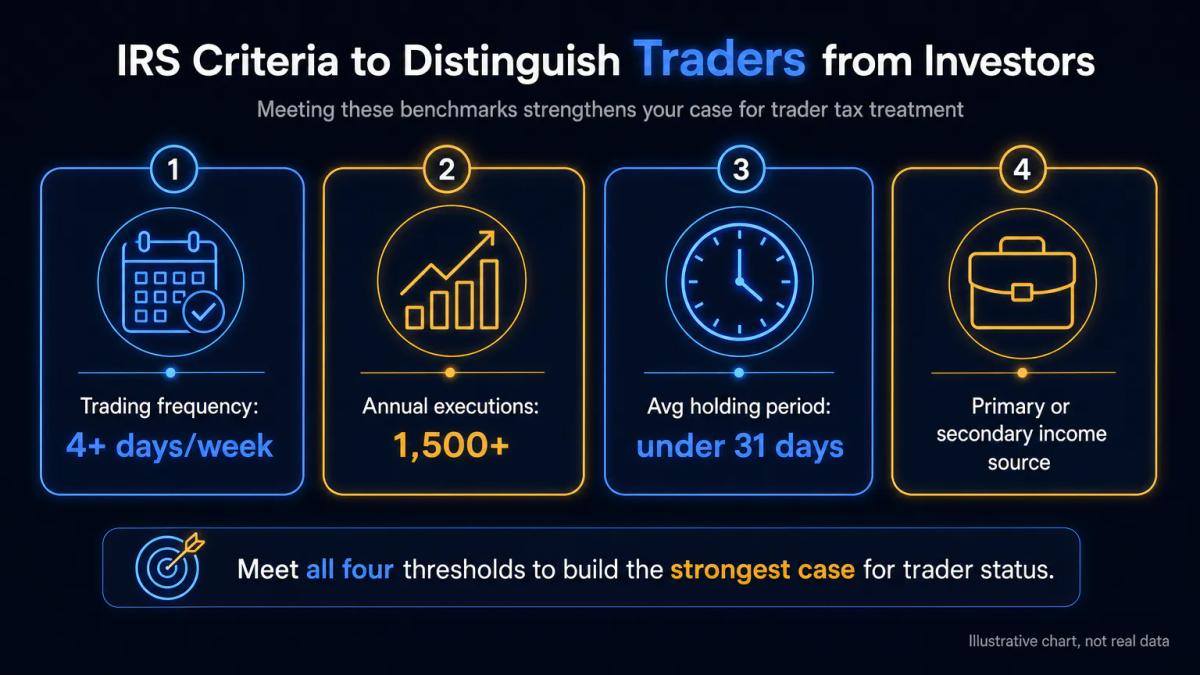
Qualification rests on a two-part test built from case law (Chen, Holsinger, Endicott), with no statutory bright line to lean on. Courts expect a profit motive focused on short-term swings, together with activity that is substantial, regular, frequent and continuous across the year. Practitioner guidance commonly cited in Tax Court opinions points to several markers:
- Roughly four trading days per week
- 1,500+ executions per year
- Average holding periods under 31 days
- Trading as your primary income source or a full-time secondary pursuit
When activity clusters unevenly across the calendar, courts tend to deny the status, as happened in Endicott, where thin months and long gaps undercut the taxpayer's claim of a trade or business.
Factors courts weigh:
- Number of executions and trading days per year
- Average holding period of closed positions
- Hours per week dedicated to trading, research and execution
- Capital at risk and whether equipment, software and workspace resemble a business
- Whether the activity is your livelihood or incidental
Business deductions and mark-to-market accounting
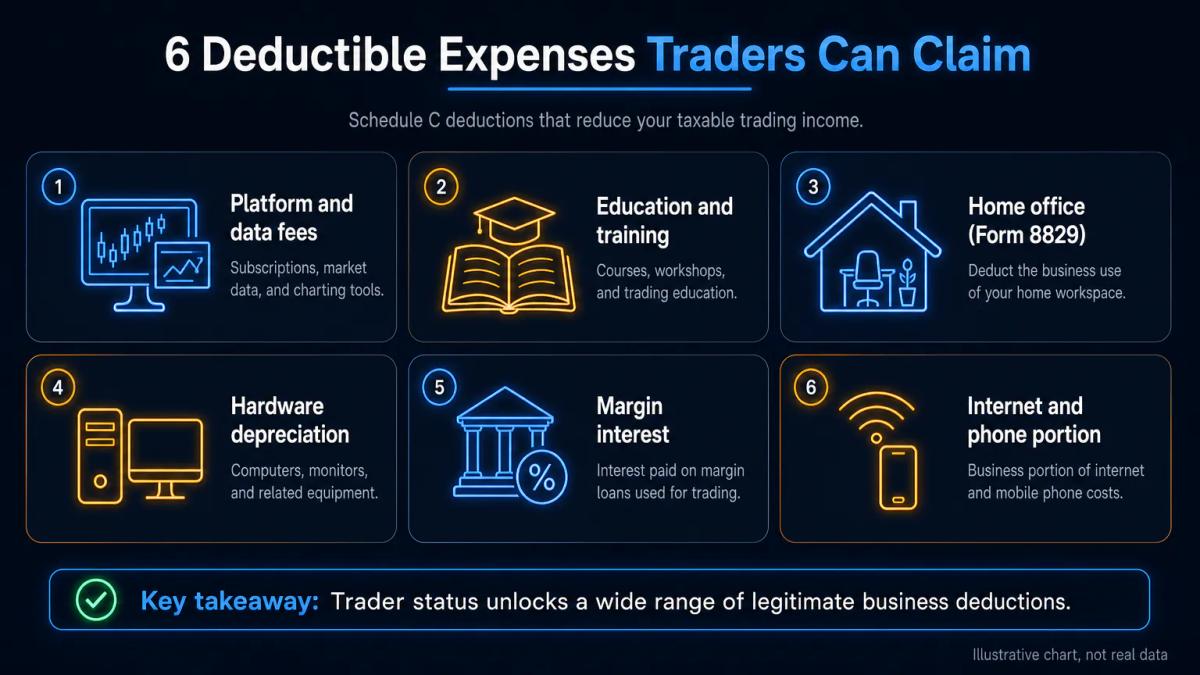
TTS unlocks a wide range of Schedule C deductions tied to the mechanics of a trading business, provided each expense has a clear nexus to current activity. Trading gains themselves stay on Form 8949 and Schedule D unless you make the Section 475(f) election. Deductions commonly claimed include:
- Data feeds, platform fees and Level 2 subscriptions
- Chartroom and research memberships
- Home office under Form 8829
- Depreciation on hardware
- Education tied directly to current activity
- Margin interest on business accounts
- A reasonable portion of internet and phone
The 475(f) election converts trades to ordinary income and loss, eliminates wash-sale deferrals, and removes the $3,000 capital-loss ceiling, which is why so many active traders consider it. Mechanically, the process follows a specific sequence:
- File an election statement with your prior-year return, or with the extension, by April 15.
- Perfect the election by attaching Form 3115 to the first return filed under the new method.
- Mark open positions to fair market value on December 31 of the election year.
Once in place, the election is effectively permanent, and revocation requires IRS consent through another Form 3115, so the decision deserves careful modelling before you commit.
Capital gains treatment and holding periods
Without a 475 election, short-term gains remain ordinary-rate capital gains taxed at your marginal bracket, and positions held over 12 months still qualify for long-term rates of 0%, 15% or 20% depending on your taxable income band, plus the 3.8% net investment income tax where it applies. Because TTS does not sweep every position into business income automatically, long-term holdings should sit in a clearly labelled investment account so that long-term treatment is preserved. Section 1256 contracts keep their 60/40 split regardless of TTS, unless you fold them into a 475 election, which most traders deliberately leave out of scope.
Documentation and record-keeping for IRS defence
An audit defence that is built only after the IRS writes rarely survives, so the records need to be contemporaneous and consistent across the year. At a minimum, the paper trail should include:
- A trade blotter logging date, instrument, entry, exit, size and rationale
- Archived broker 1099-Bs, confirmations and monthly statements
- A calendar showing trading days and hours
- Receipts for every Schedule C expense line
Common audit triggers:
- Schedule C with large losses and no gross receipts line (expenses only)
- Thin trade count paired with aggressive home-office or vehicle deductions
- Section 475 elected late or without a Form 3115 perfecting statement
- TTS claimed in a year dominated by a single large position held months
On the self-employment side, TTS gains are generally not treated as self-employment income, which means Schedule SE is not filed on trading profits. That exclusion carries a practical consequence: those profits cannot anchor Solo 401(k) or SEP-IRA contributions, which require separate earned income from another trade or business.
State treatment adds another layer of complexity, since not every state conforms to federal elections or classifies Schedule C and Schedule D income the same way. Consider a trader resident in California, New York or New Jersey: should the state refuse to honour a Section 475(f) election, or tax the Schedule C net on a different basis from Schedule D, the federal result can shift at the state line. Confirm conformity with a professional licensed in the relevant jurisdiction before relying on a federal outcome.
To see these conditions applied by a regulated broker, read our Fusion Markets review.
Frequently Asked Questions
What is the difference between trader and investor tax status?
Investors report on Schedule D with the $3,000 annual capital-loss cap and lost most expense deductions after TCJA. Traders file Schedule C for business expenses, keep Schedule D for gains unless they elect 475(f), and can convert to ordinary loss treatment without the cap.
How many trades per year do you need to be classified as a trader?
There is no statutory threshold. Tax Court cases cluster around 1,500+ executions and roughly four trading days per week spread evenly across the year, combined with short average holding periods and substantial time commitment. Low volume or seasonal activity typically fails.
Can you deduct trading losses if you are classified as a trader?
Without 475(f), losses remain capital and the $3,000 annual deduction against ordinary income still applies, with the excess carried forward. With a valid 475(f) election, trading losses are ordinary and fully deductible against other income in the year incurred.
What is the Section 475 mark-to-market election and how does it work?
Section 475(f) requires valuing open positions at fair market value on December 31 and treating gains and losses as ordinary. File an election statement by April 15 of the election year (or with a timely extension), then attach Form 3115 to that year's return to perfect the change in accounting method.
Do you have to pay self-employment tax if you are a trader?
No. Trading profits of a TTS trader are not self-employment income, so no Schedule SE and no SE tax on gains. The flip side is that those profits do not count as earned income for Solo 401(k), SEP-IRA or IRA contributions, which require separate compensation.
About the authors


Put this into practice
Brokers we have reviewed
Scored on the same five dimensions. Here are three of them — the full list is on the brokers page.



Related articles
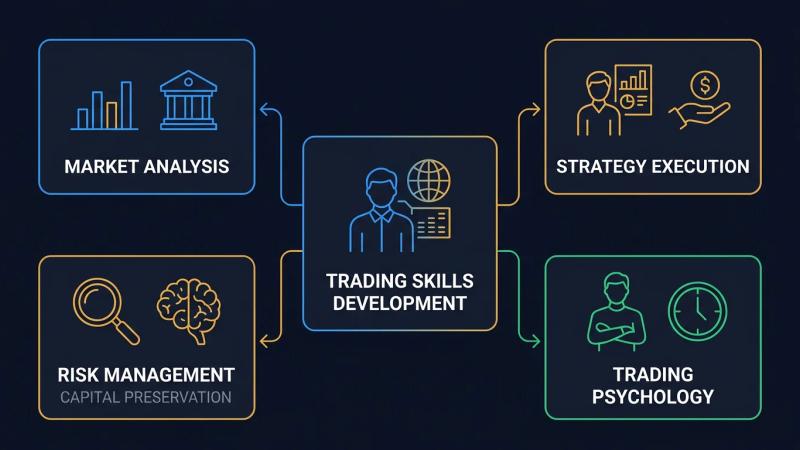
Trading Skills Development: How to Become a Better Trader
A practical guide to trading skills development: the hard skills, the soft skills, the psychological barriers, and a structured routine to build both.

TradingView Tutorial: How to Use Technical and Fundamental Analysis Together
Learn how to use TradingView for both technical and fundamental analysis in one unified workflow. Setup, tools, and tips included.
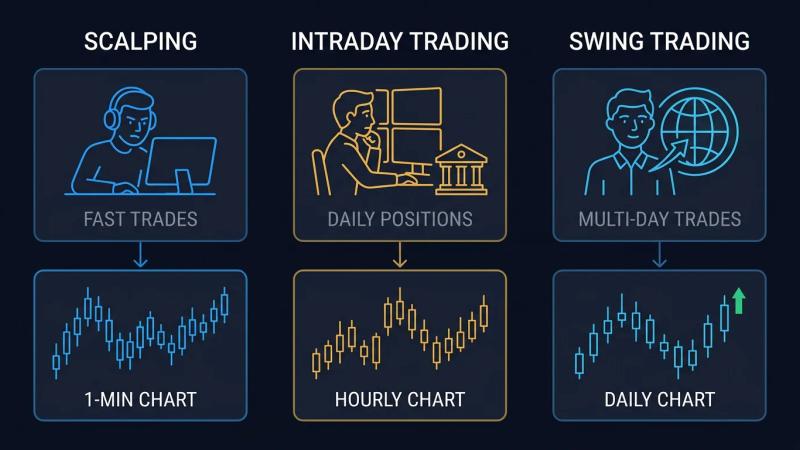
Types of Traders: Timeframe, Strategy, and Frequency Explained
A practical guide to the main types of traders, from scalpers to position traders, with the capital, technology, tax, and regulatory factors that shape each one.
0 comments