



Trading Basics · Beginner · 9 min read
What Does Short Selling Mean: Definition, Mechanics, and Risks
The core mechanism: selling what you don't own
At its simplest, short selling is a bet on a price drop that uses borrowed inventory to make the bet possible. A trader asks the broker to borrow a security, sells it on the open market at today's quote, and plans to repurchase the same quantity later at what will hopefully be a cheaper level before handing the asset back to the lender. Profits appear when the price falls between those two transactions, and losses accumulate when the price moves the other way. Shares are the most common instrument, though bonds, commodities and currency pairs follow the same core logic even if the plumbing underneath differs.
Traders use short selling for two purposes:
- Speculation: you think a stock, an index or an instrument is overvalued and you position for a drop.
- Hedging: you already own a correlated asset and you open a short to neutralise part of its downside while you decide what to do.
Boiled down, the sequence is a sale today and a repurchase tomorrow, with the trade succeeding whenever the gap between those two prices runs in the trader's favour. The mechanical contrast with a normal purchase comes from three places at once: the broker has to source the asset before anything can be sold, collateral has to be posted and kept topped up while the position stays open, and the account carries a liability (the shares owed to the lender) until the moment the position closes.
If you still need a broker, our guide to the best forex brokers compares the regulated options side by side.
How a short position works step by step
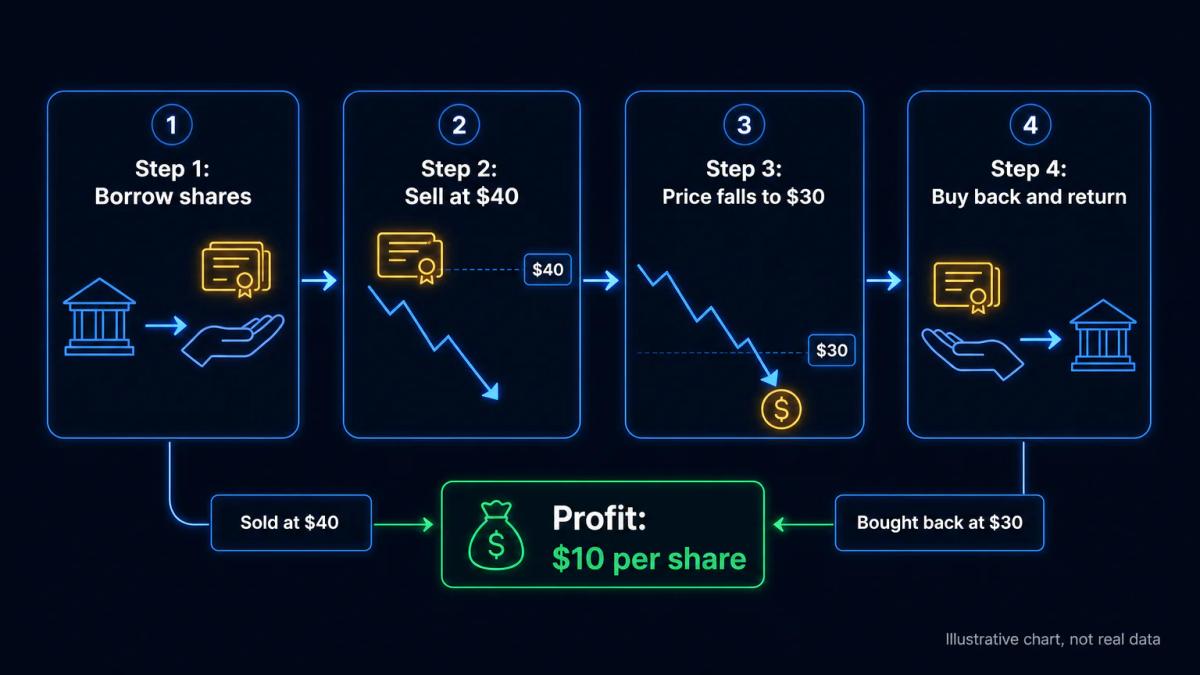
A short sale is a sequence of operations that your broker handles behind a single click, and it is useful to see each step on its own.
- You place a sell order to open. You instruct the broker to short, say, 100 shares of a company trading at $40.
- The broker locates the shares. It borrows them from its own inventory, from a margin account of another client who agreed to lend, or from an institutional pool. If no shares can be located, the trade is rejected.
- The broker sells the borrowed shares on the market. The $4,000 in proceeds lands in your account as cash, but it is restricted: it collateralises the position, not spending money.
- You post margin. Your account must hold additional equity on top of the proceeds to absorb losses if the price rises. This is the initial margin.
- You wait, paying the carrying costs. Each day you hold the short, you pay a borrow fee and owe any dividends the company declares.
- You close by buying back (covering). You buy 100 shares on the market and the broker returns them to the lender. The position is flat.
Your profit or loss is the sale price minus the cover price minus the fees. If you shorted 100 shares at $40 and covered at $32, your gross would be $800; borrow fees and any dividend you had to pay reduce the net.
Why short selling carries unlimited loss potential
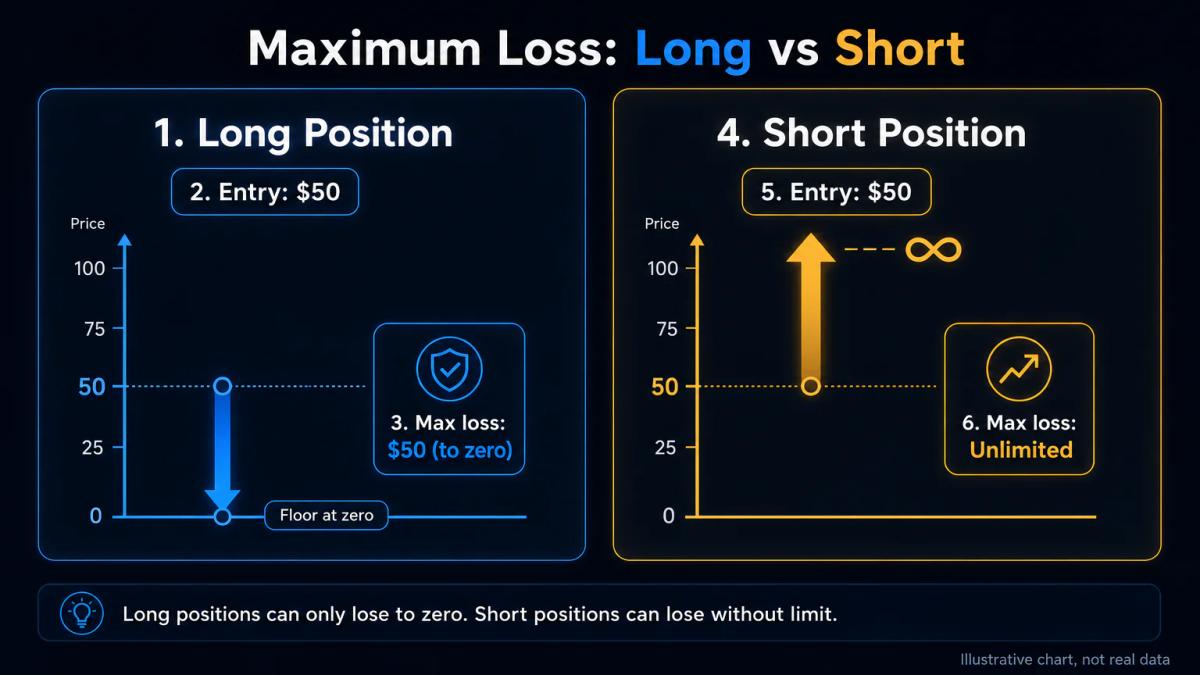
Understanding the asymmetry between a long trade and a short trade is probably the single most important idea in this entire topic, because it shapes everything from position sizing to stop placement to the psychological pressure a losing trade creates.
| Position type | Entry price | Theoretical maximum loss | Theoretical maximum gain |
|---|---|---|---|
| Long (buy) | $50 | $50 per share (price to 0) | Unlimited (price can rise forever) |
| Short (sell) | $50 | Unlimited (price can rise forever) | $50 per share (price to 0) |
A buyer faces a floor at zero, since the worst case for a long position is a bankrupt company and shares worth nothing at all. A short seller, by contrast, operates under a very different ceiling, because an open-ended rally can push the share price arbitrarily high and every dollar of that climb adds a dollar to what the trader owes per share. If you short at £50 and the stock reaches £500 before you cover, you lose £450 per share, nine times your original exposure.
This asymmetry is why position sizing on a short usually sits well below the equivalent figure on a long trade. A trader who routinely risks around 1% of equity on a long entry will often cut that number substantially before opening a short, and will also set a hard buy-stop (an order to cover automatically if the price rises to a trigger level) at the moment the short goes on, so that the exit is already defined by the time the market has a chance to turn.
Margin calls and forced liquidation
Short selling always runs through a margin account, which is a brokerage account that lets you trade with borrowed funds and borrowed assets, backed by collateral you deposit. Every short carries two margin numbers: initial margin, the equity you need to open the position, and maintenance margin, the minimum equity you must keep while it is open.
A rising stock chips away at your equity through unrealised losses, and once that equity drops below the maintenance level, the broker issues a margin call, giving the trader a narrow set of options: send in extra cash, close part of the position voluntarily, or stand aside while the broker closes it on the trader's behalf. Forced liquidation happens at whatever the market price happens to be, which during a sharp rally tends to be the worst available price of the day. One of the quickest ways to turn an uncomfortable short into a catastrophic one is to meet that first margin call with fresh collateral and leave the losing position fully open.
Short squeeze: when shorts get trapped
A short squeeze happens when a heavily shorted stock starts rallying, forces short sellers to buy back shares to limit their losses or meet margin calls, and that forced buying pushes the price up further, triggering more covers. The feedback loop can last hours or days and can multiply a stock's price well beyond anything fundamentals justify.
Two historical episodes illustrate the pattern vividly. In October 2008, Volkswagen's share price briefly made it the world's most valuable listed company after Porsche disclosed a near-total controlling stake and the free float collapsed, trapping shorts who simply could not find shares to buy back at any reasonable price. January 2021 then produced the GameStop episode, when the stock ran from roughly $20 to over $400 inside a few weeks as a retail-driven buying wave collided with heavily concentrated short interest. In both situations, the takeaway comes down to the same point: whenever short interest represents a large slice of the float and liquidity sits on the thin side, traders face a disorderly exit on top of the usual drawdown risk.
Regulatory rules and restrictions on shorting
Short selling is legal across most developed markets, though it operates inside a fairly specific rulebook that varies by jurisdiction. The main regimes break down roughly as follows:
- United States: Regulation SHO requires a broker to have a reasonable basis to believe shares can be located before executing a short, and an alternative uptick rule limits short selling in any stock that has already fallen 10% intraday.
- United Kingdom: the regime administered by the Financial Conduct Authority requires disclosure of net short positions above defined thresholds and prohibits uncovered (naked) shorting in listed shares and sovereign debt.
- European Union: the Short Selling Regulation applies parallel rules on disclosure thresholds and on naked shorting of equities and sovereign bonds.
During severe market stress, regulators have temporarily banned short selling on specific stocks or whole sectors, as happened to European and American financial shares in 2008. Retail traders face further practical limits set by the broker: some securities are flagged hard-to-borrow or no-borrow, some accounts are blocked from shorting entirely, and leverage caps differ by asset. UK retail clients onboarded through FCA-authorised brokers face caps of 1:30 on major forex, 1:20 on major indices and 1:5 on individual equities, and CFDs on crypto are prohibited for UK retail by the FCA.
Borrow costs and fees eat into your profit
Holding a short position comes with a running tab that the broker tallies behind the scenes. The borrow fee is quoted as an annual percentage of the position's market value and debited daily to the account. Rates on liquid large-cap stocks often sit at a fraction of 1% a year, whereas a crowded short in a small-cap can see its rate climb into double digits, and extreme cases have been known to run above 100% annualised when demand to borrow outstrips available inventory.
On top of that, you owe any dividend the company pays while your short is open, because the real owner of the lent shares still expects their income. If a stock is reclassified as hard-to-borrow, the broker can raise the rate at short notice. Suppose you short 1,000 shares at $20 for 30 days at a 15% annual borrow rate and the company pays a $0.10 dividend; the borrow costs roughly $246 and the dividend $100, so you owe about $346 before you even measure the price move.
Alternatives to direct short selling
Direct shorting represents only one way of positioning for a fall, and several alternative instruments can deliver similar directional exposure while altering the cost structure, the maximum loss or the amount of leverage involved.
| Instrument | How you position for a fall | Maximum loss | Main cost | Typical use |
|---|---|---|---|---|
| Short stock | Borrow and sell | Unlimited | Borrow fee, dividends owed | Direct bet on a specific company |
| Put option | Buy the right to sell at a fixed price | Premium paid | Option premium, time decay | Defined-risk bearish bet, hedge on a long |
| Inverse ETF | Buy a fund engineered to move opposite to an index | Amount invested | Expense ratio, daily rebalancing drag | Short-term bearish view on an index |
| Bear put spread | Buy a put and sell a lower-strike put | Net premium paid | Option premiums | Targeted bearish view with a cap on reward |
| CFD or spread bet on short side | Open a sell CFD on the asset | Potentially larger than deposit | Spread, overnight financing | Leveraged short exposure for retail accounts |
Short selling in forex and commodities does not need a borrow at all: a currency pair is quoted as the price of one currency in another, so selling EUR/USD is mechanically identical to buying USD/EUR, and commodity futures let you sell a contract directly without locating a physical barrel or ounce. Bonds behave more like equities for the purpose of shorting, with a repo market providing the lending leg.
Whichever route a trader chooses, the psychological profile is distinct from going long. Because losses on a short can accelerate rapidly during a sustained rally, beginners should treat a few habits as non-negotiable: a clear plan for when to cut, a fixed buy-stop level set before the position opens, and a position size noticeably smaller than its long equivalent.
To see these conditions applied by a regulated broker, read our Tradu review.
Frequently Asked Questions
Can you short sell any stock, or are there restrictions?
No. The broker must first locate shares to borrow, and if none are available the trade is rejected. Some securities are flagged hard-to-borrow with high fees, some are blocked entirely, and regulators sometimes impose temporary bans on specific sectors during market stress, as happened to financial stocks in 2008. Small-cap, illiquid and recently listed stocks are the most common restrictions you will meet.
What is the difference between short selling and buying put options?
Direct short selling has unlimited loss potential and daily borrow costs, but there is no expiry: you can hold as long as margin allows. A put option gives you the right, not the obligation, to sell at a fixed strike price by a fixed date. Your maximum loss is the premium you paid, but the option loses value with time (time decay) and expires worthless if the drop does not arrive by expiry.
How do you calculate profit and loss on a short position?
Gross profit is (sale price minus cover price) multiplied by the number of shares. From that you subtract the accumulated borrow fee, any dividends you had to pay while the position was open, and the commission on both legs. If you sold 200 shares at $50 and covered at $42, gross is $1,600; a $30 borrow fee and $20 commissions leave a net of around $1,550.
What happens if a company you shorted goes bankrupt?
If the shares are delisted and worth effectively zero, you reach the maximum profit on a short, which equals your sale price times the number of shares. The broker typically closes the position at or near zero and returns the collateral. In practice, trading is often halted first, and the exact mechanics depend on the jurisdiction and whether the company is reorganised rather than liquidated.
Is short selling illegal or unethical?
Short selling is legal in most developed markets and plays a role in price discovery by letting participants express a negative view. Specific practices are restricted, such as naked shorting in UK and EU listed shares, and regulators can suspend shorting on named securities during stress. Market manipulation (spreading false information to drive a price down and then cover) is illegal everywhere, whether the position is long or short.
About the authors


Put this into practice
Brokers we have reviewed
Scored on the same five dimensions. Here are three of them — the full list is on the brokers page.



Related articles
What Is a Pip in Forex: Definition, Calculation and Trading Examples
A pip is the smallest standard price movement in a forex pair. This guide explains pip value, the yen exception, pipettes and how to size trades with pips.
What Is a Ticker Symbol? How Stock Codes Work
A ticker symbol is the short code that identifies a stock on an exchange. Here is how to read them, find them, and avoid costly mix-ups when you trade.
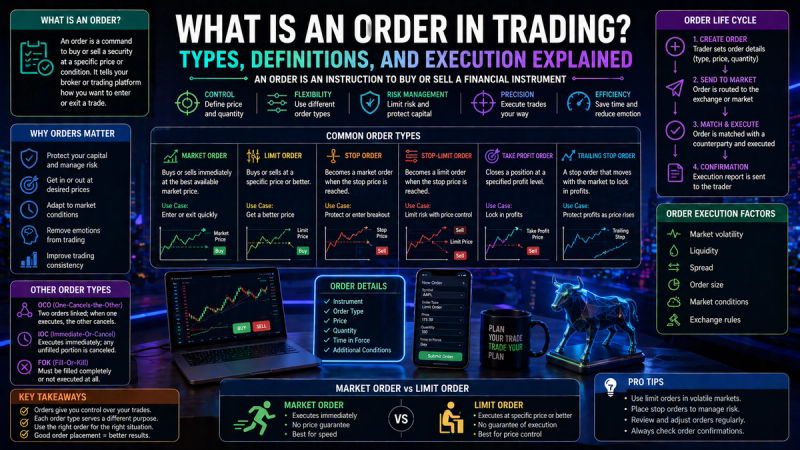
What Is an Order in Trading? Types, Definitions, and Execution Explained
Learn what Is an order in trading, explore every major order type from market to stop-limit, and understand how execution works. A guide for beginners.
0 comments