



Trading Basics · Beginner · 7 min read
What Is a Ticker Symbol? How Stock Codes Work
The smallest code, the biggest identifier
A ticker symbol lets you find, track, and trade a specific stock instantly without confusion. It is a unique alphabetic code assigned to a publicly traded security that identifies it on an exchange or broker. It For retail traders, the correct ticker is non-negotiable: one wrong letter, and you buy the wrong company.
Think of the ticker as the postal address for a listed share. The company name is the label people recognise, but the ticker is what your broker's order system and the exchange's matching engine actually read.
A security (any tradable financial instrument, such as a share, bond, or fund) can trade on more than one exchange, and each listing has its own ticker. That is why searching by name alone can be misleading, and why professional workflows always confirm the ticker before an order is placed.
Choosing where to trade matters as much as the strategy; see the best forex brokers and their conditions.
How ticker symbols work on exchanges
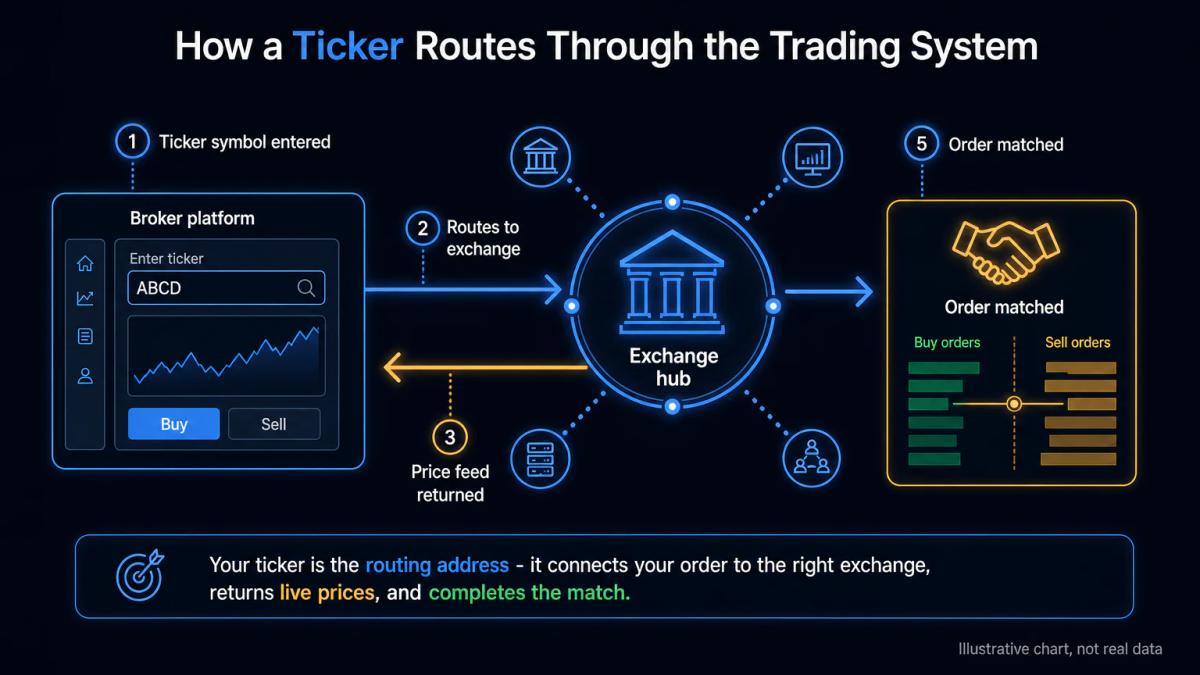
Ticker symbols function as the trading system's address for each security. Type a ticker into your broker's platform or a charting tool, and the system routes your order to the correct listing and pulls the matching price feed.
The format varies by exchange: US shares use 1 to 5 letters on NASDAQ or NYSE, UK shares add a dot and exchange code (for example, HSBA.L for HSBC on the London Stock Exchange), and other regions follow their own conventions. Different markets structure their codes differently, which is why forex vs stocks trading requires you to understand how each venue assigns identifiers.
Exchanges control which tickers exist. In the US, NASDAQ and NYSE assign tickers under rules published by the exchange and overseen by the Securities and Exchange Commission (SEC).
In the UK, the London Stock Exchange assigns the local code, and the Financial Conduct Authority (FCA) supervises the wider listing regime. A company can request a specific ticker (Ford famously holds F), but it must be free and must comply with the exchange's naming rules.
When a security is delisted, the ticker is retired and can, after a waiting period, be reassigned to another issuer.
Why ticker tape machines started it all
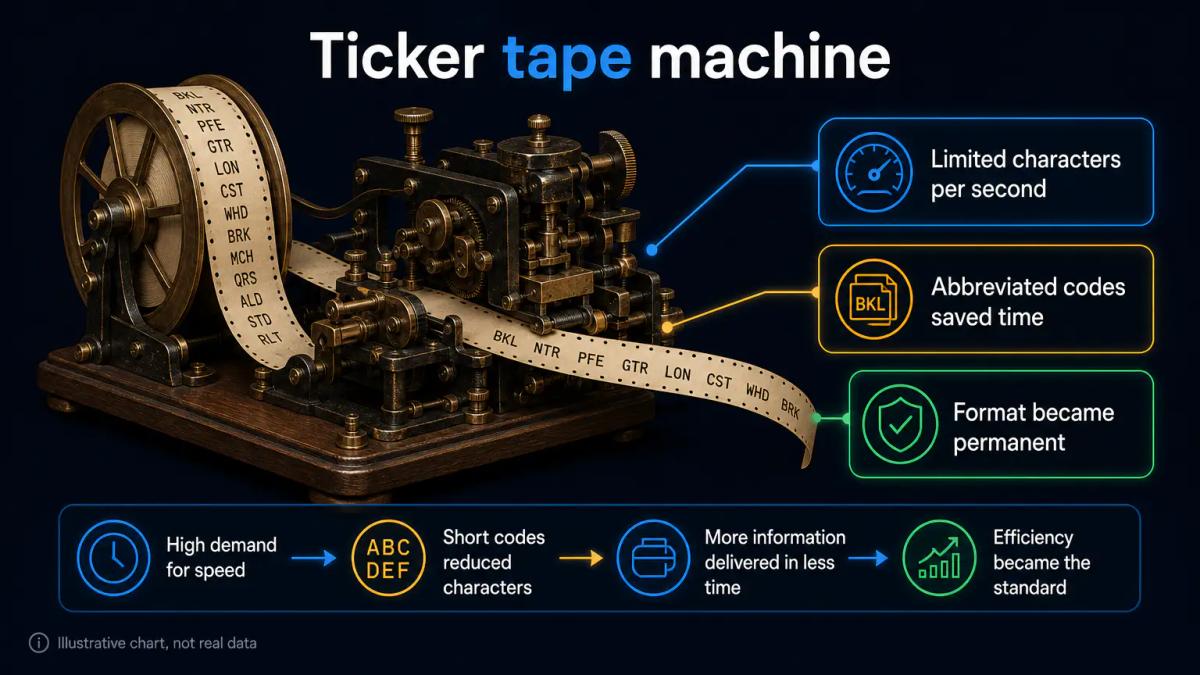
Ticker symbols originated in the 1800s, when stock prices were transmitted via telegraph and printed on paper tape by mechanical ticker machines.
The machines could only print a few characters per second, so exchanges abbreviated company names into short codes to save time and paper. That efficiency constraint became permanent: even though digital systems no longer need it, the short-code format stuck because traders and systems worldwide rely on it.
The name gives away the story. The rhythmic clicking of the printer as prices arrived from the trading floor was the ticker sound, and the paper strip it produced was the ticker tape. Once every broker's office in New York wired itself to the same feed, the tickers became a shared language.
Modern trading systems inherited that language wholesale, because rewriting it would break every price database, index rulebook, and settlement instruction ever written.
Finding and using ticker symbols in practice
To find a ticker symbol, search the company name on your broker's platform, on Google Finance, on Yahoo Finance, or on the exchange's official website.
Most brokers auto-complete as you type, so you rarely need to memorise codes. Once you have the correct ticker, use it to place trades, set up price alerts, pull historical data, or compare charts side by side.
Always double-check the ticker before you trade, especially if several companies have similar names or if you are trading across different exchanges, where the same company may carry different tickers.
Learning how to become a trader includes mastering these fundamental verification steps.
A short step-by-step keeps you safe.
- First, type the full company name into your broker's search box and note the result the platform highlights.
- Second, cross-check the ticker on the exchange's own website (LSE for London, NASDAQ or NYSE for US listings) to confirm the listing venue.
- Third, look at the currency shown next to the price: a Sterling price on London is a different instrument from a Dollar price on New York, even for the same underlying company.
- Fourth, before you submit, read the order confirmation slowly: ticker, side, quantity, order type.
This four-step check takes fifteen seconds and prevents the most common retail mistake, buying the wrong listing of a dual-listed company.
Regional ticker formats and what they mean
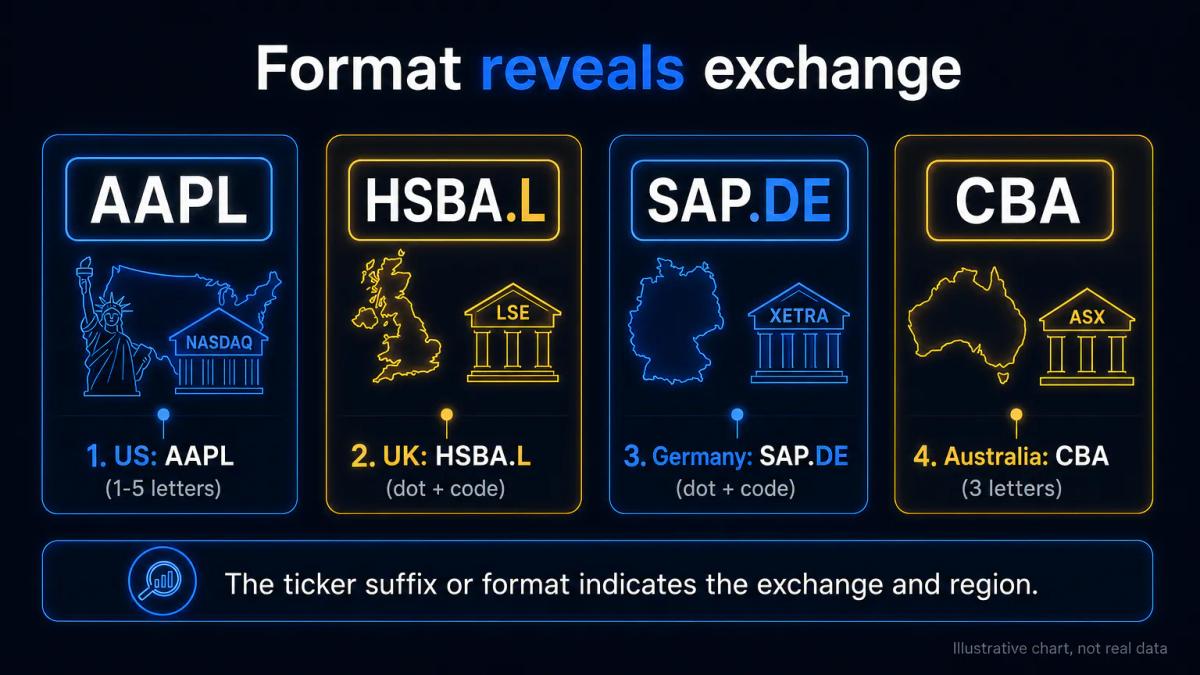
Ticker symbol format depends on the exchange and the country.
- US shares use 1 to 5 uppercase letters (AAPL for Apple, TSLA for Tesla).
- UK and European shares often append a suffix: HSBA.L for London, SAP.DE for Deutsche Börse, or ASML.AS for Amsterdam.
- Australian shares use 3 letters (CBA for Commonwealth Bank).
Understanding the format helps you spot which exchange a stock trades on and avoids confusion when comparing prices across regions. When you compare stocks vs indices, you'll notice how each asset class and region uses its own naming convention.
| Region | Example ticker | Company | Format rule |
|---|---|---|---|
| US (NASDAQ / NYSE) | AAPL | Apple | 1 to 5 letters, no suffix |
| UK (LSE) | HSBA.L | HSBC Holdings | Letters plus .L suffix |
| Germany (Xetra) | SAP.DE | SAP | Letters plus .DE suffix |
| Netherlands (Euronext Amsterdam) | ASML.AS | ASML | Letters plus .AS suffix |
| Australia (ASX) | CBA | Commonwealth Bank | 3 letters |
| Japan (TSE) | 7203.T | Toyota | 4-digit number plus .T |
What happens when ticker symbols change
Ticker symbols can change due to mergers, acquisitions, bankruptcies, or corporate rebranding.
When a company is acquired, its ticker may be delisted and replaced with the acquirer's ticker. When a company rebrands, the exchange may assign a new code. Historical price data usually stays linked to the old ticker, but your broker may need time to update its systems.
If you hold a position in a stock that changes tickers, your broker handles the transition automatically, though you should verify the new ticker to avoid trading errors. Understanding trading halts explained gives you context for how exchanges manage these corporate actions and market disruptions.
Real examples make the pattern concrete. When Facebook rebranded to Meta Platforms in 2022, its ticker moved from FB to META on NASDAQ. When Google restructured under Alphabet in 2015, GOOG was joined by GOOGL for the voting share class.
Bankruptcies are messier: a delisted issuer often ends up on an over-the-counter market with a Q added to its old ticker, warning traders that the shares are in bankruptcy proceedings. If you see an unfamiliar suffix on a code you used to trade, stop and check the corporate action history before placing another order.
Ticker symbols beyond stocks
Ticker symbols are not limited to equities. Exchange-traded funds (ETFs, funds that trade on an exchange like a share and track an index or basket of assets) have their own tickers: SPY tracks the S&P 500, and VUSA is a Sterling-denominated S&P 500 ETF listed in London.
Bonds, commodities futures, and derivatives also use ticker-like codes, though the format differs. Gold futures on the CME trade as GC, and Brent crude futures on ICE trade as B.
Learning about types of ETFs will show you how these funds use tickers just like stocks do. If you trade multiple asset classes, learn each naming convention: it prevents costly mistakes and speeds up order entry when the market is moving.
Frequently Asked Questions
What is the difference between a ticker symbol and a company name?
The company name is the label the public recognises; the ticker symbol is the short exchange code that trading systems use to identify a specific listing. Two companies can share similar names, and a single company can have several tickers if it lists on more than one exchange, so the ticker is the precise identifier and the name is not.
How do I find the ticker symbol for a company I want to trade?
Type the company name into your broker's search bar, into Google Finance, or into Yahoo Finance, and confirm the result on the exchange's own website. Check that the currency and exchange match the market you want to trade, because dual-listed companies carry different tickers on different venues.
Can two companies have the same ticker symbol?
Not on the same exchange, but the same letters can be reused on different exchanges around the world, and a retired ticker can be reassigned to another issuer after a waiting period. This is why you must always match the ticker to a specific exchange, not just to a set of letters.
What happens to my holdings if a company's ticker symbol changes?
Your broker migrates the position to the new ticker automatically, and the number of shares you own does not change if the change is a pure rebrand. If the change is caused by a merger or acquisition, the corporate action determines whether you receive shares in the acquirer, cash, or a mix. Check your account statement after the effective date.
Are ticker symbols the same on every exchange worldwide?
No. Each exchange assigns its own tickers under its own rules, so the same company can trade as different codes in different countries. Suffixes such as .L for London or .DE for Xetra indicate the exchange, and Japanese listings use four-digit numeric codes instead of letters.
About the authors


Put this into practice
Brokers we have reviewed
Scored on the same five dimensions. Here are three of them — the full list is on the brokers page.



Related articles
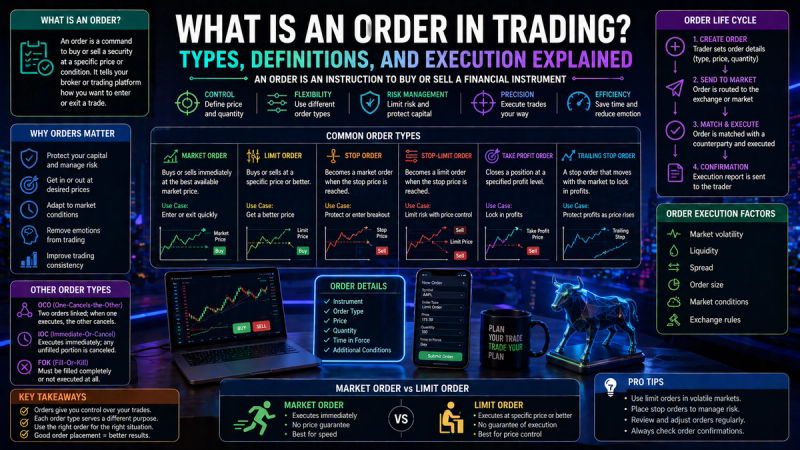
What Is an Order in Trading? Types, Definitions, and Execution Explained
Learn what Is an order in trading, explore every major order type from market to stop-limit, and understand how execution works. A guide for beginners.
What is an offshore broker: regulation, leverage, and account setup
A plain-English guide to offshore brokers: what they are, how their regulation differs from domestic firms, and the leverage, cost and tax trade-offs you accept when you open an account.
What is liquidity in forex: how it affects your trades
A plain-English guide to forex liquidity: what it is, how it moves your spreads, when it dries up, and how to size and time trades around it.
0 comments