



Trading Basics · Beginner · 7 min read
What is a requote in trading: why it happens and how to respond
The smallest gap between order and execution
In practical terms, a requote is the message that pops up when the price you clicked has already shifted by the time your broker tries to fill the order. The platform then shows you a fresh number and waits for you to confirm, decline, or hold off for another quote. This almost always involves market orders (instructions to buy or sell immediately at the best available price), where even a fraction of a second between your click and the broker's handshake with a liquidity provider (the bank or venue supplying the price) can be enough for the original quote to vanish from the book.
For a beginner, the useful framing is mechanical rather than suspicious. A requote reflects the ordinary friction of trading on live, moving prices through an intermediary, and its frequency, as well as the fairness of the new price offered, depends on the broker you use, the platform you trade on, and the moment you place the order.
Putting this into practice means opening an account: start with the best forex brokers our team reviewed.
Why requotes happen during volatile markets
Volatility is the main engine behind requotes. When price moves fast, the bid-ask spread (the gap between the buy price and the sell price) widens, and the liquidity available at any single price thins out. The exact quote you saw a moment ago no longer sits on the book by the time your order reaches the liquidity provider, so the broker returns a new price for your approval.
Several conditions make this more likely:
- Scheduled news releases, such as central bank decisions or employment data, when prices jump in milliseconds.
- Market opens and closes, especially the London and New York sessions in forex, when flows surge and spreads reset.
- Thin instruments, like exotic currency pairs or small-cap CFDs, where only a few providers quote and depth is shallow.
- Weekend gaps, when Monday's opening price can sit far from Friday's close.
During calm sessions on major pairs, requotes rarely show up at all. By contrast, in the first seconds after a US CPI print, they can become routine for anyone sending market orders through a dealing-desk broker.
Broker execution quality and liquidity constraints
Broker execution quality varies sharply: a firm with direct connections to multiple tier-1 liquidity providers and modern order routing fills most market orders at or very near the clicked price, because the round trip from your platform to the venue and back is measured in milliseconds. A broker running a dealing desk, with fewer providers or older infrastructure, has a longer window in which the price can drift, so it returns more requotes.
Execution model shapes the experience as much as speed does. Market makers (brokers that quote prices from their own book) often lean on requotes as a risk control, since asking you to confirm a new price lets them avoid filling an order that has already moved against them. With STP (Straight-Through Processing) and ECN (Electronic Communication Network) brokers, your order is routed to external liquidity, where fills usually come with some slippage (a difference between requested and executed price) rather than a formal requote. There is a commission to pay for that routing, although the manual re-approval step tends to disappear.
How requotes affect your trading outcomes
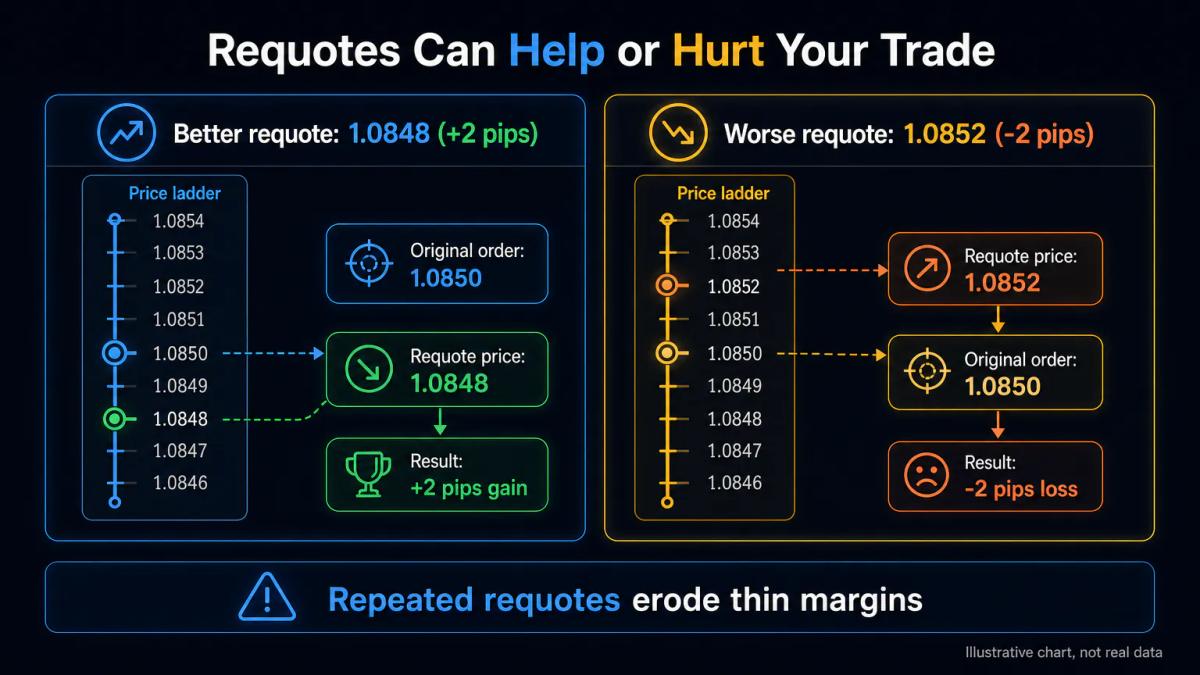
A requote cuts both ways. Should the new price land better than the one you clicked, your entry improves; if it comes in worse, your entry degrades and your eventual profit or loss shifts by that amount. The effect on any single trade is modest, yet for scalpers (traders who open many positions for a few pips each) and for news traders, repeated requotes chip steadily away at the thin margin the strategy depends on.
Imagine that you click to buy EUR/USD at 1.0850 for a 1-lot position, aiming for a 10-pip target, and a requote offers you 1.0852 instead. Accepting it would shrink the target to 8 pips of profit, a 20% cut on that trade. Should you reject the requote, the price might already have moved to 1.0855 by the time you re-submit. Much of the real cost of a requote sits in the compressed decision it forces on you, not only in the pips themselves.
Strategies to reduce or manage requotes
You can reduce the number of requotes you face with a few concrete adjustments:
- Use limit orders (an instruction to trade only at a specified price or better) for your entries. A limit order either fills at your price or does not fill at all, so there is nothing to requote.
- Set a maximum deviation in your platform. On MT4 and MT5 the "Enable maximum deviation from quoted price" box lets you auto-accept any slippage within, say, 2 or 3 pips and reject anything worse.
- Trade during high-liquidity hours, typically the London-New York overlap for forex majors, when spreads are tight and depth is deep.
- Avoid trading the first seconds of major news releases unless your strategy is specifically built for that.
- Choose brokers that disclose execution statistics, such as average slippage, fill ratio and rejection rate.
For UK retail clients, the FCA requires authorised firms to deliver best execution and to publish execution-quality information under COBS rules. Those obligations stop short of banning requotes, although they do place limits on how aggressively a broker can use them against the client.
Requote policies vary across brokers and platforms
The platform you use shapes the requote experience as much as the broker does.
| Platform | Typical requote handling | Where you see it |
|---|---|---|
| MT4 | Pop-up dialog with new price, accept or reject within a few seconds; "maximum deviation" setting on market orders | Dealing-desk and hybrid brokers |
| MT5 | Similar pop-up, plus richer order types (market, limit, stop-limit) that reduce exposure to requotes | Most multi-asset brokers |
| cTrader | Designed around ECN execution, market orders fill with slippage within a user-set range; formal requotes are rare | ECN and STP brokers |
| Proprietary web/mobile apps | Varies widely; some auto-accept inside a tolerance, others pop up a confirm screen | In-house broker platforms |
ECN-style execution reframes the question you have to answer: instead of accepting or rejecting a specific new price in a pop-up, you decide in advance how many pips of slippage you are willing to tolerate, which most traders find easier to systematise. For algorithmic and high-frequency strategies, requote pop-ups are effectively a stop sign, which is one reason professional systems route to ECN or direct-market-access venues where fills are deterministic.
The psychological toll of requote decisions
A requote forces an instant choice under time pressure, with three options on the table:
- accept a worse price,
- reject and chase the market,
- cancel the trade.
Each option carries a cost, and the pop-up usually expires within a few seconds, which leaves little room for calm analysis. Beginners tend to accept whatever is offered out of fear of missing the move, while more experienced traders sometimes reject on principle and then end up entering at a far worse price moments later.
This friction compounds over a session. Two or three requotes during a volatile hour can push you into reactive trading, oversized positions after a rejected fill, or revenge trades after a bad accept. The defence is to decide the rule before you ever see the pop-up, and that rule usually breaks down into a short checklist:
- Set a fixed maximum slippage in your platform.
- Use limit orders for any pre-planned setup.
- Avoid market orders during high-impact news.
Automating the decision in these ways removes the moment of panic that the requote dialog is designed to exploit.
For a concrete example of costs and platform, the Libertex review goes through them line by line.
Frequently Asked Questions
Is a requote the same as slippage?
No. Slippage is a difference between the price you requested and the price your order actually filled at, applied automatically. A requote pauses execution and asks you to confirm a new price before any fill happens. ECN brokers typically produce slippage; dealing-desk brokers typically produce requotes.
Can you refuse a requote and get your original price?
You can refuse, but the original price is gone. Rejecting a requote cancels the order; if you want to try again you re-submit, and the next quote may be better or worse than the one you refused. There is no mechanism that forces the broker to honour the first price.
Do ECN brokers have requotes?
True ECN execution routes your order directly to external liquidity, so instead of a requote pop-up you get a fill at the next available price within your slippage tolerance. Requotes are rare on ECN accounts, though they can appear on hybrid setups that mix ECN and dealing-desk execution.
How long does a requote notification usually last before it expires?
On MT4 and MT5 the pop-up typically stays visible for a few seconds, often three to five, before the quote is considered stale and the order is cancelled. The exact window depends on broker configuration. Expired requotes behave the same as a manual rejection: no position is opened.
Are requotes more common during news releases or market opens?
Yes, both. High-impact news releases produce the fastest price moves and the widest spreads, so brokers struggle to fill at the clicked price. Session opens, especially the London open in forex, see similar effects as liquidity resets. Requote frequency drops sharply during the quieter middle hours of each session.
About the authors


Put this into practice
Brokers we have reviewed
Scored on the same five dimensions. Here are three of them — the full list is on the brokers page.



Related articles

What is an offshore broker: regulation, leverage, and account setup
A plain-English guide to offshore brokers: what they are, how their regulation differs from domestic firms, and the leverage, cost and tax trade-offs you accept when you open an account.
What is liquidity in forex: how it affects your trades
A plain-English guide to forex liquidity: what it is, how it moves your spreads, when it dries up, and how to size and time trades around it.
What is liquidity in trading: spreads, slippage, and execution
A plain-English guide to liquidity in trading: how it moves your spreads, your slippage and your execution, with concrete numbers for forex, indices and equities.
0 comments