


Financial Markets · Intermediate · 9 min read
Is Forex Trading Legal in the Philippines? A Trader's Guide
The legal status of forex trading in the Philippines, explained
Retail currency trading is a lawful activity for residents of the Philippines, operating within a framework overseen jointly by the Bangko Sentral ng Pilipinas (BSP) and the Securities and Exchange Commission (SEC). Residents can open an account, place trades on currency pairs, and withdraw their profits, as long as the counterparty is an entity registered with the appropriate authority. Enforcement has tightened over the past several years in response to recurring fraud cases, which means the practical question for a new trader now centres on which counterparty is permitted, more than on the legality of the activity itself.
Philippine forex law separates two spheres of activity. Banks and remittance firms fall under the BSP, while retail trading platforms that solicit the public fall under the SEC. A platform that offers margined currency contracts to Philippine residents without SEC authorisation is operating outside the law, even where it holds a licence abroad. The practical consequence shapes the entire retail landscape: domestic access to a global market remains legal, and the pathway chosen then determines the level of protection available.
Day trading is also lawful in the Philippines, with no rule prohibiting intraday currency trading for individuals. Day traders operate under the same registration, disclosure and tax rules as swing or position traders, and under the general tax code for income and capital gains.
Who regulates forex trading in the Philippines
Two bodies share authority: the Bangko Sentral ng Pilipinas supervises banks, non-bank financial institutions, and foreign-exchange dealers, and sets the rules on currency conversion, remittances and reporting of large transactions. The Securities and Exchange Commission regulates investment advisers, securities brokers and any platform that offers leveraged currency contracts to retail clients. If a broker markets forex accounts to Philippine residents, the SEC is the authority that decides whether that activity is authorised.
The SEC also publishes advisories against unregistered entities offering forex and crypto products, and these advisories are a sensible first check before any account is funded. The Anti-Money Laundering Council (AMLC) adds a further layer of transaction monitoring, since deposits and withdrawals above the reporting threshold are visible to supervisors, and brokers are expected to run know-your-customer checks.
For the Philippine peso itself, the BSP sets monetary policy and intervenes in the spot market whenever it deems such action necessary. Anyone trading USD/PHP or peso crosses would do well to track policy announcements, reserve data and remittance flows, as each of these feeds directly into peso volatility.
Onshore versus offshore brokers for Philippine traders
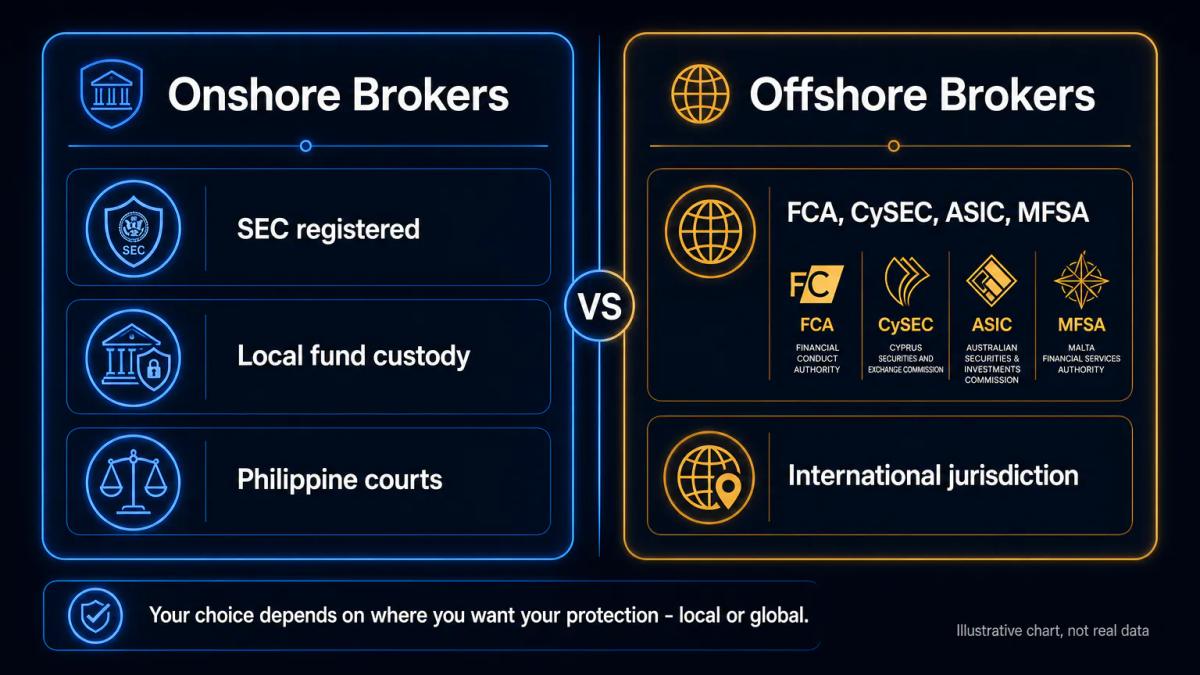
Philippine traders typically weigh two legal pathways, each with a different protection profile. An onshore broker is registered with the SEC, holds local client funds under rules the Commission can enforce, and remains reachable through Philippine courts. An offshore broker is licensed abroad, in jurisdictions such as the United Kingdom (FCA), Cyprus (CySEC), Australia (ASIC) or Malta (MFSA), and may lawfully accept Philippine clients depending on how the relationship is structured. The following comparison sets out the concrete trade-offs.
| Feature | Onshore (SEC-registered) | Tier-1 offshore (FCA, ASIC, CySEC) | Low-tier offshore |
|---|---|---|---|
| Local recourse | Yes, through SEC | Limited, foreign courts | Very limited |
| Typical minimum deposit | $100 to $500 | $100 to $200 | $10 to $50 |
| Maximum leverage on majors | Lower, conservative | Capped by regulator | Often 1:500 or higher |
| Segregation of client funds | Required | Required | Case by case |
| Peso deposits | Common | Rare, mostly USD | Rare |
High leverage from a lightly regulated venue functions as a risk multiplier applied on top of counterparty risk the trader has already accepted. Those prioritising capital safety tend to stay with SEC-registered or tier-1 licensed firms, while anyone drawn to lower entry costs offshore should at the very least verify the licence number on the regulator's own register before funding an account.
Tax obligations and reporting for Philippine forex traders
This section is general information, not tax advice: confirm your position with a Philippine-licensed accountant or tax lawyer before filing.
Forex trading profits are taxable in the Philippines and must be reported to the Bureau of Internal Revenue (BIR). The classification of your activity shapes the treatment. If you trade sporadically and your main income is salary or business, gains are typically treated as other income and added to your annual return. If trading is habitual and your main source of livelihood, the BIR can treat you as self-employed, which triggers quarterly filing, registration as a professional, and bookkeeping obligations.
Philippine personal income tax operates on a progressive scale, with marginal bands rising from zero at the lower threshold up to a top marginal rate on income above the highest band. Because the rate is marginal, the top band applies only to the slice of income that sits above it, so applying the top rate to total profits produces an inflated and misleading tax figure.
Foreign-sourced income earned by a Philippine resident is generally taxable in the Philippines regardless of where the broker is based. Profits held in a broker account abroad still need to be reported, since the taxable event is the realised gain itself, and the timing of any repatriation has no bearing on when the liability arises. The records worth keeping include:
- Contract notes
- Monthly statements
- Deposit and withdrawal records
- Screenshots of position history
For an offshore broker, these records are often the only reliable audit trail available.
Getting started: account types and minimum deposits
Accounts offered to Philippine residents fall into a small number of categories, and the entry ticket varies more than new traders expect. The main types are set out below.
- Demo account: free, funded with virtual money, no identity verification. Use it to learn the platform and test a strategy for several weeks before risking cash.
- Micro or cent account: minimum deposit from $10 to $50, trade sizes in micro-lots or cents. Best suited to a first live account where the aim is to feel real slippage on small stakes, with income generation left for a later stage.
- Standard account: minimum deposit from $100 to $500, trade sizes in standard lots or mini-lots, tighter spreads.
- ECN or raw-spread account: minimum deposit often $200 to $1,000, lower spreads with a per-lot commission. Appropriate once your strategy is defined.
Funding methods available in the Philippines include bank transfer from local banks, e-wallets such as GCash and Maya through third-party processors, and international card payments. Verification usually requires a government-issued ID, proof of address (utility bill or bank statement under three months old) and, for larger deposits, source-of-funds documentation.
Spotting forex scams and protecting yourself
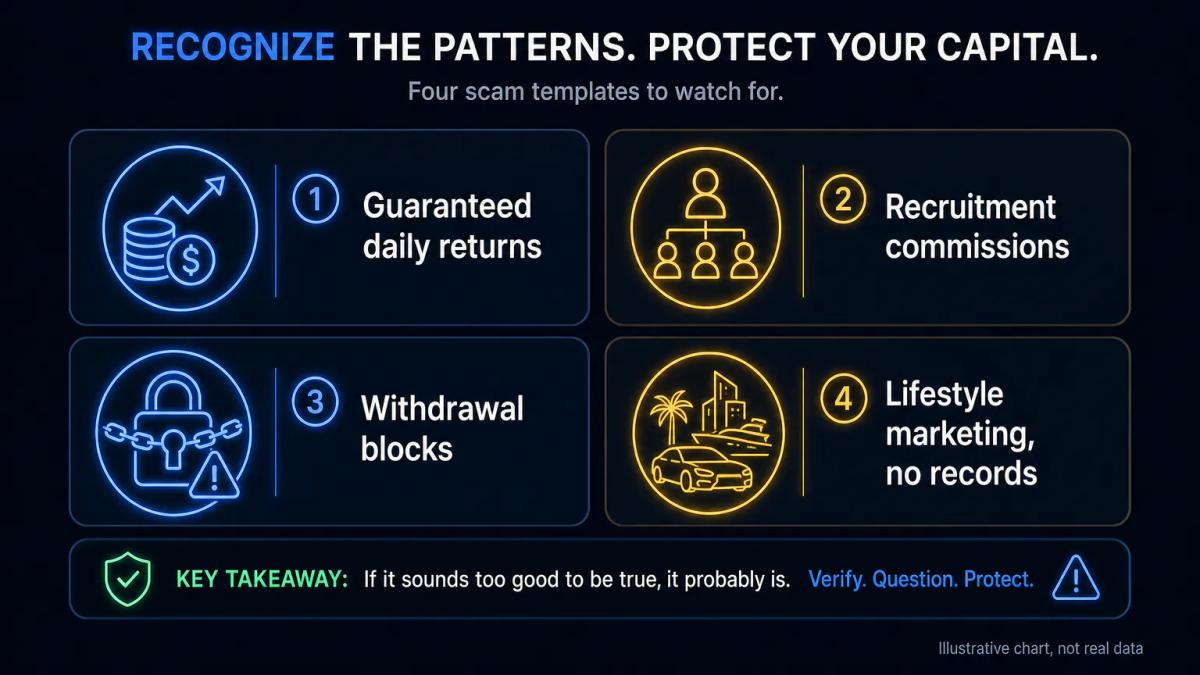
Forex fraud in the Philippines tends to follow a handful of recognisable templates, which the SEC publishes advisories on and which are the single most useful check before any deposit. Common warning signs include:
- Guaranteed daily or weekly returns.
- Recruitment-based commissions that reward bringing in new depositors.
- Difficulty withdrawing funds after an initial good run.
- Pressure to add more money to "unlock" existing profits.
- Social-media operators who showcase lifestyle images in place of verifiable trade records.
Use this short verification routine before funding any broker:
- Search the firm's exact name on the SEC advisories page.
- Ask for a licence number, then confirm it on the regulator's own register, not on the broker's website.
- Check whether the entity has a physical office in the Philippines and a registered local representative.
- Reject any pitch that promises a fixed monthly return or describes trading as risk-free.
- Test withdrawals with a small amount before scaling your deposit.
Suppose a trader deposits $200 with an unknown platform advertising 5% weekly returns. Paper gains climb for three weeks, after which the platform insists on a "tax prepayment" to release funds. That demand is itself the scam, since no legitimate broker ever collects tax on a regulator's behalf.
Risk management strategies for the Philippine market
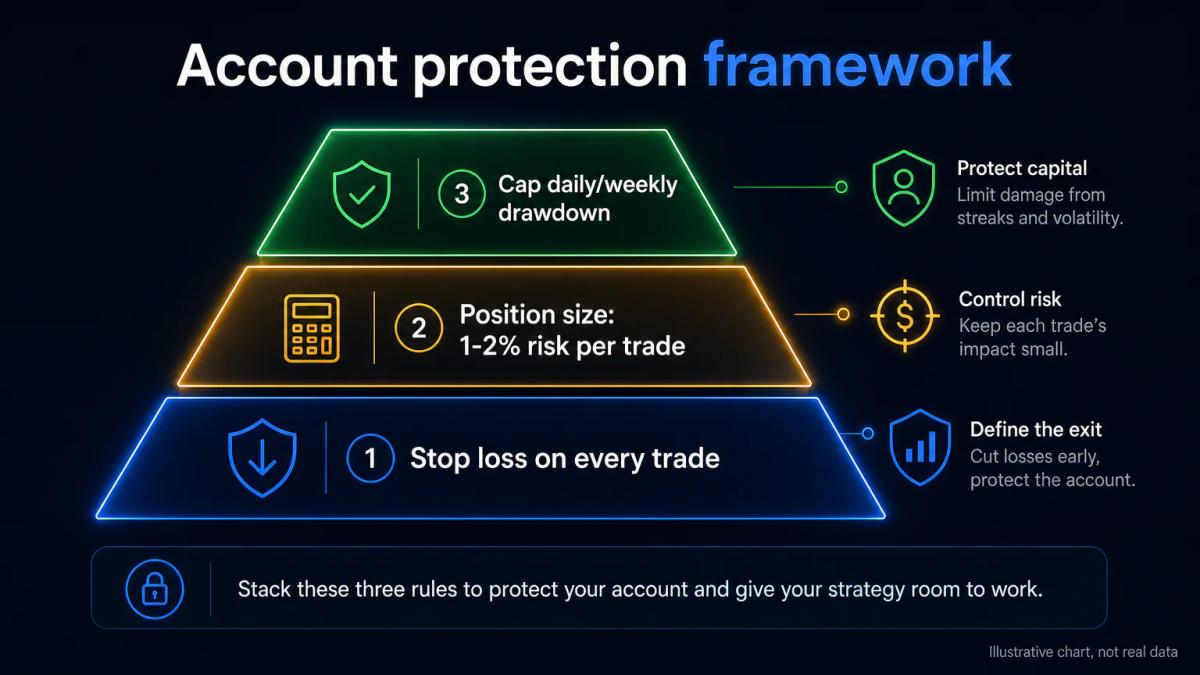
Risk management in forex is a set of position-level rules that govern each entry, applied independently of market sentiment. The following three rules tend to do most of the work:
- Set a stop loss on every trade before entry.
- Size each position so a stopped-out trade loses no more than 1% to 2% of account equity.
- Cap daily or weekly drawdown so a losing streak forces you to pause before adding more risk.
Imagine an account funded with $2,000 and a per-trade risk budget of 1%, which comes out to $20. If the stop sits 50 pips from entry on a mini-lot of EUR/USD (roughly $1 per pip), the trade would risk $50, well above budget. In that case, the options are to tighten the stop, drop to a micro-lot, or skip the setup altogether. The arithmetic should drive the decision, with conviction playing no part in the sizing.
Several peso-specific factors deserve attention when trading USD/PHP or peso crosses:
- USD/PHP tends to react to BSP policy decisions, remittance seasonality around major holidays, and tourism inflows.
- Local market hours overlap the Asian session, which is typically quieter for the majors but more active for Asian crosses.
- Economic releases from the Philippine Statistics Authority and the BSP, especially inflation and balance-of-payments data, often move the peso sharply on release day.
How to choose a broker as a Philippine resident
A practical selection process gives more reliable results than relying on a shortlist copied from a forum. Working through the following checks in order, and dropping any broker that fails one, is a sensible way to narrow the field.
- Regulatory status: SEC-registered for onshore, or a tier-1 licence (FCA, ASIC, CySEC, MFSA) for offshore. Verify the number directly on the regulator's register.
- Deposit and withdrawal rails: local bank transfer, GCash or Maya compatibility, and clear withdrawal timelines in writing.
- Costs: compare the all-in cost per trade (spread plus commission plus any swap) on the pairs actually traded, going beyond the headline EUR/USD spread.
- Platform: MetaTrader 4 (MT4), MetaTrader 5 (MT5), cTrader or a reputable proprietary platform. Test it in demo for at least two weeks.
- Support: English-language desk with reasonable response times during Asian hours.
- Negative balance protection: a policy that caps your loss at your deposit, so a gap move cannot push the account below zero.
Opening a small live account before committing serious capital is a worthwhile final step. The move from demo to live tends to change a trader's behaviour, and a $100 test with a verified broker will usually reveal more about execution quality than any amount of time spent on review sites.
Frequently Asked Questions
Is it legal for me to trade forex as a Philippine resident?
Yes. Philippine residents can legally trade forex through SEC-registered brokers in the country or through foreign brokers licensed in reputable jurisdictions. The activity itself is not restricted; what is restricted is dealing with platforms the SEC has flagged as unregistered. Check the SEC advisories page before funding any account.
What is the minimum deposit required to start forex trading in the Philippines?
It depends on the account type. Micro or cent accounts start from around $10 to $50, standard accounts typically require $100 to $500, and ECN or raw-spread accounts often ask for $200 to $1,000. Demo accounts are free and are the right starting point before any live deposit.
Do I need to pay tax on my forex trading profits in the Philippines?
Yes. Forex profits are subject to Philippine income tax and must be reported to the Bureau of Internal Revenue. Occasional traders usually report gains as other income on their annual return; habitual traders may be classified as self-employed with quarterly filing. Consult a Philippine-licensed accountant for your specific situation.
How can I tell if a forex broker is legitimate and regulated in the Philippines?
Confirm the broker's registration directly on the SEC website or, for offshore firms, on the regulator's own register (FCA, ASIC, CySEC, MFSA). Check SEC advisories for warnings against the entity, look for a physical office and local representative, and test a small withdrawal before scaling your deposit.
What is the difference between trading with an onshore and offshore broker?
An onshore broker is SEC-registered, operates under Philippine law and gives you local legal recourse. An offshore broker is licensed abroad and may offer lower minimums or higher leverage, with weaker local protection. Tier-1 offshore regulators (FCA, ASIC, CySEC) offer meaningful oversight; low-tier offshore licences offer very little.
About the authors


Put this into practice
Brokers we have reviewed
Scored on the same five dimensions. Here are three of them — the full list is on the brokers page.
Related articles

Is Forex Trading Legal in the UK? FCA Rules and Your Rights
Forex trading is legal in the UK through FCA-authorised brokers. Understand leverage caps, product restrictions, FSCS protection and the risks of offshore firms.

Most Volatile Stocks: How to Find and Trade Them
A practical guide for retail traders on where to find the most volatile stocks, why they swing, and how to trade them without blowing up your account.

Options Trading Explained: Calls, Puts, and Broker Approval
How options trading works for UK retail traders: calls, puts, strike prices, premiums, broker approval, risk limits, and tax reporting, in plain English.
0 comments