



Prop Trading · Intermediate · 9 min read
100% Profit Split Prop Firms: How It Works and What You Actually Keep
How a 100% profit split actually works
Prop firms that advertise a 100% profit split operate on a simple premise: every dollar or pound earned above the funded account's starting balance stays with the trader, while the firm itself takes no cut of trading gains. Instead of monetising profit share, these firms collect revenue through account fees and the attrition of failed challenges. In exchange for keeping the full upside, you commit to an upfront or recurring account fee and agree to clear profit targets, drawdown buffers and consistency rules before any withdrawal is released.
The structure reshapes who absorbs which risk. On the firm's side, costs include platform access, liquidity, risk desk oversight and the capital notionally allocated to each trader, which is typically simulated. On the trader's side, the burden sits in the upfront fee and the ongoing pressure of hitting monthly performance gates. Those gates exist for a practical reason: with no profit share flowing back to the firm, something has to filter out accounts that would otherwise drift sideways or bleed slowly while consuming infrastructure.
For a trader confident in their edge, the arithmetic is appealing. Consider a $3,000 month: keeping the full $3,000 compares favourably to the $2,400 that an 80/20 split would leave in your account. An honest comparison, which the rest of this article works through, has to put the fee, the buffer, the payout frequency and the tax treatment on the same page as the headline percentage.
To trade with a firm's capital, compare the best prop firms and how their evaluations work.
100% splits versus standard 70/30, 80/20, and 90/10 ratios
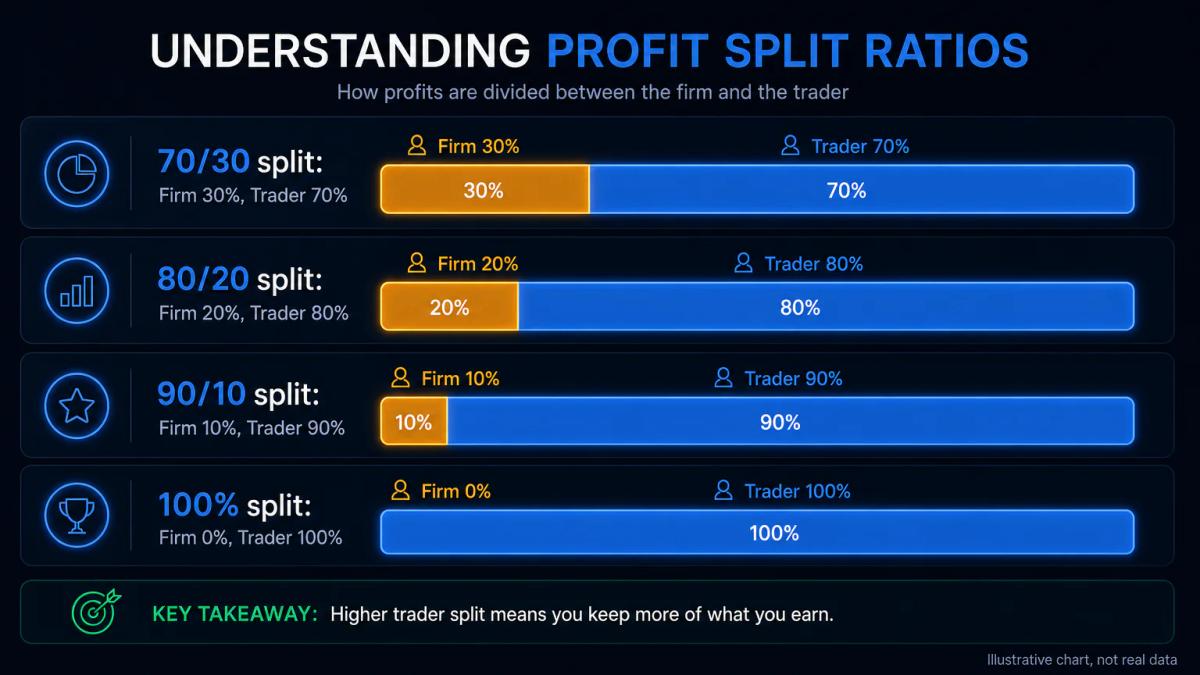
The headline percentage describes only one input into what a trader actually takes home. In practical terms, the common split ratios work as follows:
- 70/30 split: the firm keeps 30% of your profit and you keep 70%.
- 80/20 split: you keep 80% of trading profit, with 20% going to the firm.
- 90/10 split: you keep 90%, leaving 10% as the firm's share.
- 100% split: you keep everything above the starting balance, with the firm's revenue coming from the account fee.
Alongside the percentage itself, the fee structure, the drawdown buffer, the minimum trading days and the consistency requirement all move the net figure, often in directions that work against the headline split.
Split ratios in the 70/30 to 90/10 range tend to arrive with lower challenge fees, more generous drawdown buffers and softer consistency rules. Because the firm recoups its costs out of the profit share, it can afford to let the account breathe over a longer stretch. Under a 100% split, the economics work in the opposite direction: the firm's margin is locked in at sign-up through the fee, and the account rules tighten accordingly to keep the model viable.
The table below shows a hypothetical comparison on a steady $2,000 gross monthly profit, assuming the trader clears the firm's rules every month for a year. These are illustrative figures, not quotes from any specific firm.
| Structure | Profit share you keep | Typical upfront fee | Net kept on $24,000 annual profit |
|---|---|---|---|
| 70/30 split | 70% | $0 to $200 | $16,800 (less fee) |
| 80/20 split | 80% | $100 to $500 | $19,200 (less fee) |
| 90/10 split | 90% | $200 to $1,000 | $21,600 (less fee) |
| 100% split | 100% | $500 to $5,000 | $24,000 (less fee) |
Break-even logic for the 100% model is linear. A 100% split carrying a $1,000 annual fee only begins to outperform a 90/10 split with no fee once annual profit clears $10,000. Up to that profit level, the percentage split with a lower fee tends to produce a better net outcome; beyond it, the 100% model pulls ahead, assuming every monthly gate is cleared without a reset.
Imagine a trader targeting $500 per month in profit. Should they trade under a 90/10 split with no fee, they would net $5,400 over twelve months, whereas under a 100% split with a $1,000 annual fee they would net $5,000. For that profile, the lower-split model produces the stronger outcome, even though 100% sounds more attractive on the sales page.
How buffers and consistency rules affect your 100% payout
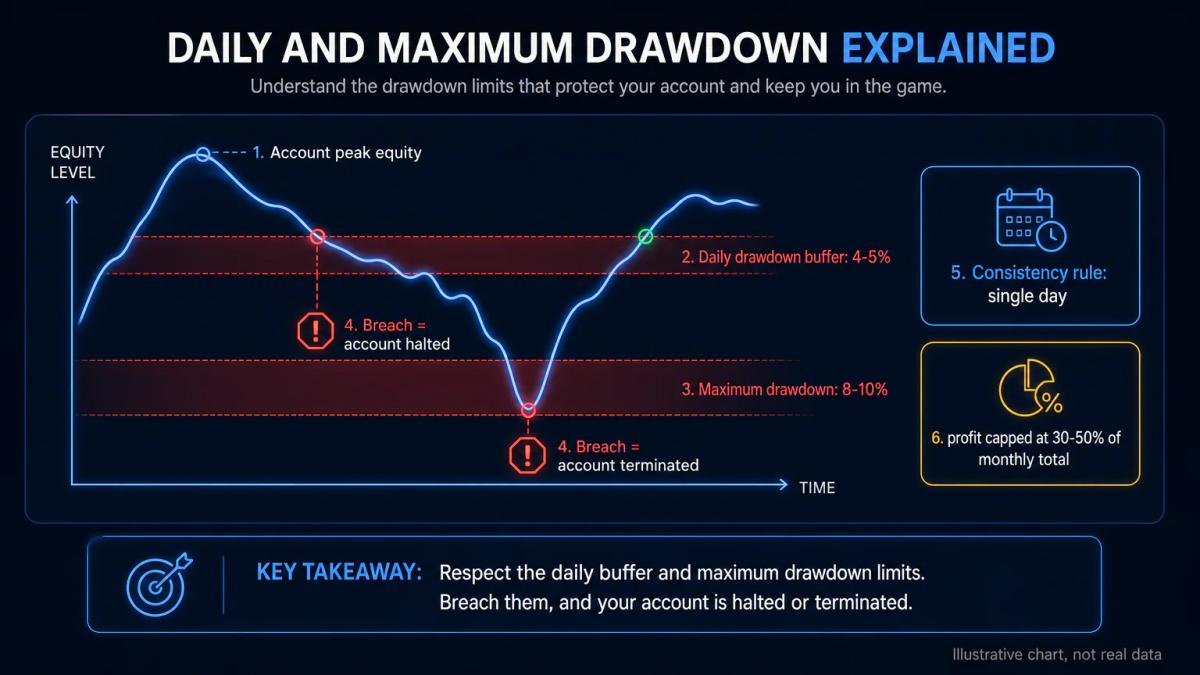
Buffers and consistency rules are the quiet mechanics that decide whether a 100% split actually pays out. The daily drawdown buffer caps how much the account can lose in a single session, usually in the region of 4% to 5% of the account balance, while a maximum drawdown caps total losses from the account's peak equity at around 8% to 10%. Any breach of either threshold typically halts the account or terminates it outright, with no appeal.
Consistency rules add a second layer on top of the drawdown gates. A typical rule caps any single day's profit at 30% to 50% of total monthly profit, which prevents a trader from passing on the back of one unusually lucky session. Firms often add a minimum number of trading days, somewhere between five and ten per month, together with a minimum monthly profit around the $200 mark, before a payout request can be processed.
These gates exist because the firm absorbs the cost of capital and infrastructure for every active account. Without them, a 100% split account could drift at a slow loss indefinitely while the firm covered the platform fees. A breach of the daily buffer usually locks the account until the following month, unless the trader pays a reset fee in the $100 to $300 range. Treatment of a missed monthly target varies by firm: some allow the shortfall to carry forward into the next cycle, while others reset the account to its starting balance and void any accrued profit.
Reading the rulebook carefully before funding is worth the time it takes, because a 100% split only delivers real value when a trader's style can live comfortably inside the published buffer without triggering constant resets.
Payout frequency and withdrawal mechanics
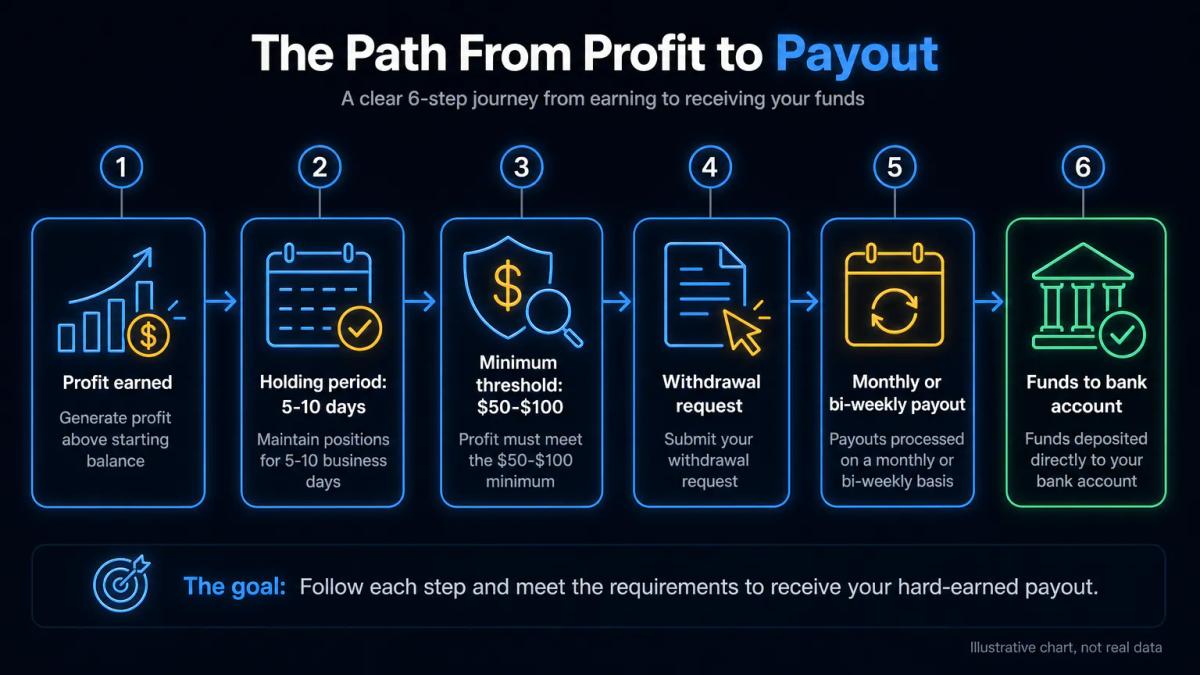
Payout cadence under a 100% split tends to run monthly or bi-weekly, with funds released after a withdrawal request, provided the minimum profit target has been met and the account has stayed inside the buffer across a holding period of roughly five to ten business days. All profit above the starting balance belongs to the trader, since the firm already collected its revenue through the account fee at sign-up.
Several mechanics tend to appear across firms:
- Minimum withdrawal thresholds, often $50 to $100, below which payouts roll into the next cycle.
- A reserve or holdback, usually 5% to 10% of the profit, kept against future losses or chargebacks and released over subsequent months.
- Processing times of three to ten business days, depending on whether you withdraw to a bank account, a card or a payment processor.
- Restrictions on withdrawing during high-impact news events or inside the first few days after a profit target is hit.
Under a 100% split the gross profit effectively equals the net profit on each withdrawal, because the firm's share was already paid upfront through the account fee rather than deducted from each payout. Checking the withdrawal policy before funding is worthwhile: a firm that advertises 100% but holds funds for 30 days operates on very different cashflow terms from one that pays out weekly.
Tax reporting and regulatory considerations
Profits from a 100% profit split prop account are taxable in your country of residence, regardless of whether the firm sends you a tax form. This section is general information, not tax advice; every trader should check their own situation with a licensed professional in the relevant jurisdiction.
Treatment varies by country, and the differences are significant:
- In the UK, prop trading income is typically assessed as self-employment or miscellaneous income by HMRC, which can bring both income tax at your marginal band and Class 2 or Class 4 National Insurance contributions, depending on how your activity is characterised.
- In the United States, payouts from a US-based prop firm are often reported on Form 1099 and taxed as self-employment or ordinary income, which can also attract self-employment tax.
- In most EU jurisdictions, prop firm payouts fall outside the regimes designed for direct trading of financial instruments, since the trader is operating on a simulated account against a payout contract and does not hold positions in their own name.
Two practical considerations tend to apply across jurisdictions. First, the upfront account fee and any reset fees are often treated as a business expense that may be deductible against the trading income, which can meaningfully change the net figure. Second, the regulatory status of the firm itself varies by location:
- A UK-based firm offering simulated funded accounts is generally not an FCA-authorised broker for that activity.
- A US-based firm may fall under CFTC or NFA rules only in relation to certain products, rather than across its full offering.
- Offshore firms frequently operate outside any regulator's remit, which places more of the due diligence onto the trader.
Keeping detailed records of fees, payouts and trading days from the first day of funding tends to make year-end reporting considerably easier, regardless of jurisdiction.
Psychological factors in choosing a 100% split structure
The pull of a 100% split carries both a numerical and an emotional component. Keeping every dollar feels cleaner than handing 10% or 20% back to the firm, and that framing alone can push traders toward structures whose rules do not suit their style. Beneath the headline percentage, the tighter buffers and consistency rules become the day-to-day reality of trading the account.
Two behavioural traps tend to show up with regularity under this structure:
- Sunk-cost pressure: after paying $1,000 or $2,000 upfront, a trader can feel compelled to size up or hold losers longer in order to recoup the fee, which raises risk at exactly the wrong moment.
- Deadline risk: a monthly profit target with a hard reset at month-end can encourage revenge trading in the closing week, when a trader who is slightly behind pushes into setups they would normally skip.
Trader fit is where the structure decides the outcome. Someone who understands their own tempo may well prefer a looser percentage split, even at 70/30, because the lower pressure allows them to trade their natural edge without an artificial deadline every month. Traders with a dense, consistent setup frequency often thrive under the 100% model, since they hit the targets without strain and the fee amortises quickly across the year. In practice, the right choice follows from expected monthly profit, risk tolerance and the stability of a trader's edge, rather than from the size of the percentage printed on the sales page.
Negotiating better terms with prop firms
Most prop firms publish fixed terms, but there is more room to negotiate than the website suggests, especially once you have a track record. Firms care about retention: a trader who has cleared six consecutive payouts is far cheaper to keep than a new sign-up acquired through paid advertising. That retention value is your leverage.
Several practical angles are worth raising, listed roughly in order of how often they succeed:
- Tier upgrades at profit milestones, for example moving from 90/10 to 95/5 after three consecutive months above $5,000 in profit.
- A waived or discounted reset fee after a first breach, in exchange for a longer cooling-off period.
- A larger funded account at the same fee once you have hit a documented profit threshold.
- An extended holding period in return for a looser consistency rule.
- A reduced upfront fee on a renewal, framed as a loyalty discount.
Negotiation tends to be harder in the pure 100% split space, because the firm's margin lives inside the fee itself and leaves less room for flexibility than at firms running a percentage split. The strongest position a trader can bring to those conversations is a documented track record across several payout cycles, backed by screenshots of statements and withdrawal confirmations. Any agreed variation should be captured in writing before funding and the email kept on file, since a verbal concession from a support agent rarely survives contact with next month's automatically generated statement.
For a concrete example of challenge rules and payouts, see our Blue Guardian review.
Frequently Asked Questions
Do you really keep 100% of your profits with a 100% profit split prop firm?
You keep 100% of the profit above the account's starting balance, with no percentage going to the firm. The firm earns its revenue from the upfront account fee and from failed challenges or resets. You still owe tax on the payout in your country of residence, and you may face a small reserve or holdback released over subsequent payout cycles.
What is the catch with 100% profit split prop firms?
The catch sits in three places: a non-refundable upfront fee of roughly $500 to $5,000, tighter drawdown buffers of around 4% to 5% daily and 8% to 10% maximum, and consistency rules that cap any single day's share of the monthly profit. Breaching any of these halts the account or triggers a paid reset.
How much does it cost to open a 100% profit split account?
Fees typically range from about $500 for small accounts (around $10,000 in simulated capital) to $5,000 or more for larger accounts (around $200,000). Some firms charge a one-time fee, others a recurring monthly or annual fee. Reset fees of $100 to $300 apply if you breach a rule and want to restart without paying the full account fee again.
Can you withdraw your profits immediately with a 100% split?
No. Most firms require a holding period of five to ten business days after the profit is realised, plus a minimum number of trading days in the month and a minimum profit threshold. Processing adds another three to ten business days depending on the payment method. Immediate same-day withdrawals are rare in this segment.
Is a 100% profit split better than a 90/10 split?
It depends on your expected annual profit and your tolerance for tighter rules. On low volumes, a 90/10 split with little or no fee often nets more. Once annual profit clears roughly $10,000 and you can consistently satisfy the buffer and consistency rules, the 100% model tends to produce a higher net figure.
About the authors


Put this into practice
Related articles

100K Funded Trading Account: What You Get and What It Costs
A plain-English breakdown of the 100K funded account: costs, splits, drawdown limits, tax treatment, platforms, psychology and how it stacks up against smaller sizes.

Best Prop Firm Forex EAs: Rules, Platforms and Real Performance
A working guide to choosing forex EAs for funded accounts: rulebooks, VPS setup, backtest hygiene, cost trade-offs and the risk parameters that keep you funded.

EA Prop Trading: How Automated Systems Work in Funded Accounts
A practical guide to running Expert Advisors on prop firm accounts: rules, MT5 configuration, backtesting, instruments, fees, tax, and pitfalls.
0 comments