


Prop Trading · Beginner · 5 min read
Trailing Drawdown vs Static Drawdown: The Prop Firm Rule That Ends Most Accounts
How the two drawdown types work and why the difference matters
Trailing drawdown resets your loss floor each time your account hits a new high, while static drawdown locks your maximum loss from day one and never moves. This single mechanic decides whether you survive a bad week or lose the account on one streak.
A drawdown (the fall from a peak in your account balance to the trough before a new peak) is the figure prop firms use to decide if you keep trading. Prop firms (companies that fund traders with their own capital after a paid evaluation) apply either rule as a hard limit. The static version is a fixed line in the sand. The trailing version is a line that climbs with your profits and then stops moving, which is where most accounts die.
To trade with a firm's capital, compare the best prop firms and how their evaluations work.
Static drawdown: your loss limit never changes
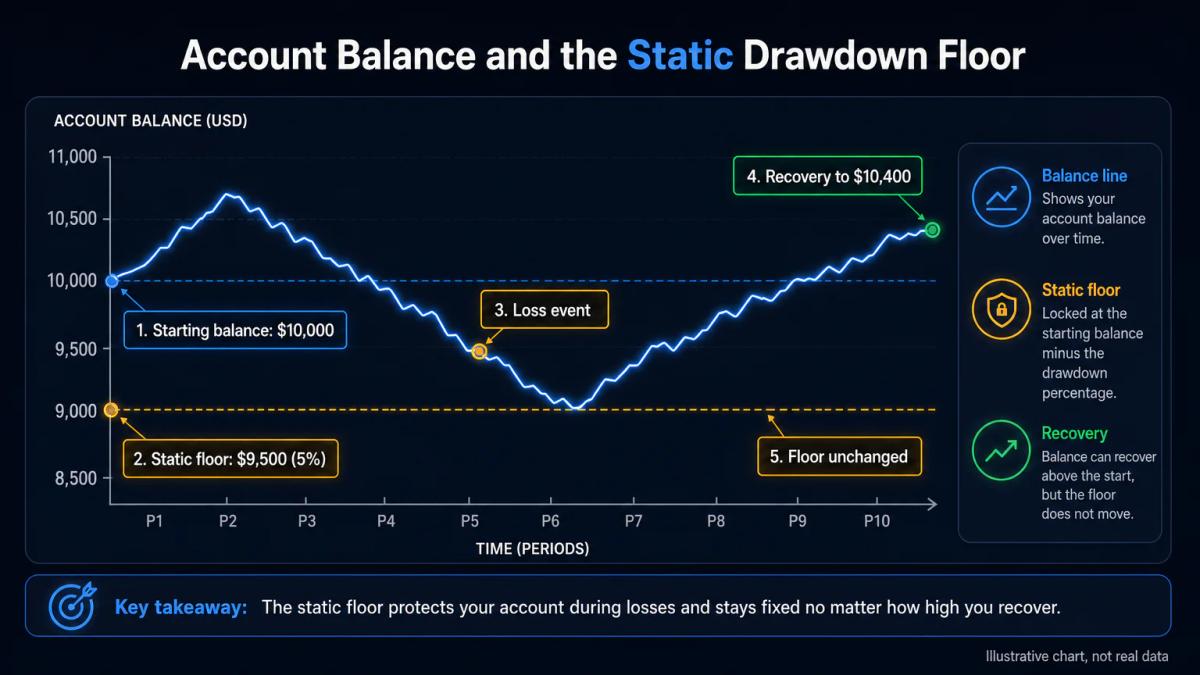
With static drawdown, your maximum loss is fixed from the moment you open the account. If you start with $10,000 and the rule is 5%, you can lose no more than $500 at any point, no matter how much you later profit.
That fixed floor has two consequences. You get the full room back after a recovery: if you fall to $9,600 and climb to $10,400, your floor is still $9,500. The ceiling never follows you up, so your buffer grows as you grow. The flip side is that early losses hurt more, because you cannot earn extra breathing room by trading well in the first days. Firms that commonly use static rules include FTMO on some account types and The Funded Trader on its standard challenge.
Trailing drawdown: your floor rises when you profit
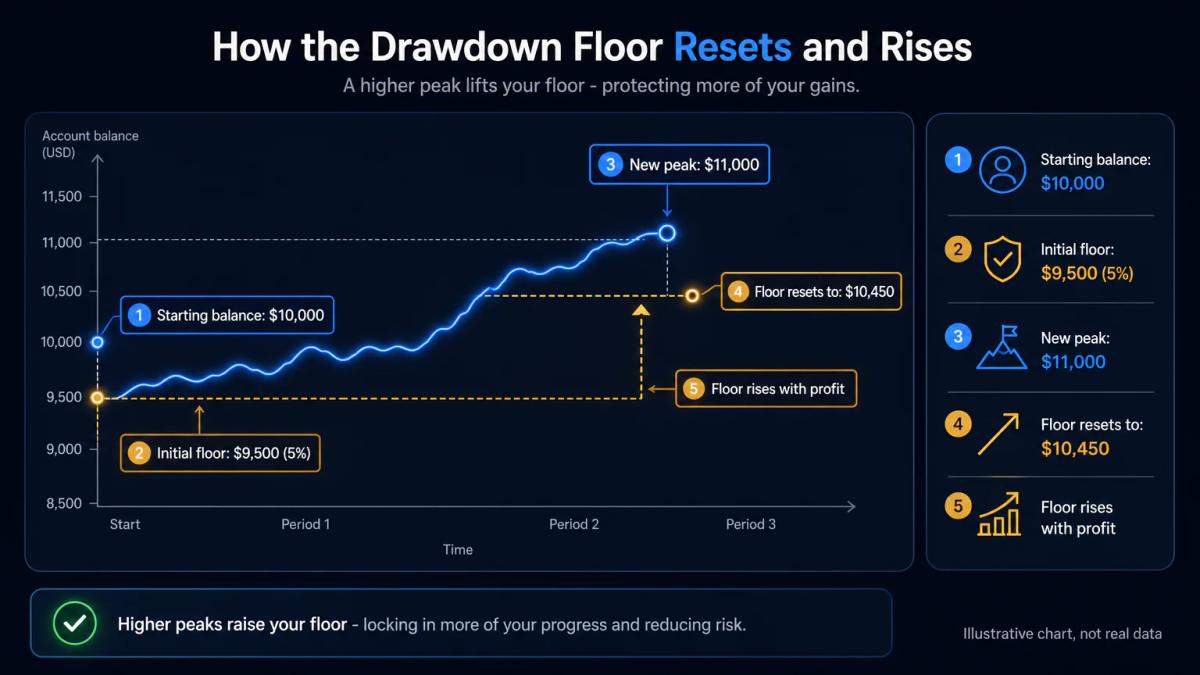
Trailing drawdown moves your loss floor upward each time your account reaches a new peak. If you grow a $10,000 account to $11,000 under a 5% rule, the limit now applies to $11,000, so your floor sits at $10,450, up from the starting floor of $9,500.
There are two common variants:
- An intraday or balance-based trailing rule follows your highest closed balance, so unrealised profits do not lift the floor.
- An equity-based trailing rule follows your highest equity peak, including open profits, which is stricter because an unclosed winner can raise your floor and then a reversal drags you under it.
Firms such as Apex Trader Funding and MyFundedFutures use trailing rules on their evaluation accounts, with the exact variant stated in each firm's rulebook.
What is the difference between trailing drawdown and static drawdown in prop trading?
The core difference is flexibility: static drawdown is a hard ceiling that never moves, while trailing drawdown resets upward whenever you make profit and then freezes once the account is funded in many programmes. Static punishes any early loss streak because you have no earned cushion. Trailing gives breathing room if you have already proven you can grow the balance, but it also removes your right to give back profits beyond a narrow band. Which rule suits you depends on whether you start fast and consolidate, or build slowly from day one.
Why trailing drawdown rules end more accounts than static
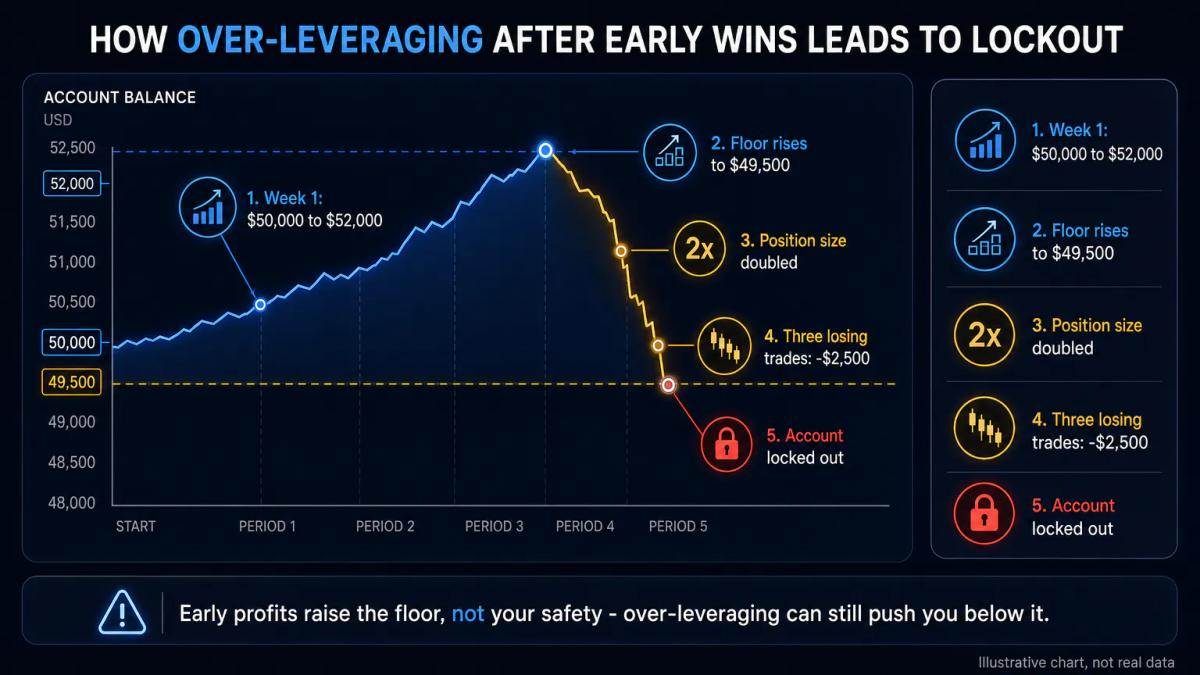
Traders often treat trailing drawdown as a safety net when it works more like a ratchet. The floor only rises while you keep printing new highs; the moment profits stall, you are trading against a tightened leash with no slack to absorb a normal losing streak.
The psychological trap is predictable, and it plays out like this: suppose a trader lifts the account from $50,000 to $52,000 in the first week, feels the cushion, doubles position size, and gives $2,500 back on three trades. The floor rose to $51,500, so the account breaches on a move the original risk plan would have survived. The daily loss limit then compounds the problem, because a single bad session can hit both the daily cap and the trailing floor at once.
How to manage your trading under each rule
Under static drawdown, your position sizing must be tight from day one because there is no margin for error. Under trailing drawdown, the discipline is different: you need to resist the pull to over-leverage after early profits, because the rising floor rewards consistency and punishes variance.
A practical checklist for each rule:
- Static: risk a fixed fraction of the starting balance per trade, usually 0.25% to 0.5%, so one streak cannot touch the floor.
- Trailing: keep the same fractional risk even after a winning week; the floor has already banked those gains for the firm.
- Both: track your distance to the floor daily, not just to the daily loss limit.
Suppose you have a $25,000 account with a 5% trailing drawdown. You run it to $26,000, then take a $400 loss. Your floor sits at $24,700, your balance at $25,600, and your real buffer is $900, not the $1,250 the headline rule suggested.
Treat the drawdown limit as sacred, not as a target to approach.
Frequently Asked Questions
What is the difference between trailing drawdown and static drawdown in prop trading?
Static drawdown fixes your maximum loss from the opening balance and never moves. Trailing drawdown recalculates that loss floor each time your account reaches a new high, so the limit climbs with your profits. Static gives you the same room throughout the challenge; trailing gives extra room only while you keep printing new highs.
Why do most prop firm traders fail due to drawdown rules?
Most failures come from misreading the trailing rule as a cushion. Traders bank early profits, feel the floor has risen, and increase position size. A normal losing streak then hits a tighter limit than the headline percentage suggests, and the account breaches. The daily loss cap compounds this by closing the account on a single bad session.
How does a trailing drawdown reset affect your account compared to a static drawdown?
A trailing reset lifts your loss floor to lock in a share of your gains, so you cannot give those profits fully back. A static rule leaves the floor at the starting figure, meaning you keep the full original buffer plus any profits as free room. Under trailing, growth tightens the leash; under static, growth loosens it.
What strategies can help you avoid hitting your prop firm's drawdown limit?
Size each trade as a fixed fraction of the starting balance, between 0.25% and 0.5%, and keep that fraction constant after wins. Track your distance to the drawdown floor daily, not just the daily loss limit. Stop trading for the day once you have used half of the daily cap, and never add to losers to defend a floor that is drifting towards you.
About the authors


Put this into practice
Prop firms we have reviewed
Scored on the same five dimensions, with the rules that decide payouts. Here are three — the full list is on the prop firms page.



Related articles

What Happens to Unwithdrawn Profits If Your Funded Account Fails
A clear breakdown of what happens to profits sitting in a funded account when it breaches a rule, from forfeiture mechanics to recovery and tax treatment.

What Is a Funded Trading Account: Definition, Mechanics, and Realistic Expectations
Funded trading accounts let you trade a prop firm's capital after passing an evaluation. Here is how the mechanics, splits, rules and costs really work.

What is a prop firm: how proprietary trading funding works
Prop firms fund traders who pass an evaluation, then split profits. Here is how the model works: fees, risk rules, asset coverage and regulatory context.
0 comments