


Prop Trading · Intermediate · 19 min read
What Happens to Unwithdrawn Profits If Your Funded Account Fails
How unwithdrawn profits vanish when a funded account fails
Picture the account dashboard the hour after a hard-limit breach: a profit figure you watched build over weeks, now attached to a terminated account. That profit belongs to the prop firm, because your contractual claim on it never crystallised into a payout. The simulated losses stay on the firm's book too, so you walk away without a bill, but the earnings you had not yet moved out of the account are gone with the closure.
The mechanic surprises traders because the account statement often shows a healthy equity curve on the day of the breach. Imagine a $100,000 simulated account carrying $4,000 of accumulated earnings. On a single session the trader breaches the daily loss limit and watches the entire balance reset: the firm books the simulated loss internally, the account is terminated, and the $4,000 that was never requested as a payout goes with it.
The reason this is possible sits in the legal structure of most retail prop programs. You are trading a demo environment, and your contractual claim on the profit only crystallises when you submit a withdrawal request and the firm approves it. Until that moment, the number on the screen is a performance figure, not a receivable. If the account is closed before the request clears, there is nothing to pay out.
Two ideas get confused here and should be separated:
- Debt. You do not owe the firm for the simulated losses that closed your account, because the capital at risk is theirs, not yours.
- Forfeiture. The profit that was accruing while the account was alive is extinguished by the same closure, so the firm keeps the money you had not yet claimed even as it takes nothing from your pocket.
Losing accumulated earnings in a funded account rarely requires anything reckless; a single oversized position on a high-impact news release, a stop that slipped during a liquidity gap, or a forgotten weekend hedge can be enough on its own. Treat unwithdrawn profit as firm money until a payout has settled in your bank, and move it out of the account as a priority once the eligibility gates clear, rather than keeping it in play as a cushion to run further risk against.
The sections below work through the specific triggers that close accounts, the eligibility gates that control payout access, how firms differ in their forfeiture rules, the tax treatment of profits that never land in your bank, the appeals route when a closure feels wrong, and the recovery options once the account is already gone.
To trade with a firm's capital, compare the best prop firms and how their evaluations work.
Drawdown limits and daily loss caps that trigger account termination

Most prop firms terminate a funded account the moment you breach either a maximum drawdown (the peak-to-trough decline in balance or equity) or a daily loss limit (the maximum loss permitted inside a single trading day); once the breach is logged, any profit you have not withdrawn is locked in with the closure. These two limits do most of the killing in retail prop programs, and understanding how each is measured is the difference between surviving a bad week and losing the account.
Maximum drawdown comes in two main flavours, and the distinction decides what you can and cannot do with your running profit:
- Static drawdown: the floor is fixed at a percentage below your starting balance and never moves. If you start at $100,000 with a 10% static drawdown, your account dies if equity touches $90,000, no matter how high the balance climbed in between.
- Trailing drawdown: the floor follows your highest balance (or highest equity, depending on the firm) up to a stated point, then locks. A $100,000 account with a 5% trailing drawdown that rises to $108,000 moves the floor to $103,000; a pullback to $102,900 closes the account even though you are still $2,900 above where you started.
- Hybrid trailing: the floor trails only on closed trades, not on open equity, which protects you from being killed by an unrealised wick.
Daily loss limits are usually a smaller percentage, often measured from one of three reference points: the previous day's closing balance, the start-of-day equity, or the account's all-time high balance. Which reference the firm uses can redraw what counts as a losing day, so a trader who ended Monday up $2,000 and loses $1,800 on Tuesday is comfortably fine against a start-of-day reference, while the same session may already be in breach against an all-time-high reference if open positions are counted.
A drawdown is tracked second by second on most platforms, so a stop that is wide of the limit by a single tick triggers automatic closure without a human on the other side deciding whether to be lenient. The breach is a software event, and the forfeiture of unwithdrawn profits follows from the same event in the same instant.
Suppose a $50,000 account carries a 5% trailing drawdown and $1,800 of unwithdrawn profit. The balance pushes the trail to $48,500, and on the next session a loss briefly prints equity at $48,450. The platform logs the breach, the account closes, and the $1,800 is forfeited even though the realised balance never dropped below $50,000.
The practical defence is to size positions so that no single trade can breach the daily loss limit on its own, and so that the sum of open risk cannot drag equity below the drawdown floor. Treating the daily cap as a wall to stay clear of tends to keep the account alive over any meaningful stretch of trading; treating it as a limit to hit eventually produces the hit.
Negative balance protection and why you do not owe the firm money
Negative balance protection is the safeguard that stops your account balance from falling below zero; if a trade closes at a loss that would push equity negative, the firm absorbs the gap and terminates the account instead of invoicing you for the difference. In the retail prop context this feature is usually embedded in the trading environment by default, because the account you are trading is a simulated book funded by the firm, with no personal margin at stake.
The reason you walk away with no debt sits in two places:
- The legal structure of most retail prop firms treats the trader as a performance contractor, so simulated losses stay on the firm's side of the ledger.
- Retail counterparties in regulated jurisdictions cannot normally be chased for losses beyond the capital they placed at risk; this is the same principle that pushed negative balance protection into mainstream retail CFD trading after the 2015 Swiss franc event, when some brokers tried to recover unlimited losses from clients.
Unwithdrawn profits sit outside the scope of negative balance protection, and this is where traders get caught. The protection caps your downside at zero on the simulated capital, yet the profit column stays firm property until a payout has been approved. When the account closes, the firm reconciles its internal book, and any accumulated earnings that were never requested as a withdrawal are released back to the firm along with the simulated capital, so your contractual claim ends with the account itself.
Imagine a $100,000 funded account carrying $3,200 of unwithdrawn profit when an overnight gap closes a position at a loss that would, in a non-protected environment, leave the account at $4,500 below zero. Negative balance protection absorbs the negative tail, so the trader walks away owing nothing, while the $3,200 that was theirs on paper is forfeited with the closure.
Walking away without a bill is a meaningful protection, because the only outcome worse than losing the account is leaving it with a debt attached. That shield covers the downside on the firm's capital and nothing beyond it, which is why leaving profit sitting in the account on the theory that the downside is capped misreads what the protection actually does.
Withdrawal eligibility gates that determine if profits can be accessed
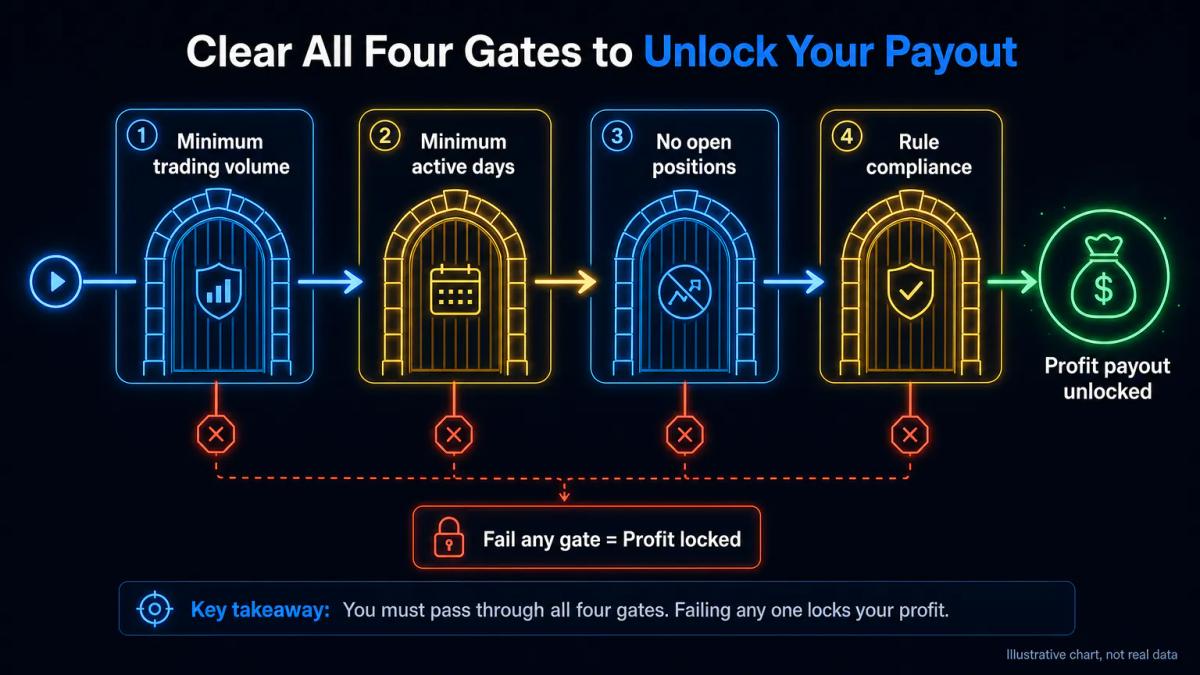
Before a prop firm releases a payout, you have to clear several eligibility gates: a minimum trading volume, a minimum number of active days, no open positions at the moment of request, full compliance with the trading rules, and a defined payout window inside the firm's calendar. Miss any one of them before the account closes, and the profit sitting in your account is locked away for good, even if the balance is well above the starting figure.
The common gates are:
- Minimum trading days: typically 3 to 10 active days during the payout cycle, with an active day defined as at least one trade placed. A trader who makes most of the profit in a single session is often ineligible to withdraw it until the required number of days has elapsed.
- Minimum trading volume: often expressed as a lot or contract total across the cycle, intended to prevent payouts on a single large winning trade.
- No open positions: payout requests are usually processed against a flat account; any open trade must be closed before the request is accepted.
- Rule compliance review: the firm reviews recent trades for prohibited strategies (news trading inside restricted windows, hedging across accounts, latency arbitrage, martingale sizing), and a flagged review can delay or deny the payout.
- Payout cycle: many firms pay on a fixed schedule, such as every 14 or 30 days from the first payout eligibility date, so profit earned mid-cycle sits in the account until the next window opens.
Most locked profit is lost at the volume gate. Consider a trader who clears a $4,000 running profit in the first week on two large trades, then stops trading because the account looks healthy. The account can still be weeks away from meeting the volume requirement, and a rule breach inside that waiting period takes the $4,000 with it.
Consider a $200,000 account where the firm requires 10 active days and a minimum traded volume equivalent to 2% of the account balance in notional terms. The trader is up $6,000 after four days and goes quiet to protect the balance. On day eight an economic release triggers a stop that breaches the daily loss limit, the account closes with the $6,000 unwithdrawn, and the first payout window was still two days away.
Withdraw profit as soon as eligibility opens, before the figure starts to feel like a comfortable cushion. Every extra day inside the account is another day during which an unrelated event can wipe the balance off the screen.
Account closure timelines and when unwithdrawn profits are forfeited
Account closure is near-instant on a hard-limit breach: the platform logs the event, flags the account, and in most cases suspends trading inside the same minute, with any profit you have not withdrawn forfeited as soon as the closure is confirmed. Some firms publish a short review window for soft-rule breaches, usually 24 to 72 hours, during which the account is frozen for trading but the status is not yet final; this is the only window in which an appeal or clarification can realistically alter the outcome.
The speed depends on the type of rule that was broken. Hard limits (maximum drawdown, daily loss cap, maximum lot size per trade, account-level stop-out) are enforced in software; the platform does not consult a human before closing. Soft rules (consistency requirements, news-trading restrictions, prohibited strategy clauses) are flagged for manual review, and the human timeline is where any grace period lives.
| Breach type | Typical closure speed | Appeal realistic | Status of unwithdrawn profit |
|---|---|---|---|
| Maximum drawdown hit | Instant, automated | No | Forfeited at closure |
| Daily loss limit hit | Instant, automated | No | Forfeited at closure |
| Max lot or exposure | Instant, automated | Rare | Forfeited at closure |
| Prohibited strategy flag | 24 to 72 hours, manual | Yes | Frozen pending review |
| Consistency rule breach | 24 to 72 hours, manual | Yes | Frozen pending review |
| Payment or KYC issue | Variable, manual | Yes | Frozen pending review |
The closure sequence usually runs: platform flags the account, trading is disabled, the dashboard status moves from active to under review or closed, the firm sends a notification email, and the internal profit ledger is reconciled against the firm's position. Once the ledger entry marks the account closed, the profit figure that was yours on paper is written off against the firm's book. In an automated breach there is no interval between these steps worth planning around.
If you suspect a soft breach, the realistic window is a matter of hours rather than days; open a support ticket with your side of the story and the trade timestamps while the account is still frozen for review. On a hard breach the moment to have acted was before the trade.
Behavioural and psychological factors that lead to account failure
Most funded accounts fail for behavioural reasons:
- Overtrading after a win.
- Revenge trading after a loss.
- Sizing up to chase a payout threshold.
- Ignoring stop placement in the belief that one more trade will fix the day.
These patterns breach drawdown and daily loss limits with reliable predictability, and the unwithdrawn profit on the account disappears alongside the breach itself.
The pressure in a funded account is different from the pressure in a personal account. In a personal account the money and the loss are both the trader's direct problem, while in a funded account the capital belongs to the firm, the loss costs the account itself, and the reward is a profit split that depends on reaching a withdrawal threshold inside a fixed window. That structure quietly rewards the trader who is willing to size slightly larger, hold slightly longer, or trade slightly more often, right up to the point where it kills the account.
The traps worth recognising are:
- The payout anchor: the trader fixates on a target number (the first payout, a specific amount) and increases risk when the balance is close but behind schedule.
- The sunk-cost response: after a bad session the trader doubles position size to recover the day inside the daily loss limit, breaching the limit on the correction leg.
- The free-money framing: the trader treats the account as the firm's problem and takes trades they would never consider on a personal account where their own payout is at stake.
- The scoreboard effect: the trader watches the balance curve and takes profit too early on winners and too late on losers to keep the equity line clean, losing sight of the trade thesis.
- The illusion of recovery: after one lucky save, the trader attributes the recovery to skill, treats variance as a repeatable method, and repeats the behaviour until it does not work.
Money forfeited from a breached account is almost always traceable to a decision the trader made, often several decisions back from the final trade, rather than to a market event nobody could have seen. A procedural defence does most of the work: a daily loss cutoff that stops you well before the firm's cap, a maximum position size that you do not override, a withdrawal rule that moves profit out of the account on the first eligible day, and a trading journal that lets you catch the first signs of the pattern on yourself.
Protecting unwithdrawn profits tends to be the work of traders who approach a funded account as a job with a fixed daily risk budget, meet the volume requirement, clear the payout and keep the firm. Approaching the same account as an opportunity with an upside to chase is how traders end up as the case studies for articles like this one.
Re-entry options and recovery paths after account failure
Once a funded account has failed and the profits are forfeited, the firm's standard offer is to buy a new evaluation (the challenge phase that leads to a funded account) at full price, or at a discount if the firm runs a reset or second-chance programme; what you do not get back is the forfeited profit from the previous account. Recovery is forward-looking, and the discount is a marketing lever that moves you into the next evaluation at a lower entry cost without refunding anything from the closed account.
The routes a trader typically has after a failure are:
- Full re-evaluation: buy a new challenge at list price, start the process from the beginning, meet the same profit target and rule set.
- Reset of a live breach: some firms sell a reset that restores the account balance to the starting figure after a breach during the evaluation phase, without requiring a full new purchase; this is almost never offered on a funded account, only on the challenge stage.
- Discounted re-entry: a reduced price on the next evaluation, offered either as a general promotion or specifically to traders who have just failed. The discount size varies and the eligibility window is usually short.
- Scaling plan re-entry: traders who passed and then failed sometimes receive a direct re-entry at the same account size without going through the full challenge, subject to the firm's review of what caused the failure.
- Change of firm: moving to a different prop firm, which treats the trader as a new applicant with no history of the previous failure, for better or worse.
Two questions are worth answering honestly before buying the next account:
- What specifically triggered the failure, and does the next evaluation's rule set actually prevent you from repeating it, or will the same behaviour under the same rules produce the same result?
- Do the unit economics of re-entry add up? A trader who buys three evaluations and fails each one has usually spent more than the first payout would have delivered.
None of these paths returns the forfeited profit from the previous account, because re-entry is a new contract with the firm and the previous balance has already been written off on its book. The only remaining mechanism for recovering that profit is the formal dispute process, which is a narrow door and the subject of the section below.
Comparing unwithdrawn profit policies across different prop firms
Prop firms do not treat unwithdrawn profits identically; some forfeit immediately on any breach, some allow a profit payout request to clear before the breach is finalised if the request was lodged before the breach timestamp, and others publish an explicit grace clause for soft-rule breaches. Reading the specific terms, not the marketing page, is the only way to know which rule applies to the account you are about to buy.
The variables that differ meaningfully between firms are the drawdown type (static, trailing on balance, trailing on equity), the daily loss reference (previous close, start-of-day, all-time high), the payout cycle length, the minimum active days, the treatment of pending withdrawal requests at the moment of breach, and the appeals path. Each of these can turn a borderline account into a payout or a forfeiture, and the differences are not visible from a top-line comparison of profit splits and account sizes.
| Policy area | Stricter end of the market | More flexible end of the market |
|---|---|---|
| Drawdown type | Trailing on equity, including open positions | Static, measured only on closed balance |
| Daily loss reference | All-time high balance | Previous day's closing balance |
| Payout cycle | 30 days from first eligibility | 7 to 14 days, bi-weekly windows |
| Minimum active days | 10 or more per cycle | 3 to 5 per cycle |
| Pending withdrawal at breach | Cancelled with the account | Honoured if lodged before breach timestamp |
| Soft-breach grace period | None, instant closure | 24 to 72 hours for manual review |
| Reset or second-chance | Not offered on funded stage | Discounted re-entry, occasional free reset |
The table captures the shape of the market, not any specific firm's current terms, which change without notice; the correct source for a decision is the live terms-and-conditions document of the firm you are evaluating, read in full before purchase.
Two items from the table deserve a direct read-across:
- Pending withdrawals honoured at breach. A firm that respects a payout request lodged before the breach timestamp effectively lets you lock in profit by submitting the request on the morning of a risky session, which is a materially different risk profile from a firm that cancels any open request with the closure.
- Trailing-on-equity drawdown. This is a different instrument from trailing-on-balance, because an unrealised wick that never becomes a closed loss can still close the account, which changes how wide a stop you can tolerate.
The cost of a profit forfeiture is the profit itself plus the price of the original evaluation plus the opportunity cost of the time spent trading toward it. A firm that charges a slightly higher evaluation fee but publishes a cleaner forfeiture rule is often cheaper over a year of trading than a firm with a lower sticker price and an opaque closure clause.
One operational note that spans every firm: profits that were forfeited to a prop firm because an account was closed are generally not deductible as a trading loss for personal tax purposes, because the account was not held in your name and the loss was simulated. The money you were paid in actual payouts is normally taxable as self-employment or trading income, depending on jurisdiction, and the correct treatment is a question for a tax adviser in your country, not for the firm. A firm's reporting of a payout to you (via a tax form, a payment statement, or none at all) tells you how the firm has booked the transaction on its side, not how you must report it on yours.
If a closure feels wrong, the formal dispute route starts inside the firm. The usable sequence runs through four steps:
- Open a support ticket with the trade IDs, the timestamps and the specific rule you believe was not breached.
- Request the firm's internal review notes.
- Escalate to a named compliance contact if the firm offers one.
- Preserve every piece of correspondence in writing.
Public pressure through forums or social media occasionally changes an outcome, and it never changes a well-documented hard-limit breach. If the firm is based in a jurisdiction with a financial ombudsman that covers prop firms, that is the end of the escalation path; most retail prop firms are not currently inside such a scheme, which is itself a reason to read the terms before you buy.
For a concrete example of challenge rules and payouts, see our FTMO review.
Frequently Asked Questions
What happens to unwithdrawn profits if my funded account fails?
They are forfeited to the prop firm at the moment the account is closed. The profit you see on the account statement is a performance figure, not a receivable; your contractual claim on it only crystallises when a withdrawal request has been submitted and approved. If the account is terminated by a drawdown or daily loss breach before the request clears, the profit is written off against the firm's internal book along with the simulated capital, and there is no mechanism to recover it under the standard account agreement.
Can I recover my unwithdrawn profits after my account is closed?
Under the standard terms, no. Re-entry options such as discounted new evaluations or scaling-plan re-entry are forward-looking, and the previous account's balance is not restored. The only route that can occasionally change the outcome is a formal dispute on a soft-rule breach, filed inside the firm's support process with trade IDs and timestamps, within the firm's review window. A hard-limit breach that was logged automatically by the platform is effectively final.
How quickly does a prop firm close an account and forfeit profits?
A hard-limit breach, such as a maximum drawdown hit or a daily loss cap hit, closes the account inside the same minute as the breach, because the enforcement is automated at platform level. Soft-rule breaches, such as a flagged prohibited strategy or a consistency violation, typically freeze the account for 24 to 72 hours of manual review before a final decision. In both cases the unwithdrawn profit is treated as forfeited once the closure is confirmed.
Do I owe the prop firm money if my account goes negative?
No. Negative balance protection on a funded account absorbs any loss that would push equity below zero, and the firm closes the account rather than invoicing you for the difference. The capital at risk is the firm's, not yours, and retail prop agreements do not create a debt for simulated trading losses. The protection does not extend to profit; any unwithdrawn earnings in the account at the moment of closure are forfeited even though you walk away owing nothing.
What is the difference between a drawdown limit and a daily loss limit?
A drawdown limit is a floor on the peak-to-trough fall in the account's balance or equity across the whole life of the account; it may be static (fixed at the starting balance) or trailing (following the highest point reached). A daily loss limit is a smaller cap on how much can be lost inside a single trading day, measured from a reference point such as the previous day's close or the start-of-day equity. Breaching either one terminates the account.
About the authors


Put this into practice
Prop firms we have reviewed
Scored on the same five dimensions, with the rules that decide payouts. Here are three — the full list is on the prop firms page.



Related articles

What Is a Funded Trading Account: Definition, Mechanics, and Realistic Expectations
Funded trading accounts let you trade a prop firm's capital after passing an evaluation. Here is how the mechanics, splits, rules and costs really work.

What is a prop firm: how proprietary trading funding works
Prop firms fund traders who pass an evaluation, then split profits. Here is how the model works: fees, risk rules, asset coverage and regulatory context.
The Real Pass Rate of Prop Firm Challenges: What the Data Shows
Most prop firm challenges have low pass rates - but what does the data actually show? We break down the numbers, the reasons, and what they mean for you.
0 comments