



Risk Management · Beginner · 7 min read
Stock Manipulators: How They Work and How to Spot Them
The mechanics of stock manipulation and why retail traders bear the cost
Behind every suspicious rally is a deliberate hand. Stock manipulators are traders, or coordinated groups of them, who bend a security's price or volume to profit from the reactions of everyone else in the tape. Their toolkit is older than the internet, but low-cost brokerage accounts, algorithmic order books and viral social platforms have made the schemes faster to run and harder to unwind. For a retail trader, the practical question is less about definitions and more about recognising the fingerprints on a chart before capital is committed.
Retail traders are the usual mark because manipulators need a crowd to buy the story. A pump-and-dump (a scheme where insiders inflate a stock with hype, then sell into the buying pressure) works only if enough new buyers step in near the top. The same logic applies to spoofing and wash trading: without a reactive audience of humans or algorithms, the illusion collapses. Understanding how the illusion is built is the first line of defence for your portfolio.
To trade with a firm's capital, compare the best prop firms and how their evaluations work.
Common manipulation techniques and how they deceive markets
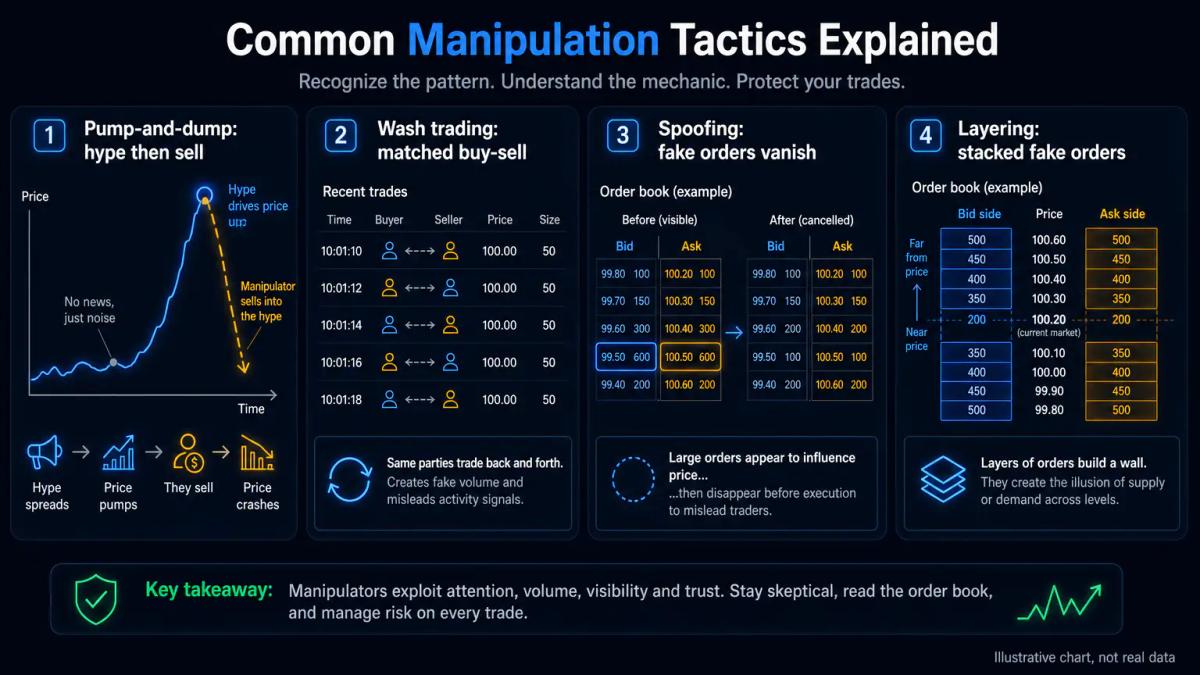
Manipulators rely on a small set of well-documented tactics, and each one exploits either human psychology or the reflexes of trading algorithms. Reading a suspicious chart with any confidence starts with knowing the mechanics of each tactic in enough detail to name what you are looking at.
| Tactic | What it does | What you see on the tape |
|---|---|---|
| Pump-and-dump | Insiders hype a thinly traded stock, then sell into retail buying | Vertical price rise, heavy promotion, no fundamental news |
| Wash trading | The same party buys and sells to itself to fake volume | Volume surge with a flat or narrow price range |
| Spoofing | Large orders posted with no intent to fill, cancelled before execution | Big bids or offers that appear and disappear seconds later |
| Layering | Multiple stacked orders at different prices to fake depth | Order book that thickens on one side, then vanishes |
| Marking the close | Aggressive trades in the final minutes to set the closing price | Unusual volume and price jumps in the last few minutes of the session |
A pip of context: pump-and-dumps target retail emotion, while spoofing and layering target the algorithms that scan the order book. Wash trading, defined as matched buys and sells by the same beneficial owner, sits between the two and fakes the volume signal that both humans and algos read as interest. Naming the tactic changes how the chart reads: what looked like a genuine rally begins to resolve into the outline of a coordinated setup.
How social media and influencers amplify modern manipulation
Modern stock manipulators lean heavily on social media platforms and paid or unpaid influencers to recruit the retail buyers a pump-and-dump needs. Coordinated posts, screenshots of alleged gains, chat-room tip sheets and celebrity endorsements manufacture urgency and false credibility. The story spreads faster than any fundamental check.
The tempo is what has changed most. A campaign that would have taken weeks of newsletter mail-outs in the 1990s can now run in hours across short-video platforms, group chats and forum threads. When a ticker trends alongside identical-sounding posts, screenshots of the same broker interface, and a countdown-style call to action, the pattern reads as the retail recruitment stage of a scheme rather than organic conviction.
Red flags and detection tools for identifying manipulation
Several tape-level signals recur across manipulated names, and any single one can have an innocent explanation. The signature of a manipulated market emerges when two or more of these appear together:
- Sudden spikes in volume with no matching news.
- Price gaps that ignore the fundamentals.
- Coordinated messaging across social platforms.
- Unusually large orders that vanish before execution.
Regulators and exchanges now run real-time surveillance algorithms that flag suspicious order-to-trade ratios, cancellation rates and matched-party trades. The order-to-trade ratio, defined as the number of orders sent for each order actually filled, is one of the core spoofing tells. For example, a trader who posts a thousand orders and executes ten is behaving very differently from one who posts twenty and executes eighteen. Exchanges also cross-reference beneficial ownership across accounts to catch wash trades that hide behind different broker IDs.
Retail traders have simpler tools, and they are enough when used together. Before entering a suspicious name, layer three checks:
- Volume against the stock's usual range.
- Price action against a credible news source.
- The promotion trail on social platforms.
If the volume spike has no filing, no earnings release, and no exchange announcement behind it, the move should be treated as suspect and left alone.
SEC enforcement and penalties for market manipulation
The U.S. Securities and Exchange Commission (SEC) prosecutes market manipulation under federal securities laws, and the sanctions include fines, disgorgement (the court-ordered return of illicit profits), industry bars, and criminal referral to the Department of Justice. Prison sentences are on the table for the most serious pump-and-dump and fraud cases.
According to the U.S. Securities and Exchange Commission (2025), the agency filed 456 enforcement actions in fiscal year 2025, including 303 standalone actions, and obtained orders for monetary relief totalling $17.9 billion. That relief broke down into $10.8 billion in disgorgement and prejudgment interest and $7.2 billion in civil penalties. The agency also returned roughly $262 million to harmed investors and paid approximately $60 million in awards to 48 whistleblowers.
The cases behind those figures are worth reading in full. The SEC alleged that Paramount Management Group and Daryl F. Heller ran a Ponzi scheme that defrauded around 2,700 investors and produced $400 million in losses, while First Liberty Building & Loan and its owner Edwin Brant Frost IV were charged over an alleged scheme that took more than $140 million from roughly 300 investors. Penalty design aims to strip the profit motive out of manipulation, and the numbers reflect that intent. In a separate enforcement sweep, the U.S. Securities and Exchange Commission brought 95 actions and obtained $2.3 billion in penalties against firms engaged in systematic violations.
How to protect your portfolio from manipulation schemes
Protection starts with a few boring habits that most retail traders skip:
- Diversify across uncorrelated assets.
- Stay away from stocks that spike on volume you cannot explain.
- Ignore unsolicited tips from anonymous social accounts.
The riskiest terrain tends to be the thinnest. Penny stocks, micro-cap tickers and illiquid over-the-counter names give manipulators room to move a price with modest capital, which is why so much documented manipulation clusters there.
Order type is a practical lever. When entering a volatile name, a limit order (an instruction to trade only at a set price or better) prevents a spoofed order book from filling you at a bad print, and a stop loss (an automatic exit that caps your downside) should be set at the same time as the entry, so the risk cap does not depend on remembering to add it later. Combine those order-level defences with three quick checks:
- Verify any thesis against official filings on EDGAR, the company's investor relations page, and credible primary reporting.
- Favour liquid, well-regulated markets where manipulation is harder and surveillance is closer.
- Size positions modestly, especially in names you cannot fully explain.
For example, a trader who takes a $2,000 position in a $500 million micro-cap with a limit order and a preset stop is materially better protected than one who market-buys the same ticker after seeing it trend on a group chat.
Reporting suspected manipulation and your role as a witness
If you suspect market manipulation, report it to the SEC through its online tip, complaint and referral system, and flag it to your broker's compliance team. Your report does not need to be a complete case; regulators build cases by combining tips, order data and trading records across many accounts.
According to the U.S. Securities and Exchange Commission (2025), the agency received a record 53,753 tips, complaints and referrals in fiscal year 2025, nearly 19 percent more than the prior year. Whistleblowers who supply original information that leads to a successful action can qualify for monetary awards. Even circumstantial evidence, a screenshot of a coordinated promotion, a trade confirmation showing a suspicious fill, contributes to enforcement work that recovers money for harmed investors.
Frequently Asked Questions
What is the difference between market manipulation and insider trading?
Market manipulation is the deliberate distortion of a security's price or volume through tactics like pump-and-dump, spoofing or wash trading. Insider trading is buying or selling based on material, non-public information about the company. Manipulation targets the trading process itself, while insider trading exploits an information advantage.
Can retail traders be prosecuted for participating in a pump-and-dump scheme without knowing it?
Retail traders who simply buy a stock that turns out to be manipulated are victims, not defendants. Prosecution focuses on organisers, promoters and anyone who knowingly coordinates the scheme. If you promote a stock in exchange for compensation without disclosing it, or knowingly help coordinate buying and selling, you can be charged.
How do I report suspected stock manipulation to the SEC?
Submit a report through the SEC's online Tips, Complaints and Referrals portal. Include the ticker, dates, screenshots of suspicious promotion, and any trade confirmations you have. If you have original information, review the SEC whistleblower programme, which paid roughly $60 million to 48 individuals in fiscal year 2025.
What are the most common stocks targeted by manipulators?
Thinly traded penny stocks, micro-cap tickers and over-the-counter names are the usual targets because a small amount of capital can move the price. Recently listed or lightly followed shares with limited analyst coverage are also frequent targets, and any stock that lacks liquidity gives manipulators the room to run a scheme.
How can I tell if a stock price spike is legitimate or manipulated?
Cross-check the move against three things: an official filing or exchange announcement, coverage from credible primary sources, and the stock's normal volume range. A legitimate rally has a traceable cause. A spike with heavy volume, no filing, and coordinated social promotion behind it is a classic manipulation signature.
About the authors


Put this into practice
Related articles

Stop-Loss Orders: Definition & Usage
Learn what stop loss orders are, how they work, and how to place them effectively. Understand stop loss placement strategies to manage trading risk.

Take Profit Orders: Definition and Usage
Learn what take profit orders are, how they work, and how to set effective profit targets. A clear guide to securing gains in your trades.

Taxable Brokerage Account: How It Works and When You Need One
How a taxable brokerage account is taxed, when it beats a retirement account, and the rules that shape harvesting losses, margin, inheritance and foreign holdings.
0 comments