


Financial Markets · Advanced · 8 min read
Taxes on Trading Income in Ireland: Rates, Rules, and Reporting
How trading income is taxed in Ireland
This article is general information for Irish-resident traders and is not tax advice; your facts need checking with a qualified Irish tax adviser or the Revenue Commissioners before you file.
The Irish tax treatment of your trading P&L turns on one upstream question that gets settled before any rate is applied. Where the Revenue considers your activity to be a trade, your net profits fall under income tax at your marginal rate, which currently sits at 20% or 40%, with the Universal Social Charge (USC) and PRSI layered on where they apply. Where the Revenue instead treats you as an investor, your gains come under Capital Gains Tax at a flat 33%, reduced by a modest annual exemption. What drives that distinction is the badges of trade, and the label you ticked in your broker application has almost no weight. For a high-rate taxpayer, the practical gap between the two regimes is considerable: once income tax, USC and PRSI stack up on a Case I profit, the effective burden can comfortably exceed half of each euro earned, whereas an investor pays only a third of the chargeable gain. Loss relief, filing cadence and record-keeping all shift with the classification as well.
Badges of trade: when the Revenue sees you as a trader
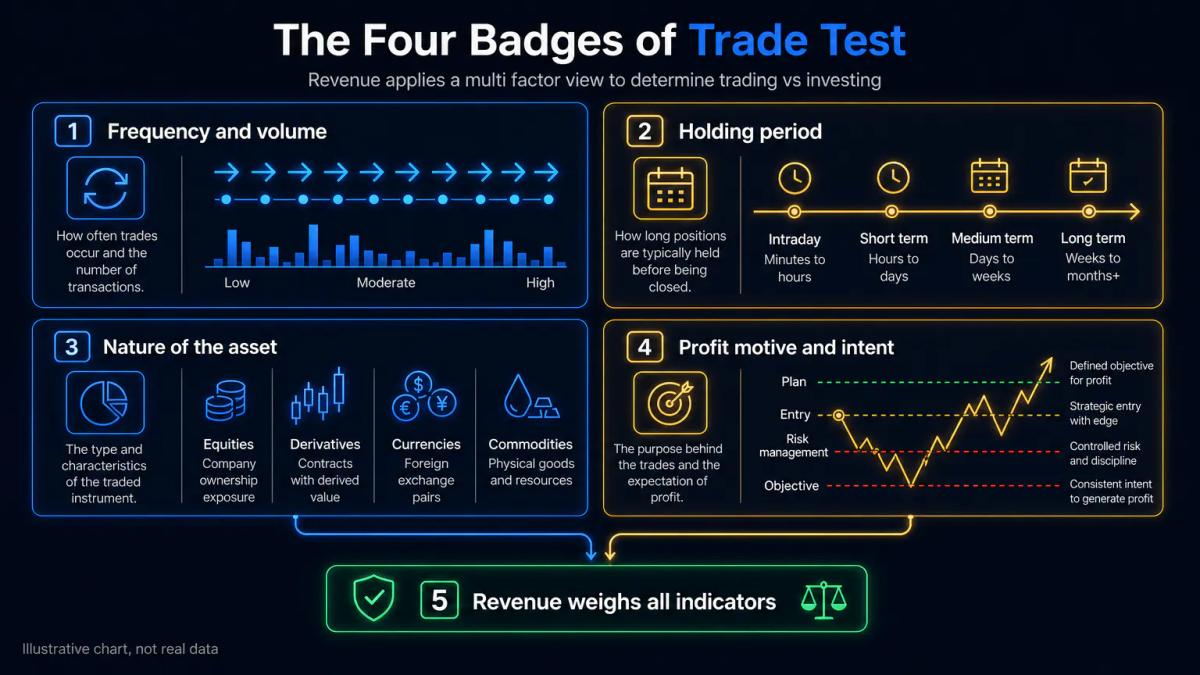
The badges of trade are the practical tests the Revenue applies when deciding whether gains should be treated as trading income or as capital gains. There is no single decisive factor, and the inspector will instead weigh the overall pattern of behaviour across several indicators before reaching a view.
- Frequency and volume: hundreds of round-turns a year point to a trade; a handful of positions a year rarely does.
- Holding period: intraday and multi-day positions lean toward trading; multi-year holdings lean toward investing.
- Nature of the asset: leveraged derivatives, CFDs and FX pairs produce no yield and are presumptively acquired to resell at a profit.
- Organisation: a dedicated setup, systematic strategy, written risk rules and separate records indicate commercial activity.
- Reliance on the activity: using trading proceeds to meet living costs supports trade status.
- Intention at acquisition: documented short-term intent weighs heavily.
- Financing: trading funded by borrowing or margin is more consistent with a trade than with investment.
Suppose you place around 400 CFD trades a year on major FX pairs, run a 2% risk-per-trade rule, hold positions for hours or days, and draw monthly income from the account to supplement your salary. In that situation, the combined picture across frequency, instrument, organisation and reliance would typically push the Revenue toward trade status, whether the net annual result is a profit or a loss. Taken on its own, no single badge is capable of settling the question.
Capital Gains Tax rates and when they apply instead
Capital Gains Tax applies when the Revenue classifies your activity as investment. The rate is a flat 33% on the chargeable gain, calculated as disposal proceeds minus the base cost and allowable incidental costs of acquisition and disposal (brokerage, stamp duty on Irish shares, transfer fees). The first €1,270 of annual gains per individual is exempt; this personal exemption is not transferable between spouses.
CGT is paid in two separate periods under the self-assessment regime. For disposals made between January and November, the tax is due by 15 December of the same year, while for disposals made during December the payment deadline moves to 31 January of the following year. The CGT return itself is filed by 31 October of the following year, either through Form CG1 or on your Form 11 if you are a chargeable person. For a high-rate PAYE investor, a 33% CGT charge is considerably lighter than 40% income tax layered with USC and PRSI, which is why the line between trader and investor status so often determines the real outcome on an Irish return.
Trading losses and how to offset them
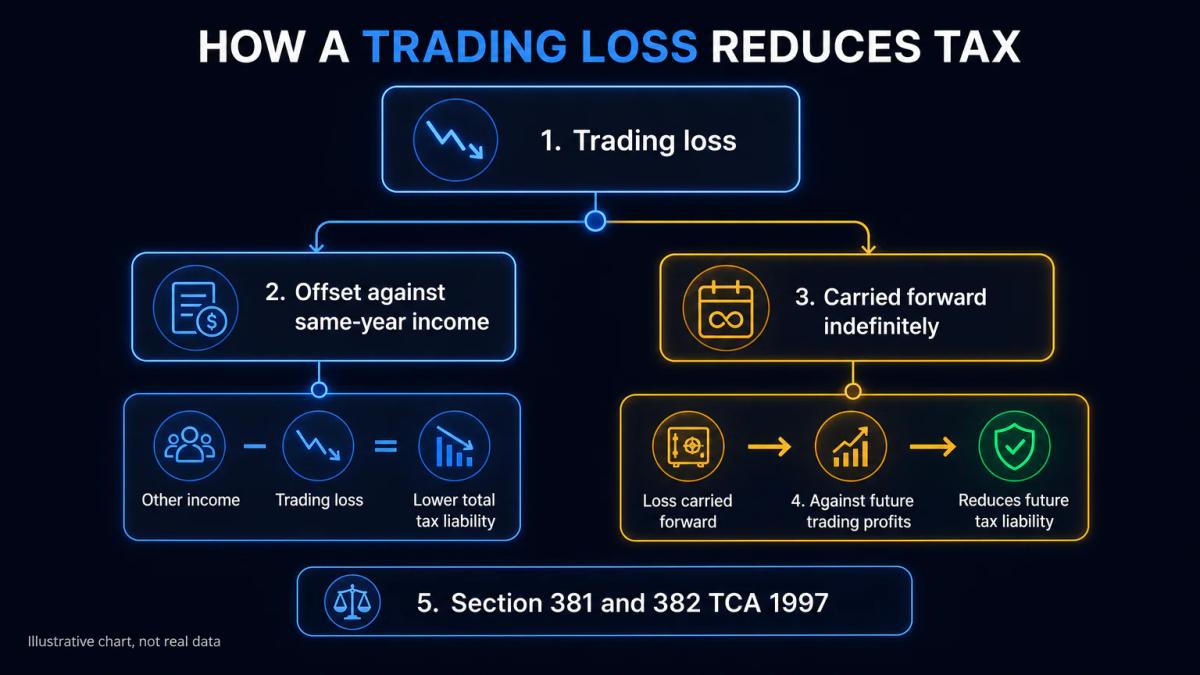
Loss relief is one area where accepting trader classification can repay the higher headline rates. Where profits (or losses) arise under Case I or Case II of Schedule D, trading losses may be set against other income of the same year under section 381 TCA 1997, or carried forward indefinitely against future profits of the same trade under section 382. Capital losses, by contrast, are confined inside the CGT ring-fence: they offset chargeable gains in the same year, any excess is carried forward against future gains, and they cannot be used to shelter salary, dividend income or interest.
Imagine two consecutive years of activity that qualify as a trade. In year one, trading produces a net loss of around €15,000 while PAYE salary sits in the mid five figures; a section 381 claim could then relieve that loss against total income for the same year, trimming the income tax and USC bill at the marginal rate. In year two, trading turns a profit of a similar size, and because no residual loss remains to be carried forward, that profit is taxed in full at marginal rates. Had the same person instead been classified as an investor, the year-one loss would have sat idle until a future capital gain arose to absorb it. The relief claim has to be made within two years of the end of the tax year in which the loss arose, and the supporting documentation must be complete.
Day trading and short-term position taxation
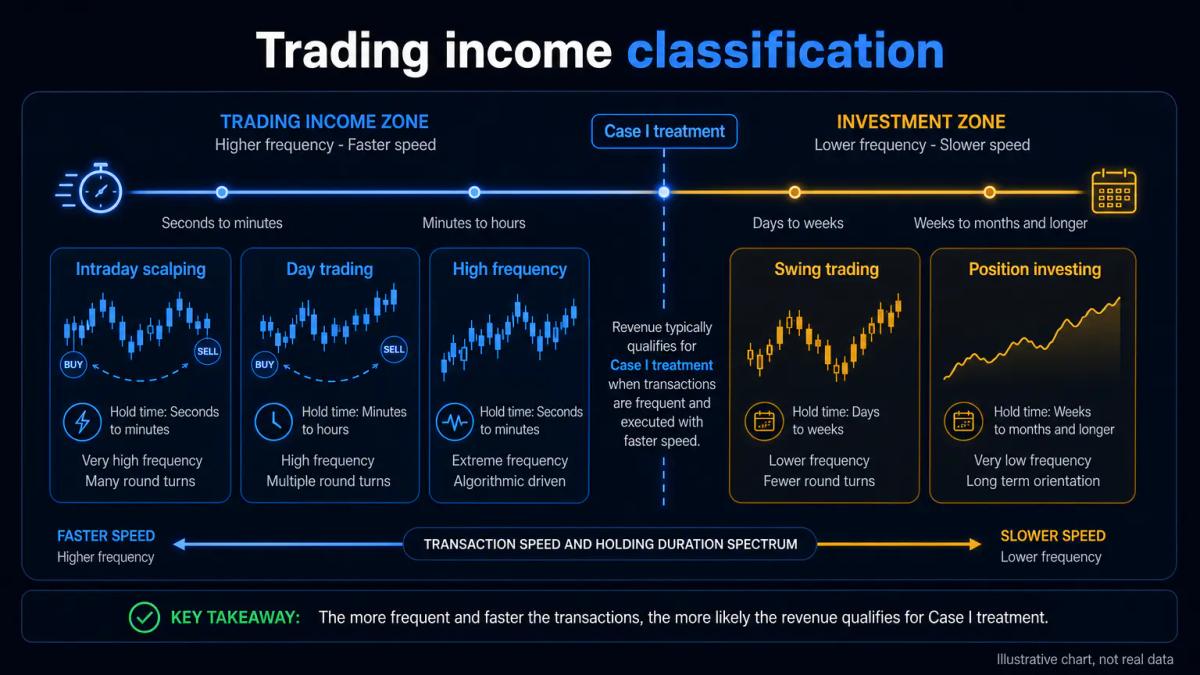
Day trading, scalping and systematic short-horizon strategies are the archetypal fact pattern for trade status, and they typically show the following combination of features:
- high frequency
- short holding periods
- derivative instruments
- organised execution
- frequent reliance on the activity for income
If you day trade from an Irish address, the sensible planning assumption is Case I treatment, which means taking a 33% CGT outcome off the table as a working baseline.
For forex tax Ireland purposes, there are two sub-cases worth working through. Spot FX and FX CFDs held by a classified trader fall under Case I, so net annual profit is treated as income and any net loss can be relieved. Spread betting on currencies through a UK-licensed provider is a grey area in an Irish context; where the Revenue holds the activity to be a trade, the winnings are trading income, whereas where the activity is held to be a wager, it falls outside both income tax and CGT. For an active, systematic account, the safer default is to treat the result as trading income unless a specific Revenue opinion indicates otherwise.
On cadence, income tax under self-assessment runs on an annual rather than a quarterly cycle, with preliminary tax due by 31 October and the balancing payment on the same date in the following year. Advanced traders operating a VAT-registered activity, carrying significant staff costs or trading through a company structure will have additional reporting cycles layered on top, though a retail CFD trader does not have a US-style quarterly filing obligation.
Dividend income and interest from trading accounts
Dividends and interest sit outside the trading-versus-investing argument and have their own treatment. Irish dividends arrive with Dividend Withholding Tax at 25% deducted at source; the gross amount is then taxable at your marginal income tax rate, with USC and PRSI applying, and the DWT is credited against the final liability. Foreign dividends are taxable at marginal rates on the gross amount, with credit for foreign withholding under the relevant double tax treaty.
Deposit interest from Irish institutions is subject to Deposit Interest Retention Tax, whereas interest earned on broker cash balances held at non-Irish institutions is reported directly on your return and taxed at marginal rates. ETFs sit in a separate regime of their own: Irish and EU UCITS ETFs are generally subject to exit tax at 41% on gains and distributions, with a deemed disposal every eight years, and they fall outside both CGT and the Case I trading computation. For active traders rotating in and out of ETFs in the expectation of 33% CGT or Case I loss relief, that treatment can be a trap, since neither regime is available.
Ireland does not offer an ISA-style wrapper for retail investors. The closest available shelters are pension vehicles such as a PRSA or occupational scheme, together with the Employment Investment Incentive, though none of these is well suited to a CFD or active-equity trader.
Record-keeping and tax reporting requirements
Section 886 TCA 1997 requires trading records to be kept for six years from the end of the tax year to which they relate. For an active trader, that record-keeping obligation translates into a detailed per-position log, and the required fields are set out in the list below:
- instrument traded
- direction of the position
- position size
- entry and exit timestamps
- entry and exit prices
- commissions
- financing or swap costs
- realised result in euro
- FX rate used to translate any non-euro P&L
A broker statement on its own is unlikely to satisfy an audit, as the Revenue typically expects to see a reconciled trade log that ties cleanly to bank and broker movements.
On the question of how to declare trading profits Ireland, a chargeable person files Form 11 under self-assessment through ROS, with the different income streams reported in their respective panels:
- Case I trading profits are entered in the self-employment section
- CGT disposals are entered in the capital gains panel
- Foreign dividends and interest are entered in their respective foreign income panels
Preliminary tax for the current year and the balancing payment for the prior year are both due by 31 October, with a mid-November extension available on ROS. Late filing triggers a capped surcharge of 5% up to two months and 10% thereafter, together with daily interest on any unpaid tax. For crypto, the classification logic runs along the same lines: active and systematic crypto trading sits in Case I, occasional disposals fall under CGT at 33%, and token-to-token swaps count as taxable events under either regime.
Frequently Asked Questions
Is day trading taxed differently from long-term investing in Ireland?
Yes. Day trading typically meets the badges of trade and is taxed as Case I income at marginal rates (20% or 40%) with USC and PRSI, while long-term investing is taxed under CGT at a flat 33% on the gain with a €1,270 annual exemption. The regimes differ not only in rate but in how losses and expenses are treated.
How do I know if the Revenue will classify me as a trader or investor?
There is no bright-line test. The Revenue weighs the badges of trade: frequency and volume of transactions, holding period, the nature of the instruments, whether the activity is organised and systematic, reliance on the proceeds, and intent at acquisition. If several badges point to a commercial, short-horizon operation, expect trade classification regardless of the label on your broker account.
Can I offset trading losses against other income in Ireland?
If you are classified as a trader under Case I of Schedule D, yes: section 381 TCA 1997 allows current-year trading losses to be set against your total income, and section 382 allows unused losses to be carried forward indefinitely against future profits of the same trade. If you are an investor, capital losses are ring-fenced to CGT and can only shelter other capital gains.
What records do I need to keep for tax purposes as a trader?
Section 886 TCA 1997 requires records for six years. For each position, keep instrument, direction, size, entry and exit timestamps and prices, commissions, swap or financing costs, realised result and the FX rate used for non-euro translation. Reconcile this trade log to bank and broker statements; a broker report in isolation will not suffice if the Revenue opens an enquiry.
Are cryptocurrency trades taxed the same way as stock trades in Ireland?
The classification logic is the same: active, systematic crypto trading is treated as a Case I trade and taxed at marginal income tax rates, while occasional disposals are CGT disposals at 33%. Token-to-token swaps, spending crypto on goods and services, and crypto earned from staking or mining are all taxable events, and each has to be valued in euro at the time of the transaction.
About the authors


Put this into practice
Brokers we have reviewed
Scored on the same five dimensions. Here are three of them — the full list is on the brokers page.



Related articles

The Crypto Market Has Matured: Here Is What Investors Are Watching in 2026
The crypto market has matured. Here is what institutional investors and informed traders are actually tracking in 2026.
Trading Halts Explained: Circuit Breakers, Suspensions, and Delays
Trading halts freeze a stock, or an entire market, when volatility, news or order imbalances threaten orderly pricing. Here is how they work and what they mean for your portfolio.

Types of ETFs: a practical guide to equity, bond, commodity and specialty funds
The main types of ETFs, from broad market equity funds to leveraged and ESG options, and how to match each to your goals, costs and risk tolerance.
0 comments