


Financial Markets · Advanced · 7 min read
How Trading Income Is Taxed in the Philippines: A Trader's Guide
How trading income is taxed in the Philippines
This article is general information, not tax advice; confirm your position with a Philippine-licensed tax professional before you file.
Whether your trading P&L lands in graduated personal income tax, in an instrument-specific capital gains regime, or in withholding at source depends on how the Bureau of Internal Revenue (BIR) characterises your activity under the NIRC (as amended by the TRAIN Law, Republic Act 10963). Residency then sets the scope of what the BIR can reach, with citizens and resident aliens taxed on worldwide income while non-residents are reached only on Philippine-source income. The sections that follow work through brackets, CGT treatment, withholding mechanics, BIR filing, deductible costs, loss carryforwards, and the crypto overlay the BIR has been tightening through recent revenue issuances.
Income tax rates and brackets for traders
Individual traders classified as engaged in business are taxed on net income under the graduated schedule of Section 24(A) of the NIRC, as amended by the TRAIN Law and refined by the CREATE Act. Annual taxable income up to PHP 250,000 is exempt, while the top marginal rate of 35% kicks in on income above PHP 8,000,000, applied only to the amount sitting inside that top band.
For the current schedule the BIR publishes under TRAIN:
| Taxable income (PHP) | Marginal rate |
|---|---|
| 0 to 250,000 | 0% |
| 250,000 to 400,000 | 15% on excess over 250,000 |
| 400,000 to 800,000 | 20% on excess over 400,000 |
| 800,000 to 2,000,000 | 25% on excess over 800,000 |
| 2,000,000 to 8,000,000 | 30% on excess over 2,000,000 |
| Over 8,000,000 | 35% on excess over 8,000,000 |
Self-employed and professional traders whose gross receipts do not exceed the VAT threshold may elect the 8% flat tax on gross receipts in lieu of graduated rates and percentage tax, under Section 24(A)(2)(b), with the election made annually and locked in once the first-quarter return is filed.
Capital gains tax on investment trading
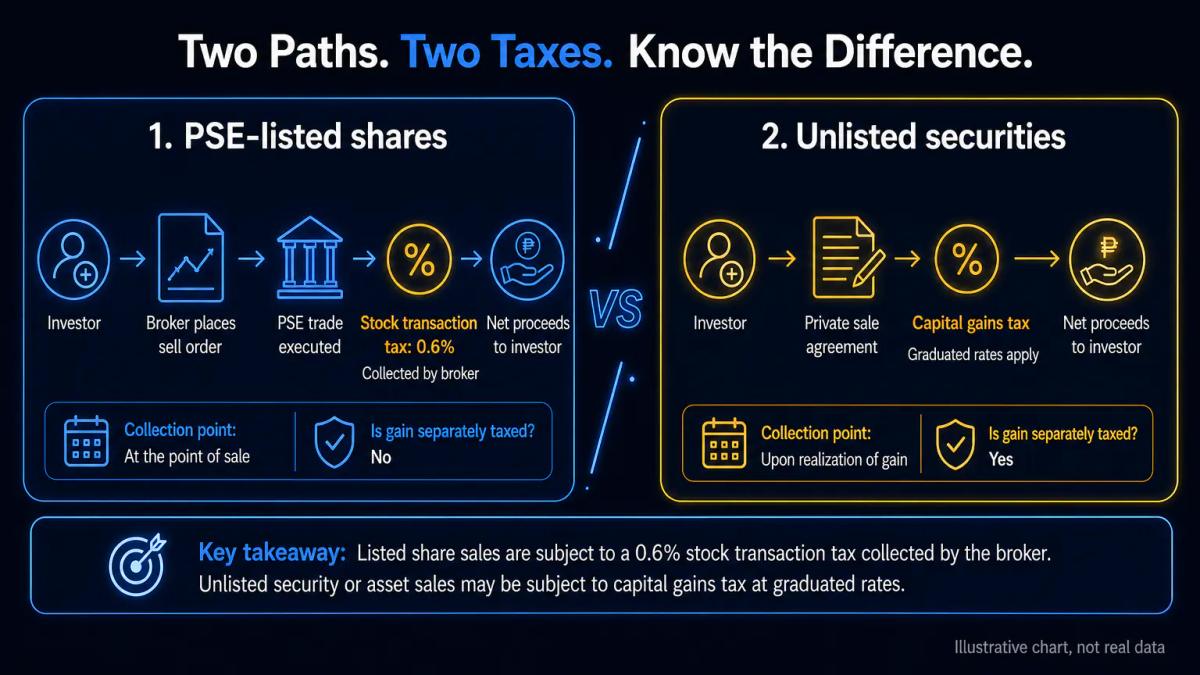
Capital gains in the Philippines are taxed by instrument rather than by holding period, so there is no short-term versus long-term CGT split equivalent to the US system. The main regimes an individual trader encounters are:
- PSE-listed shares of a domestic corporation: a stock transaction tax of 0.6% of gross selling price under Section 127(A), collected by the broker, with no separate tax on the net gain.
- Non-listed shares of a domestic corporation: 15% CGT on the net capital gain under Section 24(C).
- Real property classified as a capital asset: 6% CGT on the higher of gross selling price or fair market value.
- Foreign-listed equities, forex pairs and CFDs offered by offshore brokers: outside the Philippine CGT regime, so residents report them as ordinary income from trading or other sources, taxed at the graduated rates above.
Withholding tax on dividends and interest
For resident individuals, withholding at source is generally final on investment income, meaning the gross amount is not added back to the taxable base on Form 1701. The rates that most commonly affect traders include:
- Cash and property dividends from a domestic corporation: 10% final withholding tax under Section 24(B)(2).
- Peso bank deposits and deposit substitutes: 20% final withholding tax under Section 24(B)(1), climbing to 25% for long-term deposits pre-terminated inside four years and falling to zero for qualifying long-term deposits held the full term.
- Foreign-currency deposits in an FCDU account: 15% final withholding tax.
- Non-residents: treaty-modified rates apply where a double taxation agreement is in force.
Tax residency and filing requirements
Residency drives both the scope of taxation and the form you file. Filipino citizens are taxed on their worldwide income, while a resident alien (a foreign national living in the Philippines without a definite departure intention) is reached only on Philippine-source income. A non-resident alien present in the country for an aggregate of more than 180 days in the calendar year is treated as engaged in trade or business and taxed on Philippine-source income at graduated rates, whereas presence below that threshold triggers a 25% flat rate on gross Philippine-source income under Section 25(B).
Filing mechanics for individual traders:
- BIR Form 1700: purely compensation income, not for active traders.
- BIR Form 1701: mixed income or self-employed, including those taxed as business.
- BIR Form 1701A: purely self-employed or professional under 8% flat or graduated rates with OSD.
- BIR Form 1701Q: quarterly returns, due 15 May, 15 August, 15 November.
- Annual return deadline: 15 April of the following year.
- BIR Form 2316 and 2307: attach for creditable withholding.
Register as self-employed through BIR Form 1901, keep registered books of accounts, and issue official receipts if your activity rises to a trade or business.
Deductible expenses and trading losses
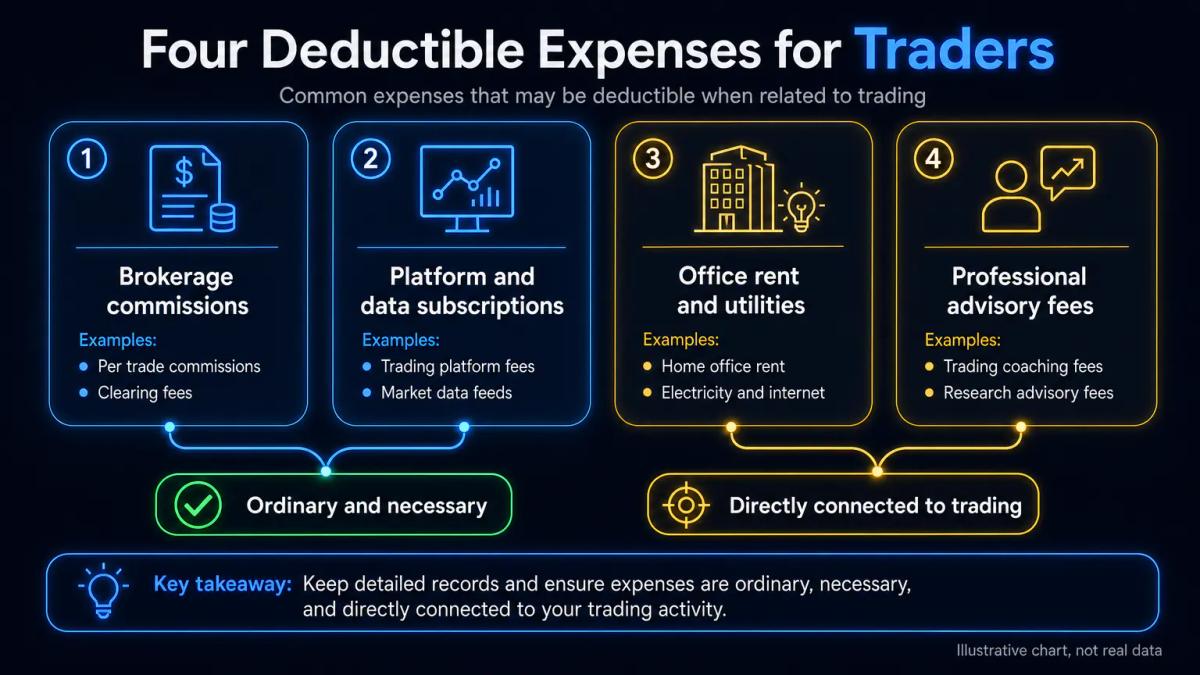
Traders filing under the graduated rates may elect either itemised deductions or the Optional Standard Deduction (OSD) of 40% of gross income under Section 34(L). Itemised deductions demand documentation under Section 34(A), with each cost being ordinary, necessary and directly connected to the trading activity.
Typical deductible items for an individual trader on itemised:
- Brokerage commissions and clearing fees supported by broker contract notes.
- Platform, data feed and charting subscriptions (TradingView, Bloomberg terminal access).
- Interest on margin financing from a Philippine-regulated broker.
- Professional fees (CPA, tax counsel, compliance).
- Depreciation on dedicated hardware under Section 34(F), straight-line or declining balance.
- Home office allocation on a square-metre basis, where exclusively used.
- Local business taxes paid to the LGU and BIR annual registration fee.
Net operating loss carryover (NOLCO) under Section 34(D)(3) allows a business-classified trader to carry net operating losses forward for three consecutive taxable years, provided there has been no substantial change in ownership and the loss did not arise from an exempt activity. These losses cannot be set against final-tax income such as dividends or bank interest, and capital losses on non-listed shares can only offset capital gains under Section 39, with no shelter available for ordinary income.
Electing the 8% flat tax removes itemised deductions altogether, so the lower headline rate comes at the cost of deductibility.
Cryptocurrency and digital asset taxation
The BIR treats digital assets as property, so the tax treatment tracks the character of the activity. Frequent, systematic crypto trading is treated as ordinary income from business and reported on Form 1701 at graduated rates (or at 8% flat where elected and under the VAT threshold). Occasional disposals by a non-dealer sit instead inside the capital gains framework; because the assets are non-listed, the gain is taxed at graduated rates, with the Section 39 holding-period rule allowing an individual to recognise only half of a gain held for more than 12 months.
The BSP registers Virtual Asset Service Providers under Circular 1108, and the BIR increasingly cross-matches on-ramp and off-ramp fiat flows against declared income. Keep a transaction ledger with timestamps, counterparties, PHP valuation at trade time (using a consistent reference such as a BSP-registered exchange rate), gas or network fees, and wallet addresses. Mining, staking rewards, airdrops and play-to-earn receipts are income at fair market value on receipt, with a fresh cost basis for later disposal.
Several structuring levers sit inside the law for traders willing to plan ahead:
- Elect the 8% flat tax where you are under the VAT threshold and your deductible expenses are light.
- Time disposals of non-listed shares across tax years to make full use of NOLCO.
- Favour PSE-listed equities, where the 0.6% stock transaction tax closes out the trade with no further income tax on the gain.
- Hold bank deposits in instruments that qualify for the long-term interest exemption.
- Keep trading-business books separate from personal investment books, so your classification is defensible on audit.
Frequently Asked Questions
Do I pay tax on trading losses in the Philippines?
No, you do not pay tax on a loss, but you need to recognise it correctly. If you are classified as engaged in a trading business, net operating losses carry forward three taxable years under Section 34(D)(3) of the NIRC (NOLCO) and offset future ordinary income, provided ownership continuity is maintained. Capital losses on non-listed shares offset only capital gains under Section 39, not ordinary income, and losses on final-tax income such as bank interest cannot be used at all.
What is the difference between day trading and investment trading for tax purposes in the Philippines?
The BIR looks at frequency, regularity, holding periods, scale of capital, use of leverage, and whether trading is your principal income source. A day trader with daily turnover, margin facilities and trading as primary livelihood is engaged in a trade or business: net income is taxed under the graduated schedule or the 8% flat on gross receipts. An investor making occasional disposals is taxed under the instrument-specific regimes (STT for PSE-listed shares, 15% CGT for non-listed, final withholding for dividends and interest).
How do I report foreign trading income to the Philippine tax authority?
Filipino citizens and resident aliens taxed as residents report worldwide income, including profits from offshore brokers, foreign-listed equities, forex and CFDs, on BIR Form 1701 or 1701A at graduated rates or the 8% flat if elected. Convert each realised transaction to PHP using a consistent BSP reference rate. Foreign tax paid on the same income may be credited under Section 34(C)(3), capped by the Philippine tax attributable to that foreign income, with the credit claimed on the annual return and supporting documents retained.
What tax forms do individual traders need to file in the Philippines?
Register the trading activity through BIR Form 1901. File quarterly returns on BIR Form 1701Q (deadlines 15 May, 15 August, 15 November) and the annual return on BIR Form 1701 (mixed or complex) or 1701A (purely self-employed or professional) by 15 April of the following year. Attach BIR Form 2307 for creditable withholding and BIR Form 2316 if you also have compensation income. Keep registered books of accounts and official receipts available for audit.
Can I deduct trading platform fees and commissions from my taxable income?
Yes, if you file as engaged in a trading business under graduated rates with itemised deductions. Brokerage commissions, clearing fees, exchange fees, platform and data feed subscriptions, margin interest, professional fees and depreciation on dedicated equipment are all deductible under Section 34(A) when ordinary, necessary and documented with official receipts or broker contract notes. If you elect the 8% flat tax or the 40% Optional Standard Deduction, you forfeit itemised deductions and accept the headline simplification instead.
About the authors


Put this into practice
Brokers we have reviewed
Scored on the same five dimensions. Here are three of them — the full list is on the brokers page.


Related articles

How to Evaluate a Prop Firm Before You Buy a Challenge
Learn how to evaluate a prop firm before buying a challenge. Use this due diligence framework to vet payouts, rules, and red flags.

Index Funds vs Active Trading: Costs, Returns and Discipline
A side-by-side look at index funds and active trading: fees, diversification, behavioural traps and tax drag, with the evidence that tips the balance for most retail investors.

Index Trading: What Are Stock Indices and How to Trade Them
Learn what stock indices are, how they're calculated, and explore trading methods including ETFs, CFDs, futures, and options. A complete guide to index trading.
0 comments