



Prop Trading · Beginner · 3 min read
1 Step Challenge Prop Firm: How Single-Phase Evaluations Work
The single-phase evaluation, explained
Traders reach for a 1 step challenge prop firm when they want funded status without stepping through several stages of assessment. The format asks you to trade a simulated account, hit one profit target, and stay inside fixed drawdown limits along the way. A drawdown is the fall from a capital peak to the trough before a new peak. If you clear the target without breaching either limit, you move directly from evaluation to funded and start earning a share of the profits.
There is one caveat worth flagging before you commit. Most proprietary trading firms are not regulated brokers, so the consumer protections you would get from an FCA-authorised broker, such as segregated client money and FSCS cover, do not apply here. Reading the trading contract in full will tell you more than the marketing page ever will, and it is where the rules that actually govern your account are written down.
If a funded account is your goal, our roundup of the best prop firms is the place to start.
Profit targets and drawdown rules
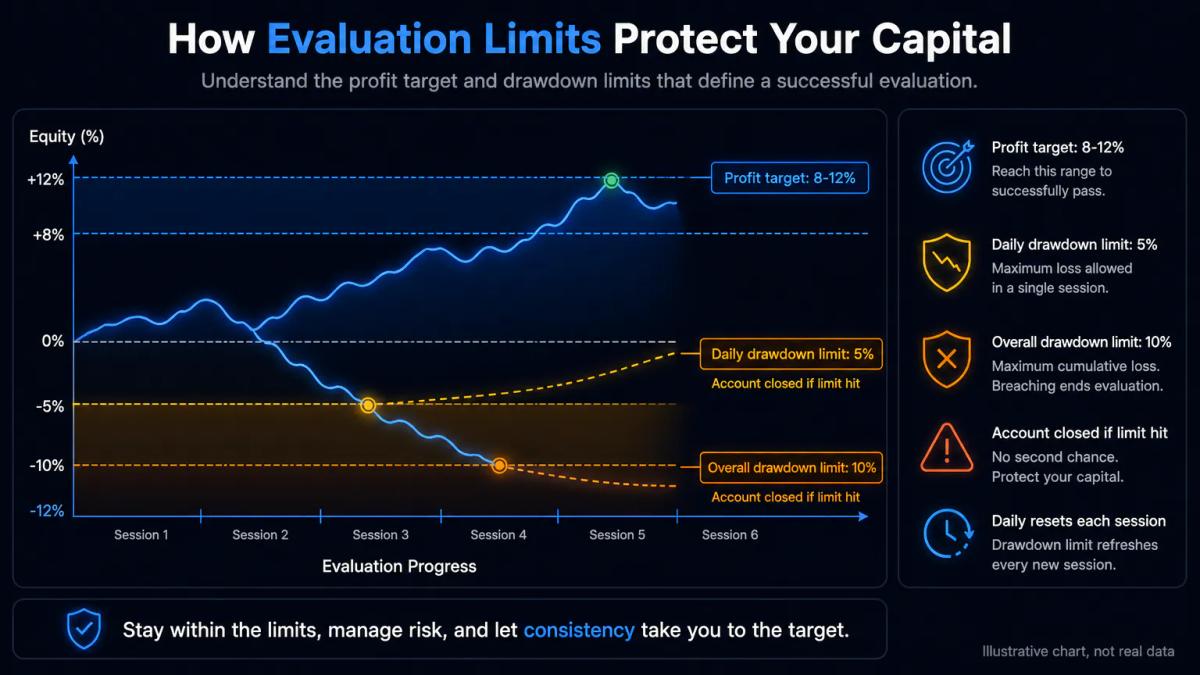
Most 1 step programs set a profit target between 8% and 12% of the account size, paired with a daily drawdown (often 5%) and an overall drawdown (often 10%). The two limits behave differently: the daily figure resets each session, while the overall figure trails your equity for the life of the account. Confusing them is what ends most attempts. A trader chasing a lost setup blows through the daily limit and the account closes the same afternoon. Once you clear the target without breaching either limit, you graduate to a funded account with a profit split, usually 70% to 90% in your favour.
Account sizes and scaling
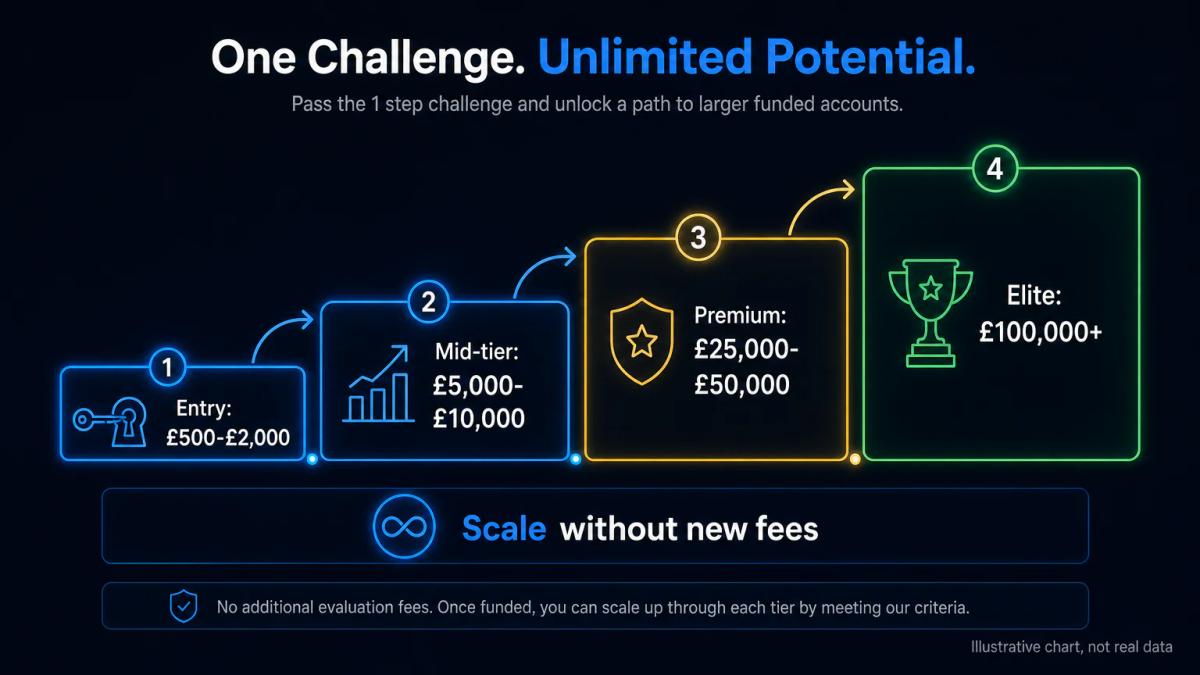
Entry-level 1 step challenges start around £500 to £2,000 of simulated capital, with premium tiers reaching £100,000 or more. After you pass and trade profitably on the funded account, many firms offer scaling plans: your allocation grows in steps if you maintain consistent returns over several months, so you trade larger position sizes without paying a new evaluation fee.
Speed and cost versus multi-step programs
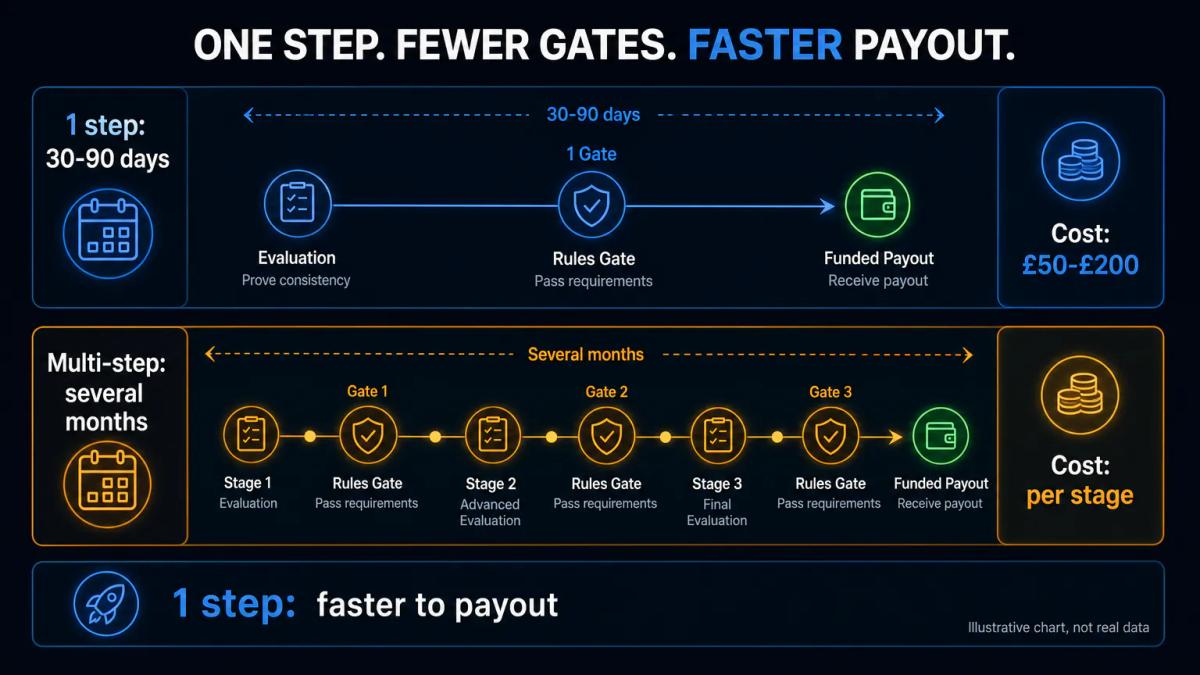
A 1 step challenge typically costs £50 to £200 upfront and takes 30 to 90 days to complete, while multi-step programs charge per stage and can span several months before you see a payout. The compressed timeline of a one phase evaluation comes with real intensity, since a single bad session can end the attempt before you get a second chance to recover. When comparing one step versus two step prop firm structures, weigh the total cost, the total time and how realistic the target looks against the drawdown you are allowed.
| Feature | 1 step challenge | 2 step challenge |
|---|---|---|
| Profit target | 8% to 12% in one phase | 8% to 10%, then 4% to 5% |
| Typical fee | £50 to £200 | £100 to £500 |
| Time to funded | 30 to 90 days | 60 to 180 days |
| Stress profile | Higher per session | Spread across stages |
Psychologically, the compressed timeline pushes some traders to oversize positions to reach the target quickly. Sticking to a fixed risk per trade (often 0.5% to 1% of the account) protects the drawdown buffer that keeps you in the challenge.
Payout frequency and withdrawal methods
Once you pass and enter the funded phase, most firms pay the profit share on a monthly or bi-weekly schedule. A minimum holding period of a few trading days is common before the first payout clears, so confirm the schedule before you buy the challenge if the timing affects your cash flow. Payouts from a prop firm count as self-employed trading income in the UK, so keep records of every payout and expense, and check your position with HMRC or a qualified accountant. Withdrawal methods vary by firm, and the common options are:
- Bank transfer.
- Card processors.
- Stablecoin rails, offered by some firms.
To compare these rules with a real firm's, the Kraken Prop review lays them out.
Frequently Asked Questions
How long does it take to complete a 1 step prop firm challenge?
Most traders take 30 to 90 days. There is usually no maximum time on a 1 step program, but the profit target and drawdown limits stay in force until you pass or breach a rule.
What happens if you fail a 1 step challenge evaluation?
The account is closed and the evaluation fee is not refunded. You can buy a fresh challenge and start again; some firms offer a reduced-cost reset if you breach a rule without losing all the buffer.
Can you withdraw money during a 1 step challenge?
No. The evaluation phase runs on simulated capital, so there is nothing to withdraw. Payouts only begin after you pass and trade the funded account through the firm's minimum holding period.
What is the typical profit split after passing a 1 step challenge?
Splits generally run from 70% to 90% in the trader's favour. Some firms start at 70% or 80% and raise the share as your account scales or after a set number of successful payouts.
About the authors


Put this into practice
Related articles

100K Funded Trading Account: What You Get and What It Costs
A plain-English breakdown of the 100K funded account: costs, splits, drawdown limits, tax treatment, platforms, psychology and how it stacks up against smaller sizes.

Best Prop Firm Forex EAs: Rules, Platforms and Real Performance
A working guide to choosing forex EAs for funded accounts: rulebooks, VPS setup, backtest hygiene, cost trade-offs and the risk parameters that keep you funded.

EA Prop Trading: How Automated Systems Work in Funded Accounts
A practical guide to running Expert Advisors on prop firm accounts: rules, MT5 configuration, backtesting, instruments, fees, tax, and pitfalls.
0 comments