


Prop Trading · Advanced · 9 min read
Prop Firm Consistency Rule: How It's Calculated and How to Pass It
The mechanism behind consistency rules
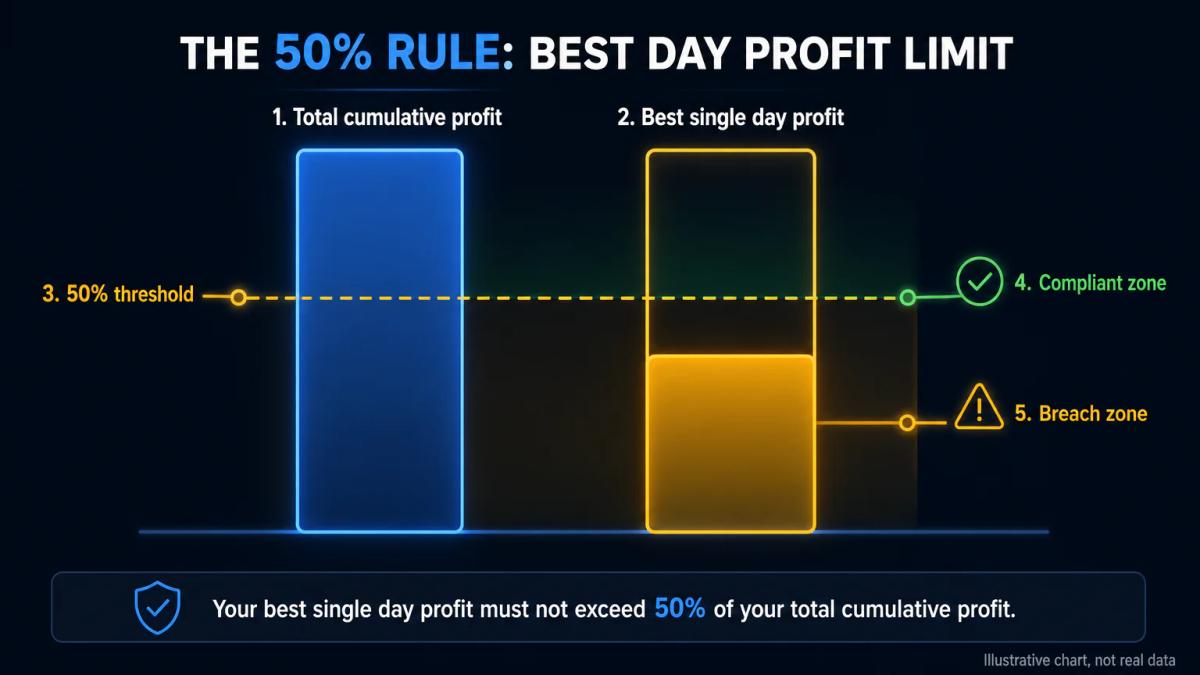
Prop firms impose a consistency rule to confirm that returns come from a repeatable process across multiple sessions, rather than from one or two outlier trades carrying the equity curve. The clause caps how concentrated your profit can be on any single day relative to the total or the average daily profit, with thresholds that usually sit between 30% and 50%. By measuring the dispersion of daily P&L, the risk engine can identify accounts whose performance leans heavily on a handful of large wins and flag them before a payout is approved.
Two calculation styles dominate the market, and each one answers the dispersion question in a different way.
- The first is the best-day rule, which compares your single largest profitable day against total net profit at the end of the evaluation or payout window; should that best day represent 50% or more of the total, you fail the cycle regardless of whether the overall return cleared the target. Your single largest profitable day is compared against total net profit at the end of the evaluation or payout window. Should that best day reach or exceed the threshold percentage, the cycle fails regardless of whether the overall return cleared the target.
- The second is the rolling-average rule, which compares each day's profit against the mean of your profitable days, usually over a window of 20 to 60 days, and flags any session that falls below (or occasionally spikes above) a fixed percentage band around that mean. Each day's profit is compared against the mean of your profitable days, usually over a 20 to 60 day window. Any session that falls below or occasionally spikes above a fixed percentage band around that mean triggers a flag.
Both variants exist to answer the same question the firm's risk desk is asking: is this trader's edge statistical or anecdotal. Consider a funded account that posts $4,000 across twenty sessions of around $200 each; operationally, that profile is far cheaper for the firm than another account posting the same $4,000 through nineteen flat days and a single $4,000 session. The second profile tends to blow up on the twenty-first session, which is precisely why the rule exists.
To trade with a firm's capital, compare the best prop firms and how their evaluations work.
Common consistency thresholds across the industry
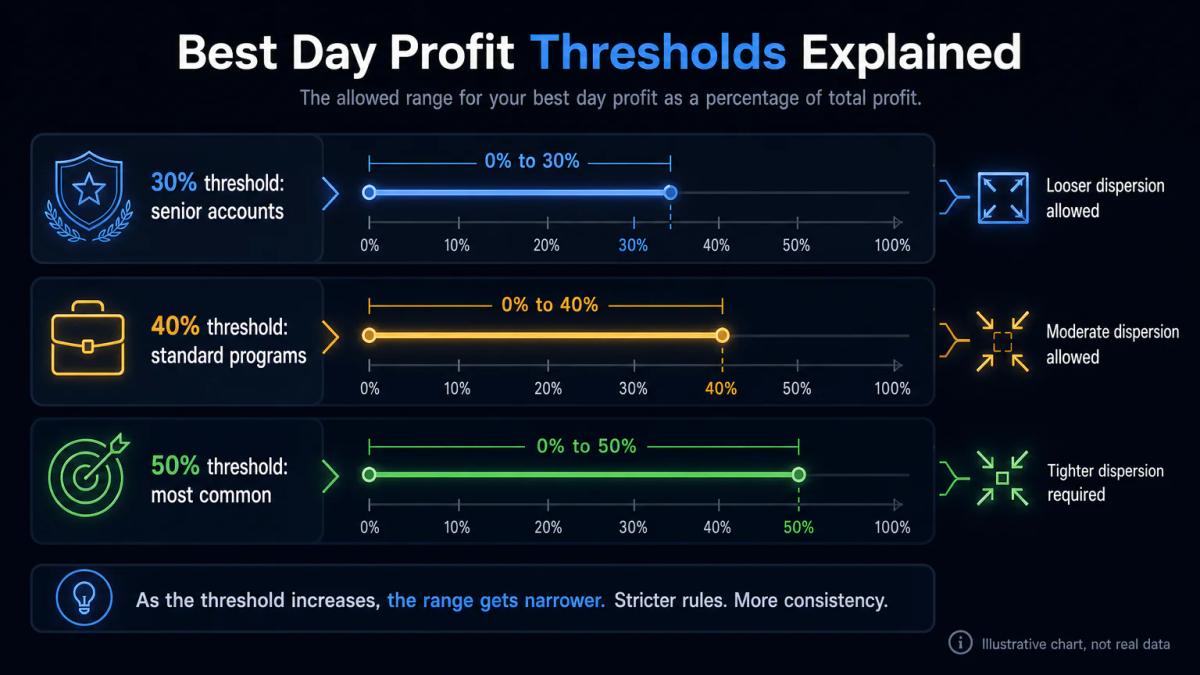
Most firms cluster around three threshold values, with the calculation window and the direction of the test being the real differentiators between programs. The three bands you will see most often are:
- 50% best-day rule: the most common configuration across the industry, used on standard evaluations and most funded tiers.
- 40% best-day rule: the typical choice for stricter programs, where the firm wants tighter dispersion before releasing a payout.
- 30% best-day rule: reserved for senior or scaled accounts, where very tight dispersion is required before the firm raises allocation.
- 50% best-day rule. The most common configuration across evaluation programs.
- 40% best-day rule. The standard for stricter programs and for firms targeting disciplined multi-session traders.
- 30% best-day rule. Reserved for senior or scaled accounts, where the firm wants very tight dispersion before raising allocation.
The table below sets out the configurations you will typically encounter when reading an evaluation agreement.
| Threshold | Metric compared | Typical window | Reading |
|---|---|---|---|
| 50% | Best day vs total net profit | Full evaluation phase | Best single day cannot exceed half of total profit |
| 40% | Best day vs total net profit | Full phase or payout cycle | Tighter dispersion, favours multi-session traders |
| 30% | Best day vs total net profit | Payout cycle on funded account | Senior tier, filters high-variance styles |
| 20-50% band | Daily P&L vs rolling average | 20-60 trading days | Each day must stay inside the band around the mean |
The arithmetic is linear and worth internalising before any session begins. If your largest winning day on a 50% best-day rule reaches $800, you will need at least $1,600 in cumulative net profit to clear the cycle, which means another $800 of profit distributed across the remaining days before you can request a payout. On a 40% rule, the same $800 best day forces $2,000 of total profit, so $1,200 across the other sessions. The threshold works as a multiplier that sets your minimum workload after any outsized session, with the compliance line following directly from the ratio.
Window length carries weight comparable to the percentage threshold when you plan your sizing. A rolling 20-day window forgets a bad day faster than a 60-day one, and that same short window also lets a single large day dominate the denominator for longer when you are early in the cycle.
How consistency violations affect your funded account
Violations are enforced automatically by the firm's risk engine, and the consequence depends on when the breach is detected. During an evaluation phase, a consistency breach generally resets or terminates the challenge, with the fee forfeit; a minority of firms allow a free retry for marginal breaches, though most do not. On a funded account, the common failure mode is a breach at payout review: the equity target is met, the breach is detected during audit, the payout is denied for that cycle, and the account is then locked, reset to starting balance, or closed outright depending on the clause.
Enforcement runs through the funding agreement you accepted at onboarding, which carries the consistency clause as a contractual term rather than a discretionary one. The risk engine computes the ratio on every closed trade, and there is no human review path once a 51% best-day lands on a 50% rule.
One specific trap is worth flagging before you accept your first funded cycle. Should you hit the profit target in just two sessions and request a payout, a 50% best-day rule will almost certainly reject you, since two sessions cannot be split under 50% unless they come out exactly equal. Traders new to funded accounts routinely close the target too fast and then discover that passing the P&L hurdle and passing the consistency hurdle are two separate problems.
Strategies to stay compliant with consistency requirements
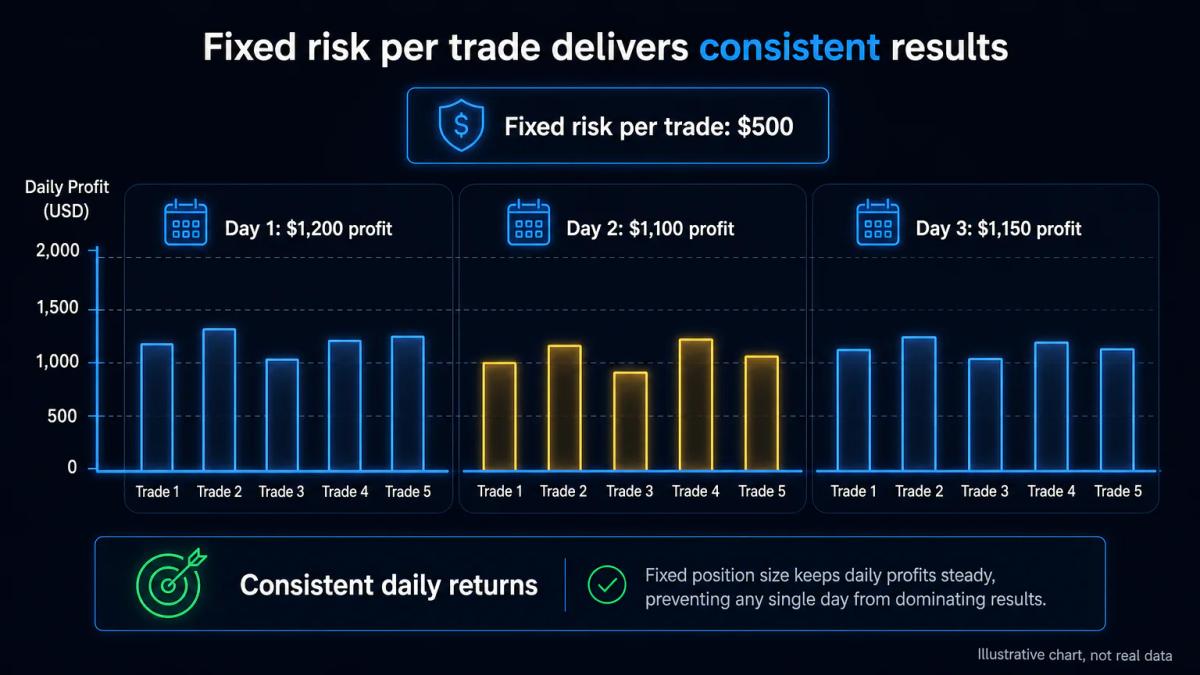
Staying compliant is primarily a position sizing and session management challenge, with strategy itself usually being the smaller part of the puzzle. The edge you traded through the evaluation already works; what tends to break down is the risk-per-trade distribution after a strong early session, when the temptation to keep pressing the position size grows.
- Fix risk per trade in currency terms for the duration of the cycle, keeping away from R-multiples or percent-of-equity sizing that would let the stake drift with the equity curve. Floating risk compounds the dispersion the firm is measuring, and that compounding tends to show up precisely on the day you hoped to clear the cycle.
- Set a hard daily profit cap that sits below your current implied ceiling. If your rule is 50% best-day and you are at $600 cumulative, your next best-day ceiling also sits at $600, so stopping at $400 gives you useful headroom for the next session.
- Spread entries across sessions so your daily P&L flattens naturally. Two trades of 0.5 lots on consecutive days, for example, produce a flatter distribution than a single trade of 1 lot, even though gross exposure is identical.
- Avoid news-driven position sizing. The temptation to upsize on a high-conviction catalyst remains the single most common cause of a 50% breach, and the appeal of that one trade is usually what the risk engine ends up flagging a week later.
- Reconcile the ratio daily by dividing your current best day by current net profit. If the quotient sits above the threshold, your only compliant correction is to add profit on other days, which means working the smaller sessions patiently rather than searching for another large one.
Imagine you are trading a 40% best-day rule with a $5,000 profit target. On day three you take a clean session and close +$1,600, so your minimum total profit to stay compliant jumps to $4,000, leaving $2,400 to accumulate across the remaining days before any payout. No single future session can exceed $1,600 either, so if on day seven you catch another $1,700 session, the breach is locked in regardless of what happens afterwards.
The psychological adjustment is where most funded traders struggle most visibly. A rule that caps upside on good days feels punitive after a profitable evaluation, and the common reflex is to argue with it rather than respect it. Traders who last on funded capital tend to treat the consistency threshold as a hard parameter of the instrument, placing it in the same category as margin requirements, and they build their session plan from the threshold backwards.
Consistency rules versus scaling plans and account progression
Scaling plans and consistency rules are tightly coupled, and the interaction is where traders who passed the evaluation often fail the funded phase. Firms typically grant a scale-up (a 10% to 25% balance increase, or an uplift to a larger account tier) after a defined period of consistent profitability, often 30 to 60 days with no rule breach and a minimum net return. In that sense the scaling trigger operates as a consistency test in its own right, so the rules you cleared on the smaller account continue to shape what you can do on the larger one.
The post-scale breach is the predictable failure mode here. Your position sizing was calibrated to the smaller balance, and after the uplift the same lot size produces a smaller percentage return, which pushes most traders to scale lots proportionally with the new balance immediately. Should you do that in a single step, your first strong session on the new tier is likely to blow past the best-day threshold measured against the still-small cumulative profit on the new account. A gentler approach is to scale lot size gradually across the first ten sessions on the new tier, letting the cumulative profit on the larger account build before the position size catches up.
A second-order effect shows up on rolling-window rules too. A scale-up resets the context for the risk engine on some firms (new account, new window) while continuing the old window on others, and the two regimes call for different sizing responses in the week after scaling. Read the specific clause before the uplift date so you know which regime applies to your account.
Why prop firms enforce consistency rules
From the firm's balance sheet, the consistency rule works as a cheap filter against adverse selection. A funded trader is effectively a short option for the firm, with upside capped through the profit split and downside exposure left open through drawdown. Traders whose returns concentrate in one or two sessions produce a return distribution with fat tails, and those fat tails break the hedging assumptions and payout reserves the firm has planned around.
The rule also addresses a specific legal and operational concern. Prop firm evaluations in most jurisdictions are structured as simulated trading or as proprietary capital allocation, which keeps them outside retail investment regulation, and the economic viability of that model depends on evaluation fees roughly offsetting payouts across the trader population. A cohort dominated by lottery-ticket strategies breaks that balance quickly, which is why consistency clauses tightened across the industry after several high-profile firm failures turned drawdown control into a reputational issue.
Consistency rules across different asset classes
Thresholds vary by asset class because the natural dispersion of daily P&L varies with the instrument. Firms calibrate the rule to the volatility regime they are underwriting, so the same trader running the same risk-per-trade will see different headroom depending on what they trade.
| Asset class | Typical threshold | Window | Rationale |
|---|---|---|---|
| Forex majors | 40-50% best-day | Evaluation phase or 20-30 days | Moderate intraday range, deep liquidity |
| Index futures | 50% best-day | 20-30 days | Larger tick values, wider daily ranges |
| Commodity futures | 50% best-day, sometimes relaxed | 20-30 days | Event-driven spikes common |
| Equities (CFD or cash) | 40-50% best-day | Full phase | Earnings and gap risk create dispersion |
| Crypto | Often excluded, or 50%+ | Shorter window | 24/7 session, extreme intraday range |
Two practical implications follow from how firms apply these thresholds across asset classes:
- Trading multiple asset classes on the same account forces you to the strictest applicable rule, since firms apply the tightest threshold wholesale rather than averaging across instruments. A mixed forex and crypto account, for instance, typically inherits the forex threshold across all positions.
- Firms that offer separate accounts per asset class let you optimise sizing per instrument, with the trade-off being that you then run parallel consistency ratios that have to be tracked independently.
Confirm the exact wording for your tier and instrument before the first session, because the asset-class qualifier is where most traders miss a clause and then discover it only at payout audit.
For a concrete example of challenge rules and payouts, see our Instant Funding review.
Frequently Asked Questions
What happens if I breach a consistency rule on my prop firm account?
On an evaluation, the challenge is terminated or reset and the fee is forfeit. On a funded account, the breach is usually caught at payout audit: the payout is denied for that cycle and the account is locked, reset or closed depending on the firm's clause. The enforcement is automatic and contractual, with no discretionary appeal in the standard case.
How do I calculate my consistency ratio to avoid violations?
For a best-day rule, divide your single largest winning day by your cumulative net profit. If the quotient is at or above the threshold (0.50 for a 50% rule, 0.40 for 40%), you are in breach or on the edge. Run the division after every closed session; the only compliant correction is to add profit on other days, not to realise a larger day.
Can I trade different asset classes and still meet consistency requirements?
Yes, but a mixed-asset account typically applies the strictest applicable threshold rather than averaging across instruments. If you want threshold calibration per instrument, use separate accounts per asset class and track each consistency ratio independently. Read the asset-class qualifier in your funding agreement before trading more than one instrument on the same account.
Do all prop firms use the same consistency rule threshold?
No. The 50% best-day rule is the most common configuration, 40% is standard for stricter programs, and 30% appears on senior or scaled tiers. Calculation windows also differ: some firms use the full evaluation phase, others a rolling 20 to 60 trading days. The percentage is only half of the specification, the window length is the other half.
How long does it take to prove consistency before I can scale my account?
Typical scaling triggers require 30 to 60 days of consistent profitability on a funded account with no rule breach and a minimum net return, though the exact period and return threshold are firm-specific. The scaling event itself is a consistency checkpoint, and the sessions immediately after an uplift are the highest-risk window for a post-scale breach.
About the authors


Put this into practice
Prop firms we have reviewed
Scored on the same five dimensions, with the rules that decide payouts. Here are three — the full list is on the prop firms page.



Related articles

Prop Firm Payouts: How Profit Splits, Thresholds and Withdrawals Work
A plain-English guide to prop firm payouts: how profit splits are calculated, when you can withdraw, how long settlement takes, and what to do if a firm holds your funds.

Prop Firms That Accept US Clients: What to Check Before You Sign Up
US traders face a narrower shortlist of prop firms than European peers. Here is how to read funding models, drawdown caps, tax reporting, and payout terms before you commit.

Prop Firms That Allow News Trading: Rules, Limits, Splits
A working guide to prop firms that allow news trading: which firms permit it, the position caps and stop rules they enforce, and how splits and fees compare.
0 comments