



Forex Broker Comparison Metrics to Look Out For
This article is for informational purposes only and does not constitute financial advice.
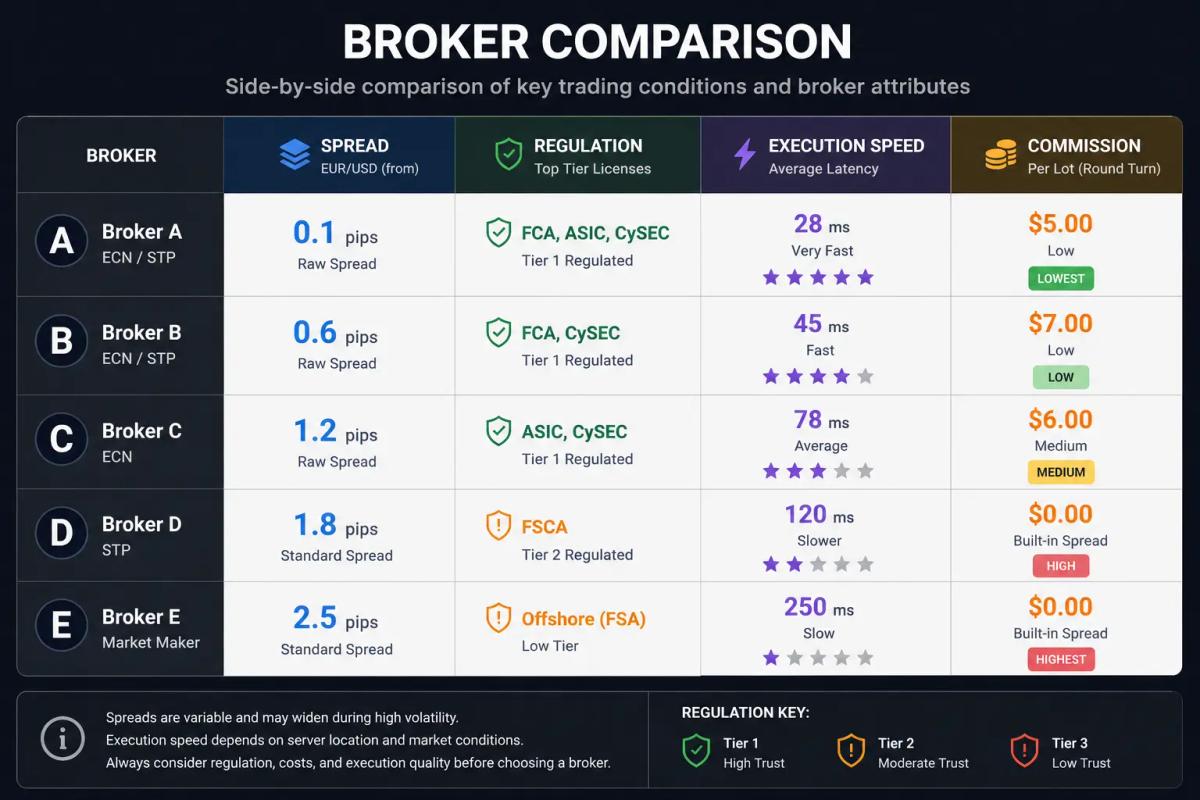
Choosing a forex broker is one of the highest-leverage decisions you'll make as a trader. The right infrastructure supports your edge. The wrong one costs you on every trade, delivers worse fills, and may offer little accountability if something goes wrong. This guide gives you a concrete, prioritized set of forex broker comparison metrics to apply to any broker, so you're evaluating what actually affects your results.
Why Most Broker Comparisons Miss the Point
Broker comparison sites are typically optimized for affiliate revenue. The brokers paying the highest commissions get the best ratings. This system produces a predictable result: comparisons that lead with star ratings, deposit bonuses, and platform screenshots, while burying the metrics that determine whether you'll actually make or lose money from the broker relationship itself.
The gap between advertised metrics and real trading conditions
A broker can advertise "spreads from 0.0 pips" while delivering an average spread of 1.8 pips in real market conditions.
The gap between what brokers advertise and what you experience at the trading terminal is where traders get burned. The metrics in this guide close that gap. They're measurable, verifiable in most cases before you deposit, and directly tied to your cost base, fill quality, and fund safety.
Start with the one metric that determines whether the rest even matters.
Pick a well-regulated CFD provider among the best forex & CFD brokers.
Metric 1 - Regulatory Status and Jurisdiction Tier
Two brokers can both call themselves regulated while operating under frameworks with almost nothing in common. The quality of oversight varies enormously by jurisdiction, and understanding the tier system is the foundation of any serious broker evaluation.
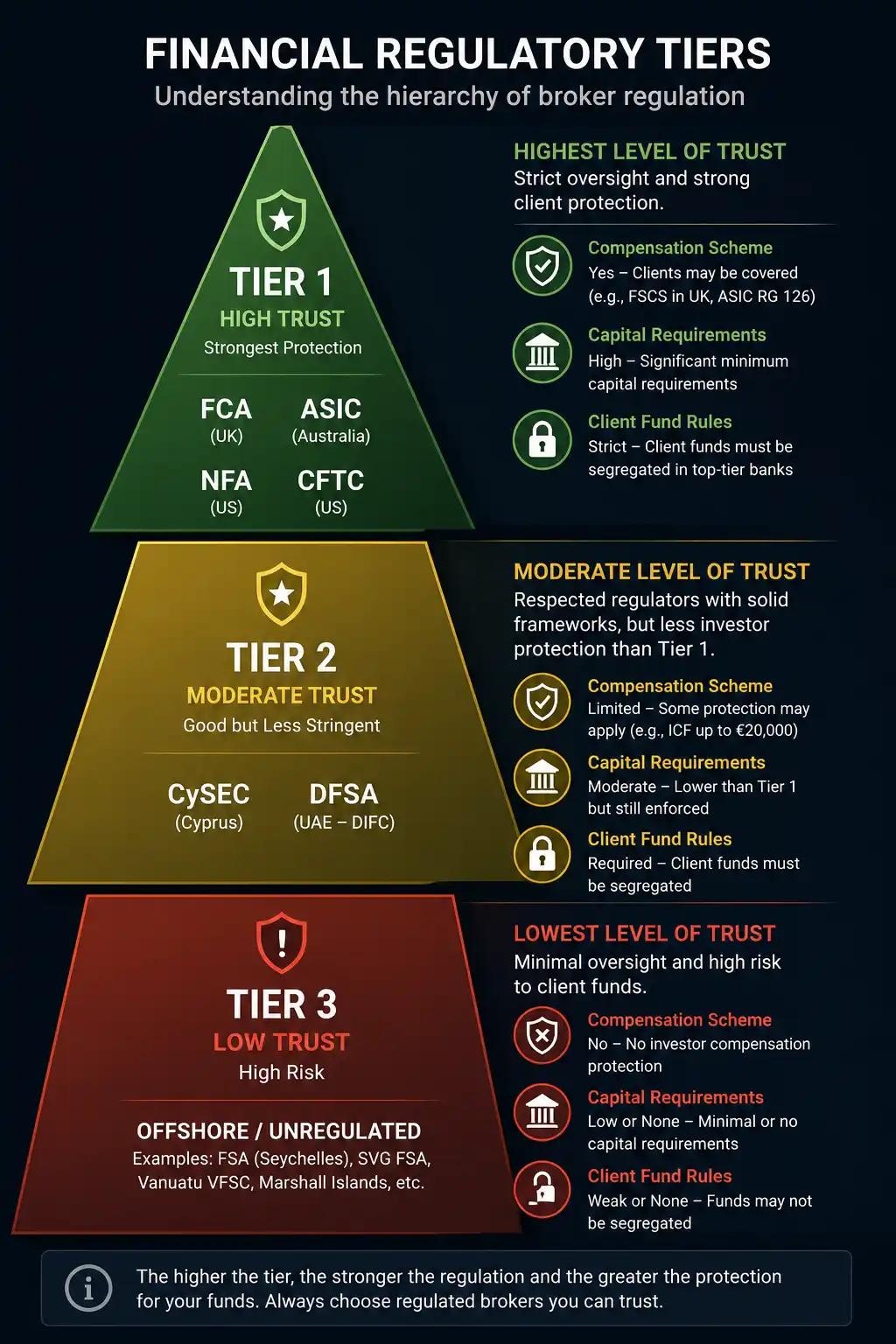
Tier 1 vs Tier 2 vs Tier 3 regulators
Tier 1 regulators are the gold standard. These include:
- FCA (Financial Conduct Authority, UK)
- ASIC (Australian Securities and Investments Commission, Australia)
- NFA / CFTC (National Futures Association / Commodity Futures Trading Commission, USA)
- DFSA (Dubai Financial Services Authority, UAE)
Tier 1 regulators enforce strict capital requirements, mandate segregated client funds, conduct regular audits, and several operate investor compensation schemes. The specific protections available vary by jurisdiction.
Tier 2 regulators are credible but less stringent. CySEC (Cyprus Securities and Exchange Commission), for example, is an EU-recognized regulator, but its enforcement record and capital requirements are lighter than the FCA's.
Tier 3 and offshore regulators, covering jurisdictions like Vanuatu, St. Vincent, the Seychelles, or Belize, offer minimal oversight and very limited recourse if things go wrong. Minimum capital requirements in these jurisdictions can reach into the tens of thousands of dollars, but they remain a fraction of what Tier 1 frameworks demand, and the regulatory infrastructure around them is not comparable.
What regulation actually protects and what it does not
Tier 1 regulation provides several concrete protections:
- Client funds held in segregated accounts, separate from broker operating capital
- Compensation schemes in select jurisdictions: FSCS in the UK covers up to £85,000 per person; ICF in Cyprus covers up to €20,000. Note that equivalent schemes are not available in all Tier 1 jurisdictions, including the USA and UAE
- Negative balance protection, mandatory in many Tier 1 jurisdictions
- Regulated dispute resolution processes
Regulation sets a meaningful baseline for broker conduct and ensures the broker is operating within defined rules. However, it does not protect you from poor execution, wide spreads, bad platform infrastructure, or a broker that is technically compliant but operationally mediocre.
One more important detail: many brokers operate multiple legal entities across jurisdictions. The entity that accepts your account registration is what matters. Always verify which legal entity holds your account and which regulator covers it.
Metric 2 - Spread Type and Real Cost Per Trade
Spreads are the most quoted metric in broker comparisons and the most consistently misrepresented. A spread figure in isolation is nearly meaningless.
Raw vs standard vs variable spreads
- Raw spreads: The direct interbank or liquidity provider spread, passed through to you with no markup. Typically 0.0 to 0.3 pips on major pairs. Always paired with a per-trade commission.
- Standard spreads: A markup added on top of the raw spread, with no separate commission charge. The markup is how the broker earns on each trade. Typical range: 0.8 to 2.0 pips on EUR/USD.
- Variable spreads: Spreads that widen during low liquidity or high volatility. An advertised spread of 0.6 pips can become 5 pips during a news event or the Asian session.
How to calculate true cost including commission
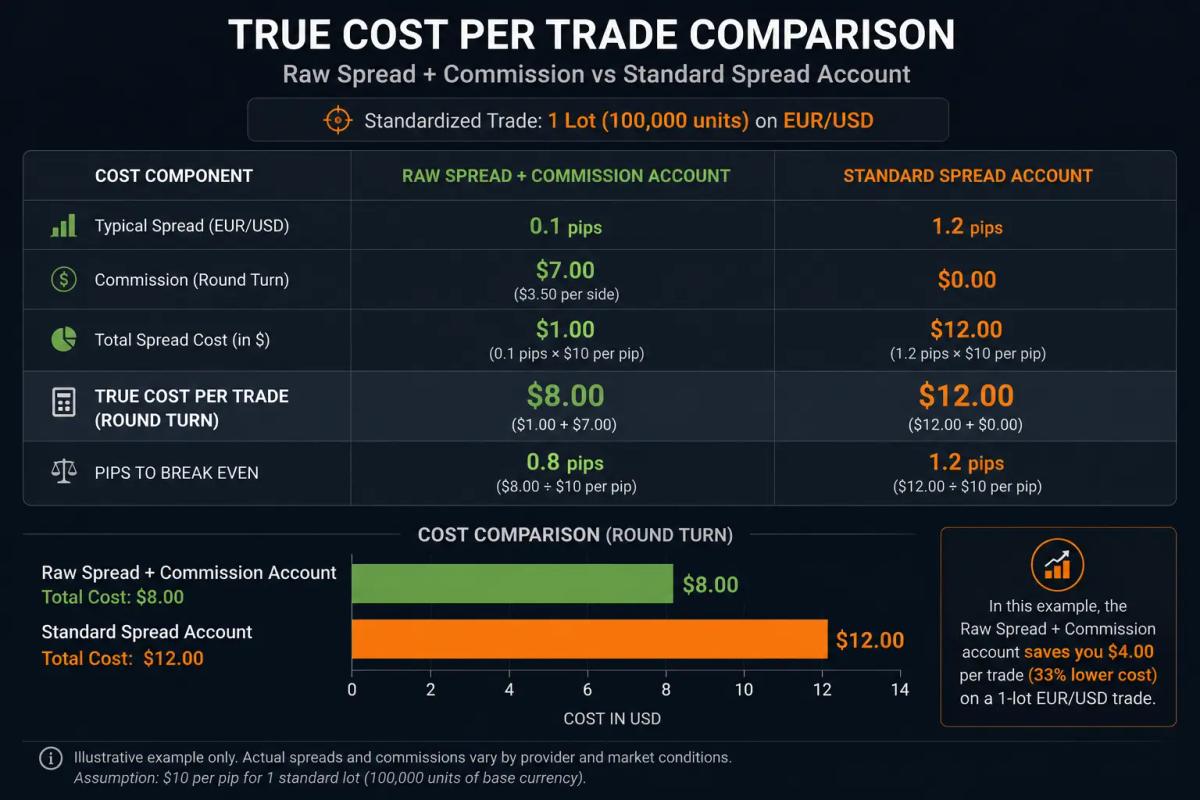
The only meaningful number is cost per round turn per lot, combining spread and commission.
Here's the formula:
Total cost = (Spread in pips x Pip value) + Commission (per lot round turn)
For a standard lot on EUR/USD (pip value = $10):
- Raw account: 0.1 pip spread + $7 commission = $1 + $7 = $8 per round turn
- Standard account: 1.2 pip spread + $0 commission = $12 + $0 = $12 per round turn
Scale that up. On 10 lots over 100 trades, a 0.2 pip difference in effective spread costs you $2,000 in additional friction. For high-frequency traders, this number can dwarf every other consideration.
Always request the typical spread figure, the time-weighted average during normal market hours. The minimum exists mostly to anchor your expectations in the broker's favor.
Metric 3 - Execution Model (STP, ECN, Market Maker)
How a broker routes and fills your orders determines both the quality of your fills and the structural incentives shaping the broker's behavior toward you.
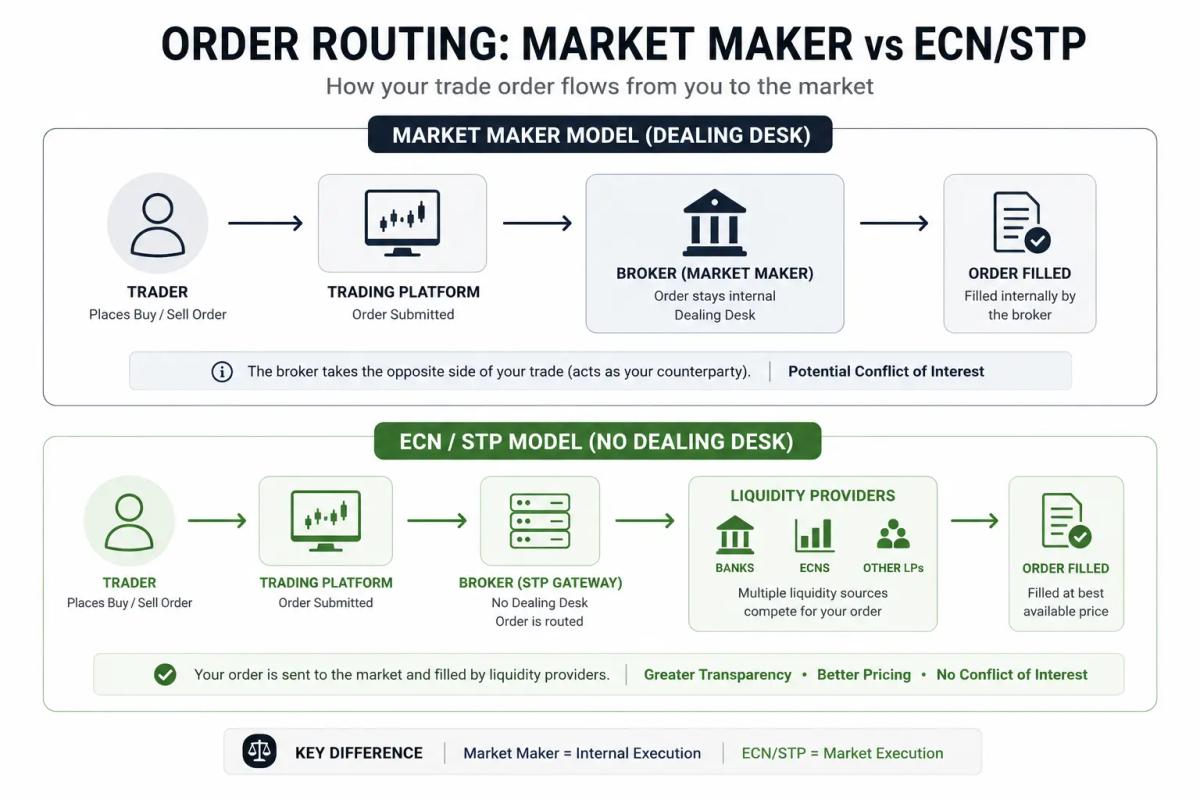
How execution model affects fills and conflicts of interest
There are three primary models:
- Market Maker (Dealing Desk): The broker takes the other side of your trade internally. They profit when you lose. This creates a direct conflict of interest. Market makers can manipulate spreads, requote prices, or generate artificial slippage. The incentive structure is misaligned, regardless of how any individual broker behaves.
- STP (Straight Through Processing): Your order is routed directly to liquidity providers without a dealing desk. The broker earns on spread markup. No direct conflict on individual trades, though the spread markup is still present.
- ECN (Electronic Communication Network): Your order enters a pool of liquidity from multiple providers, banks, and other market participants. You get the best available bid/ask. Paired with a commission per trade. Least conflict of interest; most transparency.
Matching execution model to trading strategy
- Scalpers and high-frequency traders: ECN or true STP only. The conflict-of-interest risk with a market maker compounds over high trade volume.
- News traders: ECN preferred. Market makers and some STP brokers widen spreads aggressively or freeze execution during news events.
- Swing and position traders: Model matters less at this frequency. A quality market maker with competitive spreads can be entirely workable.
It’s worth noting that "ECN" and "STP" are frequently used as marketing labels without technical accuracy behind them. Ask the broker for their liquidity provider list and whether they operate a dealing desk.
Metric 4 - Execution Speed and Slippage Track Record
Execution speed claims are among the most inflated numbers in broker marketing. "Under 50 milliseconds" is a common boast. What brokers typically don't advertise is what happens to your order when the market moves fast.
Why advertised execution speed is not the same as experienced
The speed figure in broker materials usually reflects ideal conditions: a small order, a liquid pair, a calm market. Your experience during high-impact news events, session opens, or periods of thin liquidity will be different. The relevant metric is slippage frequency and magnitude under stress.
Positive slippage, fills better than requested, does happen with quality ECN brokers. It is a sign of genuine market access. Negative slippage, fills worse than requested, is the costly kind. A broker that consistently slips you 1 to 2 pips on fills is adding an invisible tax to every trade you place.
How to assess slippage data before funding an account
Some brokers publish execution quality statistics: fill rates, average slippage, percentage of orders filled at requested price. If a broker doesn't publish them, treat that silence as informative.
Practical steps before depositing:
- Open a demo account and trade around a scheduled news event (NFP, CPI, central bank decisions). Observe requotes, spread spikes, and fill quality.
- Search third-party forums (Forex Factory, Reddit's r/Forex) for live trader reports on the specific broker during volatile periods.
- Ask the broker directly for their execution statistics. Document the response.
- If live accounts are available at low deposit thresholds, test with a minimal real-money position. Demo and live execution can differ materially, which is worth exploring further.
Metric 5 - Commission Structure and Fee Transparency
A broker's cost structure extends well beyond the spread. The full picture requires looking at every fee category, because the ones buried in the small print are often the ones that sting.
Visible fees vs hidden costs
Spreads and commissions are straightforward to compare. The less visible fees require active investigation.
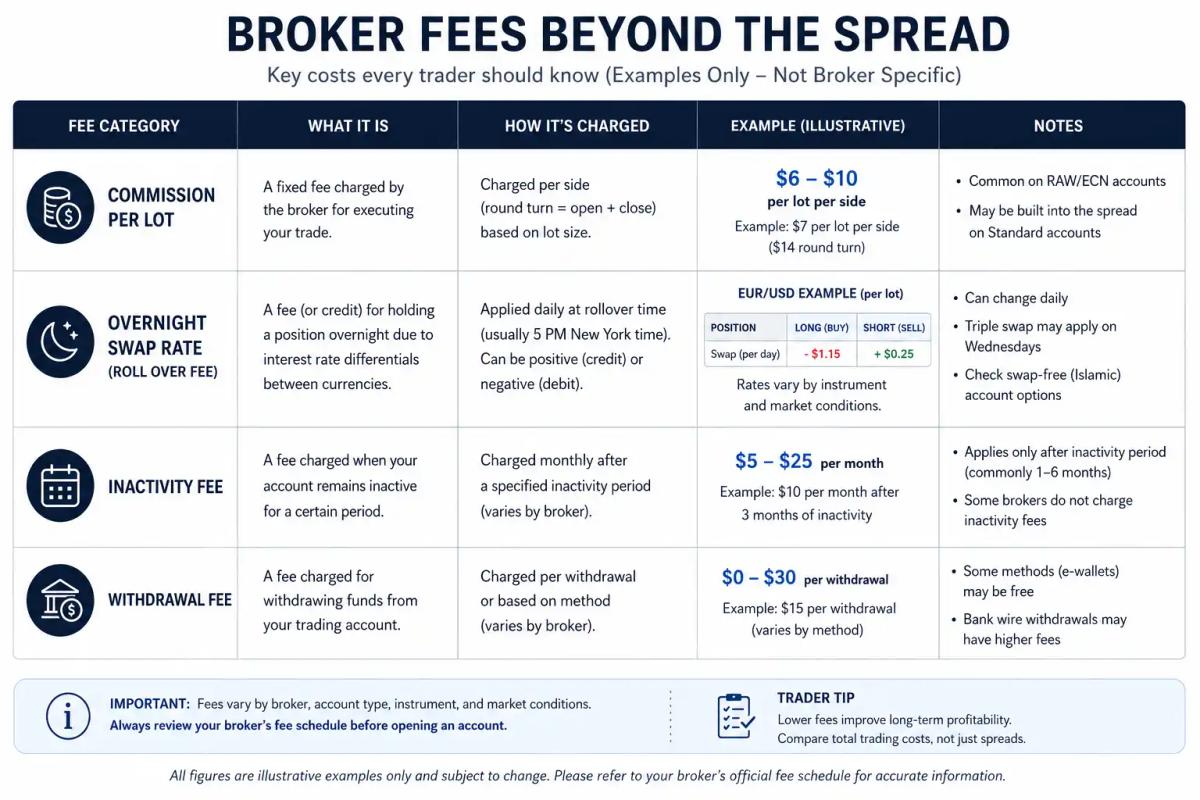
Swap rates, inactivity fees, and withdrawal charges
Swap rates (overnight financing) are particularly important for swing and position traders. A broker's swap rates on your typical positions can easily exceed your spread costs if you hold trades for days or weeks. Always check the long and short swap rate on the pairs you trade most.
Inactivity fees can systematically drain small or dormant accounts. The specific thresholds and amounts vary by broker, so always read the fee schedule in full before opening an account.
Withdrawal fees and processing times are a practical risk signal. A broker that makes it easy to deposit and difficult to withdraw is showing you its priorities. Check the withdrawal process, minimum amounts, and reported processing times from actual users.
Metric 6 - Instrument Coverage and Liquidity Depth
A longer product list doesn't automatically mean better access. What matters is the quality of liquidity behind the instruments you actually trade.
Breadth vs depth
Breadth is the number of instruments offered. Depth is the quality of pricing and execution on each one. A broker offering 400 currency pairs may have deep, competitive liquidity on EUR/USD and USD/JPY while providing essentially synthetic or dealer-driven pricing on the other 390.
For traders focused on major and minor pairs, breadth is largely irrelevant. What matters is that your specific instruments have tight, consistent spreads and reliable execution during your trading hours.
Exotic pairs and off-hours liquidity
If you trade exotic pairs (USD/TRY, USD/ZAR, USD/MXN, for example), liquidity depth becomes a primary concern. These pairs carry wider natural spreads, and a broker with poor liquidity access will add meaningful markup on top. Execution quality on exotics during off-peak hours can deteriorate sharply.
Check the spread on your instruments of interest during the Asian session if you trade those hours. The advertised spread is almost always a peak-hours number.
Metric 7 - Leverage Offering and Margin Policy
Leverage amplifies both gains and losses. The ratio available to you depends heavily on your jurisdiction, and understanding the margin policy terms is not optional when trading leveraged products.
Regulatory leverage caps by jurisdiction
- EU / UK (FCA, CySEC): Maximum 30:1 on major forex pairs for retail traders (ESMA regulations)
- Australia (ASIC): Maximum 30:1 on major pairs for retail clients
- USA (NFA / CFTC): Maximum 50:1 on major pairs, 20:1 on minors
- Offshore jurisdictions: Up to 500:1 or higher, with no meaningful safety requirements
The protections that Tier 1 regulators mandate, including negative balance protection and leverage caps, exist because extreme leverage can wipe accounts and generate negative balances in fast-moving markets. Offshore leverage offerings come without those protections.
Margin call and stop-out policy comparison
Two numbers define your exposure to forced liquidation:
- Margin call level: The equity percentage at which the broker issues a margin warning (e.g., 80% of required margin)
- Stop-out level: The equity percentage at which the broker begins forcibly closing your positions (e.g., 50%)
A stop-out at 50% gives you considerably less buffer than one at 20%. Compare these numbers across brokers and understand exactly what happens to your positions during a liquidation event. Some brokers close positions from largest to smallest; others close all simultaneously. The difference can be significant.
Metric 8 - Platform and Technology Infrastructure
The trading platform is your direct interface with the market. Its reliability, order type range, and execution infrastructure have a direct impact on your ability to execute your strategy.
Native vs third-party platforms
- MetaTrader 4 (MT4): The most widely used platform in retail forex. A large ecosystem of indicators and EAs, though its architecture is aging relative to newer alternatives.
- MetaTrader 5 (MT5): More order types, faster backtesting, multi-asset support. Increasingly preferred by newer brokers.
- cTrader: Cleaner interface, built-in level II pricing, strong for ECN/STP environments. Excellent for algorithmic trading.
- Proprietary platforms: Can be excellent or poor. Require scrutiny. Look for uptime records and user reviews.
API access, order types, and uptime reliability
If you use automated strategies or third-party tools, API availability matters. Check whether the broker offers FIX API or proprietary API access, and what the rate limits and latency look like.
Order types are a practical necessity. Stop-loss, take-profit, trailing stop, and OCO (one cancels other) orders are baseline requirements. Some brokers restrict order types on certain account levels.
Uptime reliability is the least glamorous metric until it isn't. A platform that drops during high-volatility periods, exactly when you need it most, is a structural risk. Search for outage reports and downtime history on third-party forums before committing to a broker.
Metric 9 - Account Types and Minimum Deposit Thresholds
The account structure a broker offers tells you something about how they think about their clients.
What account segmentation reveals about broker incentives
A broker offering 12 different account tiers with escalating features and minimum deposits may be structuring its product to extract maximum revenue per client segment rather than offering genuinely appropriate conditions. A simple two-tier structure (standard and raw) is usually more transparent and easier to evaluate.
Key questions for any account type:
- What is the actual spread and commission structure at each tier?
- Are execution conditions genuinely different between tiers, or is it cosmetic segmentation?
- Is there a minimum deposit requirement that affects which accounts you can access?
- Are all risk protections (negative balance protection, segregated funds) consistent across all account types?
Minimum deposits range from $0 at some brokers to $10,000 or more for premium execution tiers. A low minimum deposit is a client acquisition tactic. The trading conditions are what deserve your attention.
Demo account fidelity as a proxy for live conditions
A demo account should mirror live trading conditions as closely as possible. Some brokers configure demo accounts with better fills, tighter spreads, and zero slippage to create a favorable first impression. If your demo performance is significantly better than what live traders report, that gap is worth investigating.
Test the demo during major news events. Compare demo spreads to reported live spreads from user forums during the same periods. The difference will tell you what you actually need to know.
Metric 10 - Customer Support Quality and Fund Safety Mechanisms
Fund safety is the baseline question of whether your capital can be recovered if a broker fails or acts in bad faith.
Segregated accounts, compensation schemes, and negative balance protection
Segregated accounts mean client funds are held separately from broker operating capital. If the broker becomes insolvent, your funds are not mixed into the bankruptcy estate. This is a regulatory requirement under most Tier 1 jurisdictions. Ask whether your funds are held in segregated accounts and at which institution.
Compensation schemes provide a last-resort recovery mechanism in select jurisdictions:
- FSCS (UK): Up to £85,000 per person
- ICF (Cyprus): Up to €20,000 per person
These schemes cover you if the broker fails. They're a meaningful protection, but they don't make you whole on a large account. Equivalent schemes are not available in all Tier 1 jurisdictions. Traders registered under US or UAE entities, for example, should confirm directly what protections apply to their specific account.
Negative balance protection ensures your account cannot go below zero, even in extreme market moves. This is mandatory for retail clients under FCA and ASIC rules. Confirm it applies to your specific account type.
Support responsiveness as a risk signal
Support quality can seem like a secondary concern until you have a position stuck open, a withdrawal stalled, or a dispute to resolve. At that point, responsiveness is everything.
Test support before depositing: contact via live chat and email with a specific technical question. Measure the response time and quality. A broker that takes 72 hours to answer a pre-sales question will not move faster when your money is on the line.
How to Weight These Metrics for Your Trading Style
The relative importance of each metric shifts based on how you actually trade. No single framework fits every trader.
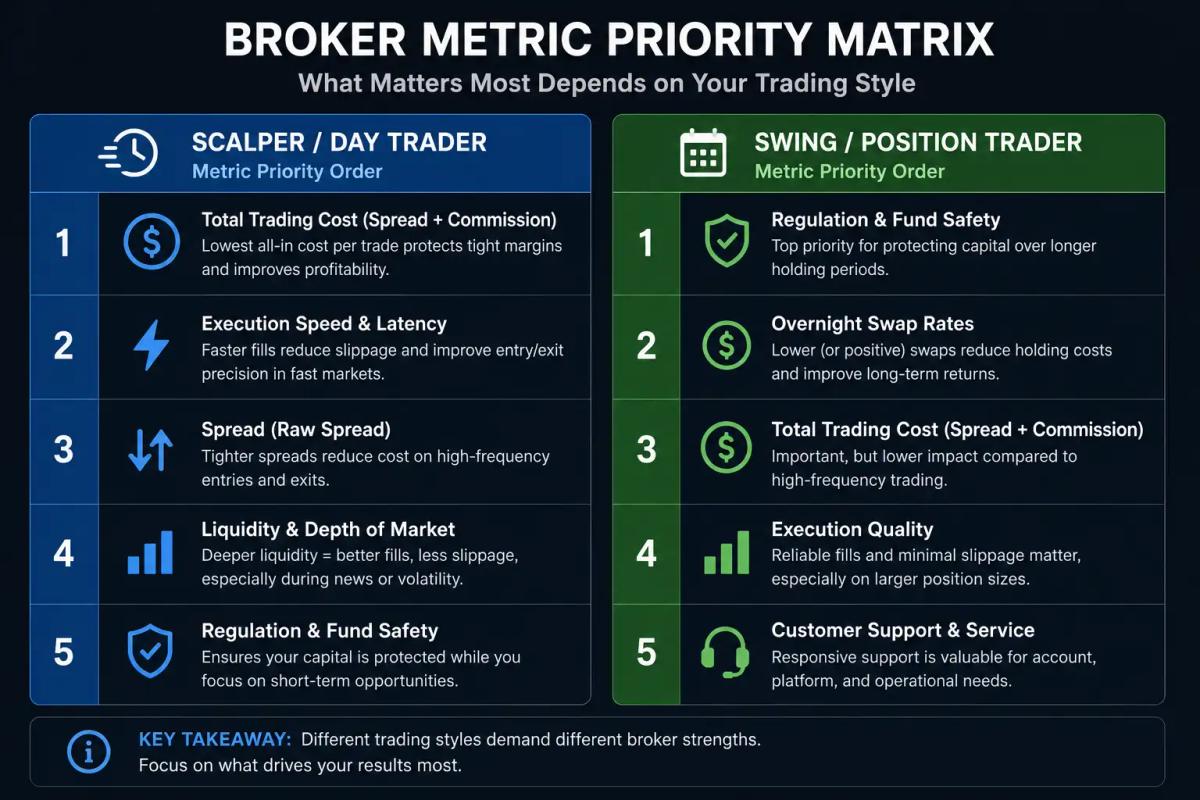
Priority matrix for scalpers
Scalpers execute high trade volumes with small targets per trade. Cost and execution quality dominate everything else.
Priority matrix for swing and position traders
Swing and position traders hold trades for days to weeks. Overnight costs, fund safety, and broker stability matter more than microsecond execution.
The right broker for a scalper running 50 trades a day is probably not the right broker for a swing trader running 10 trades a month. Evaluate against your own trading style.
Frequently Asked Questions
How do I calculate the true cost per trade?
Multiply the spread (in pips) by the pip value for your lot size, then add any per-trade commission. For a standard lot on EUR/USD with a 0.8 pip spread and no commission, your cost is $8 per round turn. For a raw spread account at 0.1 pips plus a $7 round-turn commission, the cost is also $8 per round turn, identical in this example, but conditions vary by broker and instrument.
What is the practical difference between STP and ECN for a retail trader?
Both route your orders away from a dealing desk, removing the direct conflict of interest present with market makers. The main practical difference is that ECN connects you to a pool of multiple liquidity providers and allows your order to interact with other market participants, often producing tighter spreads and the possibility of positive slippage. STP routes to one or a small set of liquidity providers with the broker applying a spread markup. In practice, a well-implemented STP and a standard ECN can produce similar results for most retail order sizes.
Does a Tier 1 regulated broker always mean safer funds than Tier 2?
Tier 1 generally means stronger capital requirements, more rigorous auditing, and more robust compensation schemes. The specific entity holding your account matters more than the headline regulator, however. A broker group headquartered under FCA oversight may route retail accounts from certain regions through a CySEC or offshore subsidiary. Always verify which legal entity holds your account and which regulator covers that entity specifically.
How do I assess execution quality before depositing real funds?
Open a demo account and actively trade around major scheduled news events (NFP, CPI releases, central bank decisions). Observe spread behavior, requote frequency, and fill quality under stress. Supplement this by reviewing user reports on third-party forums. If the broker publishes execution statistics (fill rates, average slippage), request them. For brokers with low minimum deposits, a small live-account test can also reveal differences between demo and live conditions.
What are swap rates and why do they matter?
Swap rates (also called overnight financing or rollover rates) are the cost or credit applied to positions held open past the daily rollover cutoff, typically 5:00 PM New York time. They reflect the interest rate differential between the two currencies in the pair. For traders holding positions overnight or for multiple days, swap costs can accumulate to a meaningful expense that rivals or exceeds the spread cost. Always check the specific long and short swap rates on the instruments you trade most frequently.
Does a low minimum deposit indicate anything about broker quality?
No. Minimum deposit requirements are primarily a client acquisition tactic. A $10 minimum deposit tells you the broker wants access to a large retail audience. It says nothing about spread quality, execution model, regulatory standing, or fund safety. Evaluate the actual trading conditions independently of the entry threshold.
How do I read a broker's conditions page without being misled?
Focus on the typical spread figure, the time-weighted average during normal hours. Find the full commission schedule including per-lot charges, swap rates, and inactivity fees. Identify which legal entity you'll be registered under and verify its regulator. Look for the margin call and stop-out levels. If any of these figures are absent from the conditions page, contact support and document the response. Incomplete transparency on trading conditions is itself informative.
What does negative balance protection actually mean?
Negative balance protection means your account cannot fall below a zero balance, even if a market move is so extreme that your losses exceed your deposited funds. Without it, you could theoretically owe a broker money after a losing trade. Under most Tier 1 regulatory frameworks (FCA, ASIC), negative balance protection is mandatory for retail clients. It is a meaningful safety mechanism in volatile markets, but it does not protect you from losing your deposited capital.
About the authors


Put this into practice
Related articles

Forex Spread Explained: What It Costs You on Every Trade
A plain-English guide to the forex spread: what it is, how to calculate the cost of one, and how it shapes the profitability of your trading strategy.

How Many Day Traders Are Successful? What the Data Shows
A clear, evidence-based look at how many day traders actually make money, how long they last, and the habits that separate survivors from the majority who quit.

How to Choose the Best CFD Brokers
Learn how to choose the best CFD brokers with this step-by-step guide covering regulation, fees, platforms, and key red flags to avoid.
0 comments