



Financial Markets · Beginner · 10 min read
ETF vs Mutual Fund: Structure, Costs, and Tax Impact Compared
The core structural difference, explained
ETF vs. mutual funds: which one is better? The choice comes down to structure: both are pooled investment vehicles that hold a basket of assets, but an ETF (exchange-traded fund, a fund whose shares trade on a stock exchange) is bought and sold intraday like a stock, while a mutual fund is priced once per day and bought directly from the fund company. That single structural fact shapes how you access the vehicle, when your order fills, what you pay in fees, and how tax events reach your account.
A pooled vehicle simply means many investors' money is combined and managed as one portfolio. You own units or shares of that portfolio, not the underlying stocks or bonds directly. Both ETFs and mutual funds work this way, which is why they often hold identical assets: an S&P 500 ETF and an S&P 500 mutual fund can track the same index with near-identical holdings.
The difference is the wrapper around those holdings. The ETF wrapper is built for the exchange: shares are created and redeemed by large institutions called authorised participants, and retail investors trade the resulting shares on the open market. The mutual fund wrapper is built for direct dealing with the fund manager: you subscribe, the manager creates new units for you, and you redeem back to the manager. Everything else, the fees, the tax profile, the liquidity, flows from that starting point.
How trading and pricing work differently
Mutual funds calculate net asset value (NAV, the total value of the fund's assets divided by the number of units in issue) once per trading day, typically after the market closes. Any order you place during the day, whether at 9am or 3pm, executes at that single end-of-day NAV. You do not know your exact price at the moment of ordering; you know it after the cut-off.
ETFs trade continuously during exchange hours. Their share price moves second by second with supply and demand, and it usually tracks the underlying NAV closely thanks to the creation and redemption mechanism run by authorised participants. You see a live bid and offer, place a market or limit order, and get filled at a known price. This intraday tradability is the single most visible practical difference.
The pricing mechanics also affect what happens in stressed markets. Because ETF shares trade on the exchange, their price can temporarily diverge from the value of the underlying holdings, creating a premium (share price above NAV) or a discount (share price below NAV). During the March 2020 volatility, several bond ETFs traded at meaningful discounts to their stated NAV for short periods, according to the Bank of England's Financial Stability Report on that episode. Mutual funds do not show visible premiums or discounts because they only trade at the calculated NAV, but the underlying illiquidity risk still exists; it appears instead as delayed pricing or, in extreme cases, as fund gating.
| Feature | ETF | Mutual fund |
|---|---|---|
| Pricing frequency | Continuous, intraday | Once per day at NAV |
| Order visibility | Live bid and offer | Executed after cut-off |
| Where you buy | Stock exchange, via broker | Directly from fund company or platform |
| Premium or discount to NAV | Possible | Not visible |
Fee structures and cost comparison
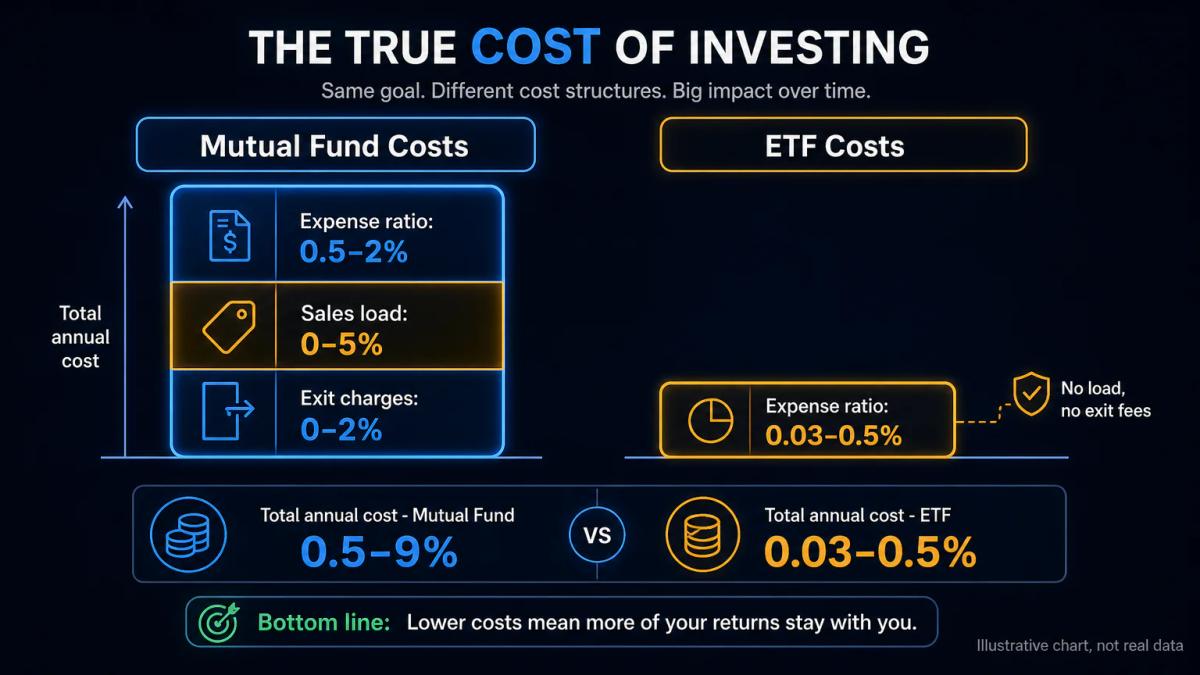
Mutual fund costs are typically higher and more layered. Ongoing charges (called the ongoing charges figure or OCF in the UK, expense ratio in the US) commonly range from 0.5% to 2% annually for actively managed funds, and some share classes carry sales loads (a one-off entry fee) or exit charges. The all-in cost of an actively managed equity mutual fund often lands in the 1% to 2% range once you count platform fees.
Broad index ETFs frequently charge 0.03% to 0.25%, and even more specialised ETFs rarely exceed 0.75%. They carry no sales loads. The trade-off is that you pay your broker: a commission on each buy or sell (many brokers now charge zero on ETFs, but not all) and the bid-offer spread on the exchange.
| Cost component | Typical actively managed mutual fund | Typical index ETF |
|---|---|---|
| Ongoing charge | 0.50% to 2.00% | 0.03% to 0.50% |
| Entry or exit load | 0% to 5% (share class dependent) | None |
| Broker commission per trade | Usually none | $0 to $10 typical |
| Bid-offer spread | Not applicable | 0.01% to 0.50% typical |
Cost matters more than most beginners realise. A 1% annual cost gap compounded over 25 years reduces a portfolio's terminal value by more than a fifth: this is a straightforward compounding calculation, not a forecast. That gap is the strongest single argument for the ETF wrapper when the underlying strategy is a passive index. Where the argument weakens is with actively managed strategies that are not available as ETFs, which is common in some UK and European fund ranges.
Tax efficiency and capital gains distribution
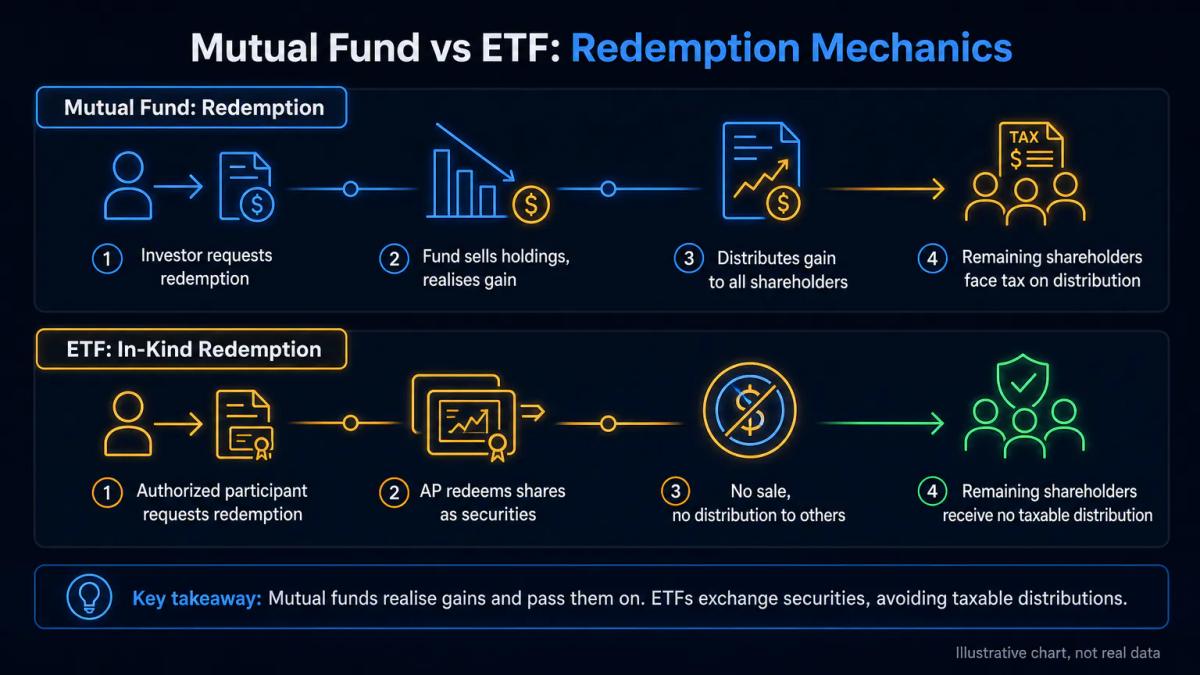
ETFs are generally more tax efficient than mutual funds, and the reason is mechanical. When a large investor leaves an ETF, the authorised participant redeems shares in kind, handing back a basket of the underlying securities rather than forcing the fund to sell them. Because the fund does not sell, it does not crystallise a capital gain, and so it does not need to distribute one to remaining shareholders. Mutual funds, which must sell holdings to meet cash redemptions, distribute realised gains annually, and you owe tax on those distributions even if you did not sell a single unit.
The practical impact depends on the jurisdiction and the account. In a UK ISA (Individual Savings Account, a tax-sheltered wrapper) or a US retirement account, this tax efficiency advantage largely disappears because gains and income are shielded anyway. In a general investment account, it can be material year after year.
UK investors face an extra layer: reporting status. A fund domiciled outside the UK must have HMRC reporting fund status for gains to be taxed as capital rather than as offshore income. According to HMRC's Investment Funds Manual, non-reporting funds have gains taxed at income tax rates, which are higher for most investors. Both ETFs and mutual funds can be reporting or non-reporting: check the fund's factsheet before buying, particularly for US-domiciled ETFs, which are usually not reporting funds and are increasingly hard for UK retail investors to access under PRIIPs (Packaged Retail and Insurance-based Investment Products) rules.
Liquidity, flexibility, and real-time trading
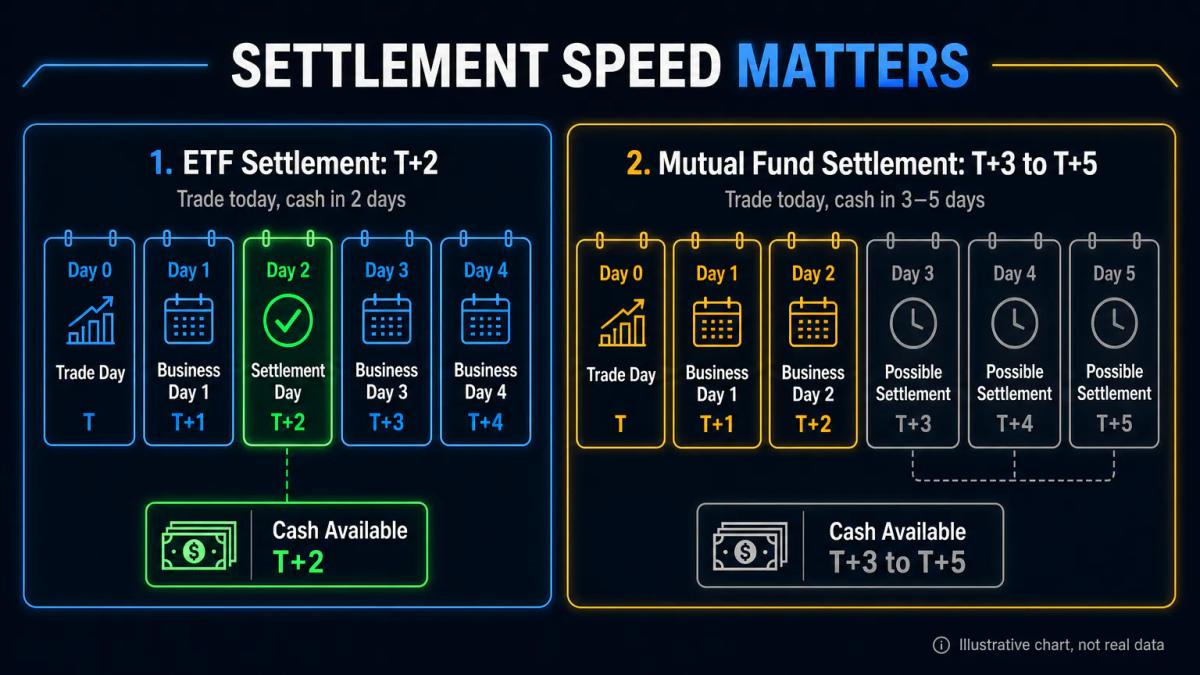
ETFs offer intraday liquidity: place an order, get filled at a live price, and see your cash proceeds settle within the exchange's standard cycle (typically T+2 in most major markets, moving to T+1 in the US and UK). Mutual funds settle after the daily NAV strike, so between placing your redemption and receiving cleared funds you often wait three to five business days.
That flexibility is not automatically an advantage. For a long-term saver making monthly contributions through dollar-cost averaging, once-daily pricing is not a disadvantage; it simply removes the temptation to react to intraday moves. For an active investor who wants to rebalance around an event, intraday trading matters.
Flexibility also includes order types. With an ETF you can place a limit order (buy only at or below a chosen price), a stop order, or trade around a specific news event. Mutual funds only accept market-on-NAV orders. You also cannot short a mutual fund or use it as collateral in the way you can with an ETF at some brokers. Whether any of this matters to you depends on how you actually invest: if you never look at intraday prices, the ETF's flexibility is a feature you will not use.
Diversification and professional management
Both ETFs and mutual funds give you instant diversification: one purchase can spread your money across hundreds or thousands of individual securities. A global equity ETF or mutual fund can hold 2,000 to 3,000 companies across dozens of countries. This is the core benefit of the pooled structure and applies equally to both wrappers.
Management style is where they diverge in emphasis rather than in kind. Mutual funds still dominate active management, where a manager picks holdings with the aim of beating a benchmark. According to the S&P Dow Jones Indices SPIVA Europe scorecard, a majority of actively managed European equity funds have underperformed their benchmark over ten-year horizons: that finding has been consistent across multiple SPIVA report editions and is the empirical backbone of the case for passive index investing.
ETFs are historically dominated by passive index tracking, though actively managed ETFs are growing quickly in the US and expanding in Europe. If you want a well-known active strategy in the UK market, it is often only available as a mutual fund or OEIC (open-ended investment company, the UK's standard mutual fund structure). If you want low-cost broad exposure to a market or factor, ETFs are usually the cheaper wrapper. The choice is between the strategy and the wrapper, and sometimes the strategy dictates the wrapper.
Which is right for your situation
Use ETFs when you want low ongoing costs, tax efficiency in a general account, intraday flexibility, and transparent live pricing. This suits self-directed investors building a passive core portfolio, active investors who trade around events, and anyone who values seeing what they are paying and when.
Use mutual funds when you want a specific actively managed strategy that has no ETF equivalent, when you are contributing small amounts on a fixed schedule through a platform that charges per trade for ETFs, or when you prefer the discipline of once-a-day pricing that removes the intraday screen from view.
| Investor profile | Typical fit | Why |
|---|---|---|
| Beginner, monthly contributions | ETF or mutual fund | Depends on platform: free fund dealing favours mutual funds, commission-free ETFs favour ETFs |
| Long-term passive index investor | ETF | Lower ongoing charges compound meaningfully |
| Active trader, intraday moves | ETF | Live pricing, limit orders |
| Investor wanting specific active manager | Mutual fund | Strategy often only available in this wrapper |
| Retiree taking regular income | Either | Depends on distribution frequency and platform fees |
UK retail investors should also check who regulates the fund and its manager. Both UK-authorised OEICs and UCITS ETFs (Undertakings for Collective Investment in Transferable Securities, the EU's cross-border fund standard) fall under FCA oversight when sold to UK retail clients, with protection through the Financial Services Compensation Scheme up to the FCA's stated limit for investment claims. According to the FCA, the FSCS protects eligible claims against authorised firms up to a per-person limit that the FCA publishes on its site; check the current figure before you rely on it.
ETF vs index fund: a related distinction
An index fund and an ETF describe different things: an index fund is a strategy (passively tracking a chosen market index), while an ETF is a structure (a fund whose shares trade on an exchange). The two overlap heavily but are not the same word.
Most ETFs are index funds because passive tracking was where the ETF wrapper first took hold, but a growing minority are actively managed. Most index funds have historically been mutual funds, particularly in markets like the UK where index tracker OEICs remain popular, but index ETFs now hold the majority of global passive assets.
The practical takeaway: when you compare an ETF against an index fund, you may actually be comparing two wrappers holding the same strategy. Look at the ongoing charge, the tracking difference (how closely the fund matches its index after fees), the domicile and reporting status, and the platform cost of holding each one. The wrapper matters, but the strategy inside it matters more.
This content is general information and not advice: every situation needs checking with a licensed professional in the relevant jurisdiction.
Frequently Asked Questions
What is the main difference between an ETF and a mutual fund?
An ETF trades on a stock exchange at live intraday prices, while a mutual fund is priced once per day at net asset value and bought directly from the fund company. That structural difference drives most of the other gaps in costs, tax and flexibility.
Are ETFs always cheaper than mutual funds?
Not always. Ongoing charges are typically lower for ETFs, but you may pay a broker commission and the bid-offer spread on each trade. If your platform charges nothing for mutual fund dealing but a commission per ETF trade, small regular purchases can be cheaper in a mutual fund wrapper.
Can you trade an ETF during the day like a stock?
Yes. ETFs trade continuously during exchange hours with live bid and offer prices. You can place market orders, limit orders and stop orders, and you see the execution price immediately. Mutual funds only execute at the once-per-day NAV cut-off.
Which is more tax efficient: an ETF or a mutual fund?
ETFs are generally more tax efficient in a general investment account because their in-kind redemption mechanism rarely forces the fund to realise capital gains. In a UK ISA or a US retirement account the advantage largely disappears because the wrapper already shelters gains and income.
Is an index fund the same as an ETF?
No. Index fund refers to a passive strategy that tracks a market index; ETF refers to an exchange-traded structure. Most ETFs are index funds and most index funds are mutual funds, but the terms are not interchangeable. Actively managed ETFs and index ETFs both exist.
About the authors


Put this into practice
Related articles

ETN vs ETF: Key Differences and Which One Fits Your Profile
ETNs and ETFs look similar on a trading screen, but one is debt and the other is ownership. Here is what that changes for your money.

Forex Market Sentiment: What It Is and How to Read It
A plain-English guide to forex sentiment: what buy-to-sell ratios mean, where to read them, and how to use extremes as contrarian setups.

Forex brokers for Iranian residents: eligibility, sanctions and practical access
A factual guide for Iranian residents on which forex brokers can legally onboard them, how sanctions shape access, and what to check before depositing.
0 comments