



Prop Trading · Advanced · 9 min read
Funded Trading Accounts in Australia: Rules, Firms and Getting Started
What a funded trading account actually is
A funded trading account is capital allocated by a proprietary trading firm, operated under a written rulebook that defines targets, drawdowns and payout terms. Your upfront evaluation fee buys the opportunity to prove consistency; the firm then supplies the balance and shoulders the market risk, while you contribute execution in exchange for a contracted share of profits. The structure sits closer to a performance contract than to a brokerage relationship, since the firm owns both the capital and the exposure that comes with it.
For an Australian trader, this changes the economics of scaling. You pay a fee to prove consistency on a simulated or live account sized at $25,000, $100,000 or $200,000, and on passing receive an allocation on those terms, which compresses years of compounding a personal $5,000 account into an evaluation window. Profit splits typically run from 70/30 to 90/10 in your favour, though the trade-off remains firm: should you breach a drawdown rule even once, the account is closed with no appeal and no refund of the evaluation fee.
This distinguishes a prop firm Australia arrangement from a retail broker account, where the following all sit with the trader:
- the capital is yours
- the profits are yours
- the losses are yours
If a funded account is your goal, our roundup of the best prop firms is the place to start.
ASIC rules and leverage caps for Australian traders
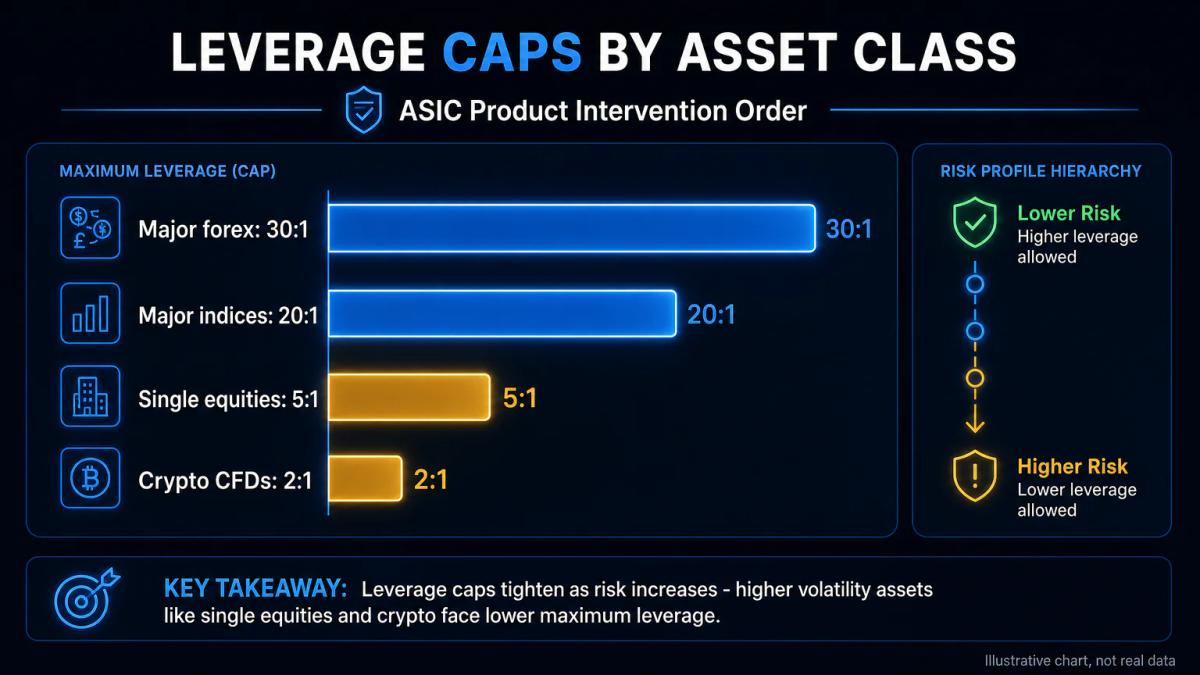
ASIC's Product Intervention Order on CFDs, in force since 29 March 2021, caps retail leverage at 30:1 on major forex pairs, 20:1 on major indices and gold, 10:1 on minor indices and non-gold commodities, 5:1 on single equities, and 2:1 on crypto-asset CFDs. The order also mandates negative balance protection and bans trading inducements for retail clients.
These caps bind any CFD issuer holding an Australian Financial Services Licence (AFSL). Where a prop firm routes orders through an AFSL-licensed broker and onboards you as an Australian retail client, you trade under those limits. If instead the firm operates offshore, through entities commonly set up in jurisdictions such as St Vincent and the Grenadines, the UAE or Seychelles, and classifies you under the terms of that jurisdiction, significantly higher leverage becomes available, with 100:1 or 500:1 on forex being standard.
The compliance gap carries real consequences. An offshore funded account Australia setup gives you more notional size per dollar of margin, yet the trade comes at a cost: you lose ASIC's negative balance protection, your access to AFCA dispute resolution, and the enforcement route that a locally licensed counterparty provides. Several prop firms label their product as 'simulated' or 'demo-based' precisely to argue they fall outside the CFD issuer regime; the legal status of that framing has not been fully tested, and ASIC's December 2023 review flagged scrutiny of the sector.
Most prop firms, Australian or offshore, size their internal leverage well below retail caps anyway, often 1:50 to 1:100 on forex but with much smaller account sizes relative to position limits.
How prop firms evaluate and fund your account
The standard model is a two-step evaluation, with each step enforcing the same daily and overall drawdown rules:
- Step one requires an 8-10% profit target over an unlimited or 30-day window.
- Step two drops the target to 4-5%, keeping drawdown rules identical.
Each structure prices risk differently, so the evaluation fee is effectively an option premium on the funded allocation.
Single-step and instant-funding variants exist as alternatives:
- Single-step compresses the test to one 10% target with tighter consistency rules.
- Instant funding skips the evaluation entirely, charges a higher fee, applies lower profit splits in early withdrawal cycles, and uses stricter drawdown math.
Firms screen for three behaviours during the evaluation window:
- Consistency, meaning no single trade exceeds a defined percentage of total profit.
- Minimum trading days, typically 3-5, which prevents single-trade passes.
- News-event compliance where applicable to the firm's rulebook.
Breaching any one voids the evaluation. The economic logic is straightforward: because the firm relies on the pass to predict behaviour during the funded phase, consistency rules filter out one-shot gamblers who happen to clear the target.
Drawdown limits, profit targets and payout terms
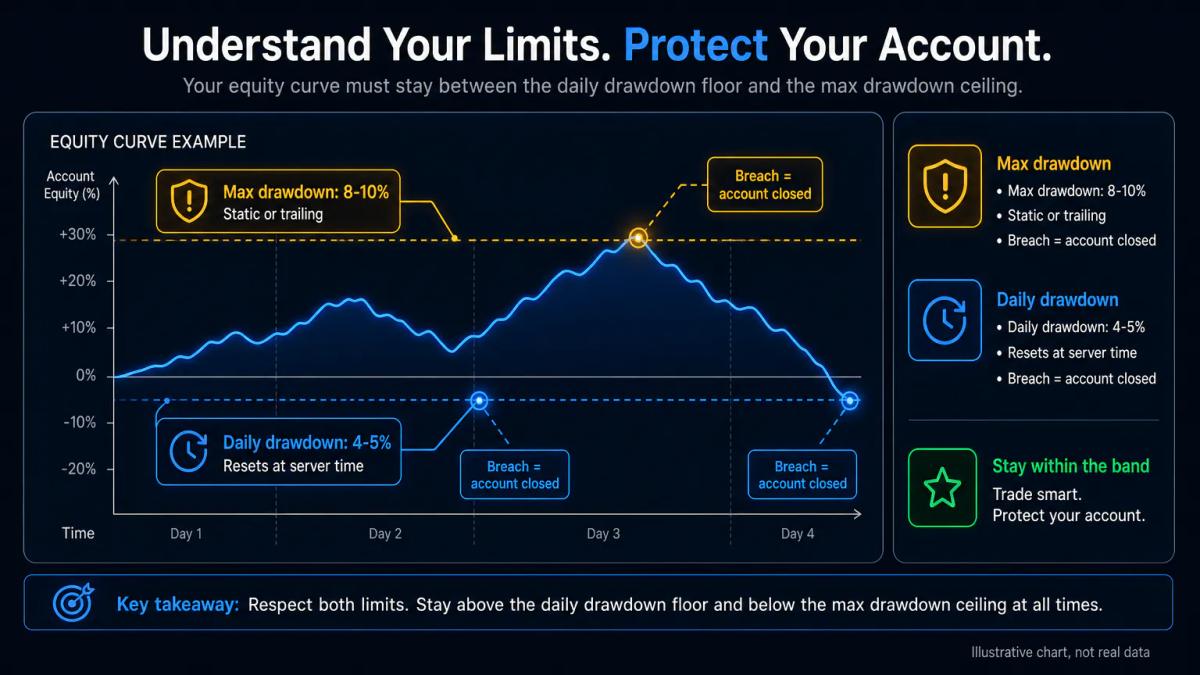
Two drawdown types govern every funded account:
- Daily drawdown, usually 4-5% of starting balance or equity depending on the firm, which resets at a defined server time.
- Maximum drawdown, usually 8-10%, which is either static (anchored to initial balance) or trailing (following the account high-water mark until it locks at initial balance plus target).
| Term | Typical range | What triggers a breach |
|---|---|---|
| Daily drawdown | 4% to 5% | Equity below daily floor at any point |
| Max drawdown (static) | 8% to 10% | Equity below fixed floor at any point |
| Max drawdown (trailing) | 8% to 10% | Equity below rolling floor until locked |
| Profit target (eval) | 8% to 10% step 1, 4% to 5% step 2 | Reached, not breached |
| Minimum trading days | 3 to 5 | Fewer days voids the pass |
| Profit split | 70% to 90% to trader | Contractual |
Payout cycles typically run bi-weekly or monthly on the funded phase, with a first-payout waiting period of 14 to 30 days from first trade. Some firms offer on-demand withdrawals after a minimum profit threshold. Processing time, once requested, ranges from same-day (crypto rails) to 5-10 business days (wire transfer). Fees are rare but not absent: a handful of firms deduct a flat processing charge on wire withdrawals under a minimum amount.
Tax and reporting obligations for funded trading income
The following is general information: Australian tax treatment of prop firm income is unsettled in parts, and your position depends on facts the ATO assesses case by case; confirm with a registered tax agent before filing.
The ATO's framework for trading income turns on whether you are carrying on a business of trading or investing on capital account. The relevant guidance is TR 97/11 and the business-indicia tests:
- scale of activity
- repetition and regularity
- business-like organisation
- profit intention
- capital employed
A funded trader with daily activity, defined strategy and documented process typically falls on the business side, meaning profits are ordinary income under section 6-5 of the ITAA 1997 and losses are deductible against other income (subject to the non-commercial loss rules in Division 35).
If you fail the business tests, gains are generally assessable as ordinary income from an isolated profit-making undertaking, because CFD-equivalent payouts from a prop firm are not disposals of a CGT asset in the usual sense. ATO Taxation Ruling TR 2005/15 treats financial contracts for differences as on revenue account for most individuals.
Several record-keeping and reporting habits make the picture cleaner at year-end:
- Track every payout in AUD at the exchange rate on the date of receipt.
- Retain evaluation fee receipts, which are deductible against business income and more constrained if non-business.
- Expect PAYG instalments once the ATO notices recurring income.
GST does not apply to the trading income itself.
Risk management when trading firm capital
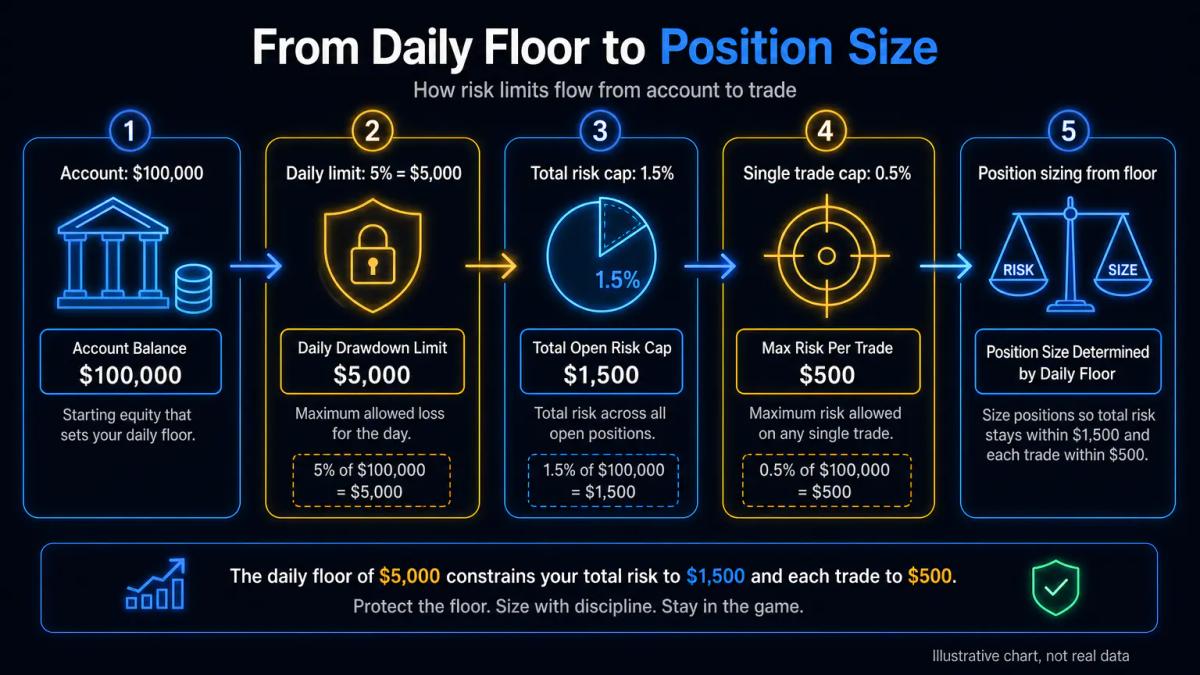
The psychological asymmetry between personal and funded capital is sharp. On a personal account, a 2% loss stings but survives; the same 2% on a funded account can land on top of an existing intraday drawdown and close the account permanently. Because the rule set compresses recovery optionality, position sizing has to be anchored to the daily drawdown floor rather than left loose against the overall maximum.
Consider a working heuristic for a $100,000 account with a 5% daily limit: cap total risk on open positions at 1.5% of balance, and cap any single trade at 0.5-0.75%. That leaves headroom for two or three correlated losers before the daily floor comes into play, so a serious drawdown remains one losing day away rather than one bad trade away. Correlation is the silent killer, since three EUR crosses sized at 0.5% each amount to a 1.5% EUR trade dressed as diversification.
Stop losses function as structural safeguards rather than discretionary tools. Account rules often void payouts retrospectively if a review finds martingale, grid or no-stop behaviour on the day a drawdown was breached, so the responsibility for managing the P&L curve under the firm's constraints sits squarely with the trader.
Platforms, market access and withdrawal timelines
MT4, MT5 and cTrader dominate the funded-account space, with a growing minority offering DXtrade, Match-Trader or TradingView-integrated execution. MT5 is the default for firms needing futures, stocks and crypto alongside forex; cTrader attracts firms positioning on execution transparency and depth of market data.
Market access is defined by the firm's liquidity provider rather than by the trader. A firm partnered with a single-venue LP may advertise 'global markets' while routing all orders through one aggregator, carrying the spread and slippage profile that implies. Imagine paying an evaluation fee only to discover the symbol list is thin or the weekend spread widening is punishing: checking both before you commit removes that risk.
Withdrawal rails determine the real timeline. The main options break down as follows:
- Crypto rails (USDT on Tron, USDC) typically clear in minutes to hours.
- Wise and Revolut business transfers run same-day to T+1.
- SWIFT wires to an Australian bank account take 2 to 5 business days, occasionally longer around public holidays.
First withdrawals carry additional KYC checks that extend the first cycle by a few days.
Comparing Australian and international prop firms
The choice set divides on regulation, speed and profit terms.
| Dimension | AFSL-aligned Australian firms | Offshore international firms |
|---|---|---|
| Regulator | ASIC via licensed broker partner | Varies (SVG, UAE, Seychelles) |
| Leverage on major forex | Typically capped at 30:1 retail | Commonly 100:1 to 500:1 |
| Negative balance protection | Mandated | Discretionary |
| Dispute resolution | AFCA access via AFSL partner | Internal or offshore arbitration |
| Typical profit split | 70% to 85% | 80% to 90% |
| First payout window | 14 to 30 days | 7 to 14 days |
| Payout rails | Bank transfer, PayID | Crypto, Wise, bank transfer |
| Platform choice | MT4, MT5, cTrader | MT4, MT5, cTrader, DXtrade |
The compliance gap is the main variable at play. An Australian-aligned structure gives you AFCA and ASIC enforcement if the firm refuses a payout or changes rules mid-cycle, while an offshore structure typically routes any dispute through a terms-of-service process heard under the law of a jurisdiction with limited practical recourse. Offshore profit terms look more attractive precisely because the firm is pricing in that enforcement discount.
To compare these rules with a real firm's, the FTUK review lays them out.
This article is general information only and does not constitute financial, legal or tax advice. Each trader's situation is different, so decisions on funded accounts, taxation and regulatory status should be confirmed with a licensed professional in the relevant jurisdiction before acting.
Frequently Asked Questions
Do I need my own capital to start a funded trading account in Australia?
Only the evaluation fee, typically $100 to $600 depending on account size and firm. Instant-funding variants charge more. You risk no personal capital in the market itself, and losses on the funded account are absorbed by the firm within its drawdown rules.
What happens if I breach the drawdown limit on a funded account?
The account closes immediately, open positions are liquidated at market, and the evaluation fee is not refunded. Some firms offer a reset or discount on a new evaluation; most do not restore the funded account itself. Breach is contractual and final under standard terms.
How long does it take to get paid out from a funded trading account?
First payouts usually require 14 to 30 days from your first trade. Once requested, processing runs same-day on crypto rails, 1-2 business days on Wise or PayID, and 2-5 business days on SWIFT to an Australian bank. First withdrawals carry extra KYC and run longer.
Can I trade crypto on a funded account as an Australian trader?
Yes, most firms offer major crypto CFDs on MT5 or cTrader. ASIC caps retail crypto CFD leverage at 2:1 for AFSL-licensed CFD issuers; offshore firms frequently offer 10:1 or higher. Weekend trading, swap costs and widened spreads apply, and the firm's symbol list determines coverage.
What is the difference between a prop firm evaluation and a live funded account?
The evaluation is a paid test on a demo or simulated environment where you must hit a profit target under drawdown and consistency rules. The funded account is the allocation issued after passing, with the same rules but a profit-sharing contract. Many firms keep the funded phase on simulated execution and settle P&L internally.
About the authors


Put this into practice
Prop firms we have reviewed
Scored on the same five dimensions, with the rules that decide payouts. Here are three — the full list is on the prop firms page.



Related articles

High Frequency Trading (HFT): How Speed Became a Market Edge
A grounded look at high frequency trading (HFT): the infrastructure, the strategies, the regulatory guardrails, and what it changes for you at the retail level.

How to Become a Proprietary Trader: Path, Requirements, and Reality
A practical guide to becoming a proprietary trader: institutional versus online routes, evaluation mechanics, risk limits, taxes and a first 90-day plan.

Kraken Crypto Prop Trading Explained: How It Works and How to Get Started
A plain-English explanation of Kraken's funded trader model, plus the five steps to getting started: verify your account, pick a tier that fits your risk, rehearse the rules, pass the evaluation, then trade funded.
0 comments