



Technical Analysis · Intermediate · 9 min read
Double Top and Double Bottom Pattern: Identification, Entry Rules and Risk Management
A double top and double bottom pattern is a reversal formation where price tests the same level twice before turning. The double top prints two peaks at resistance and signals a bearish reversal; the double bottom prints two troughs at support and signals a bullish reversal. Confirmation requires a decisive close through the neckline on rising volume.
What is a double top and double bottom pattern?
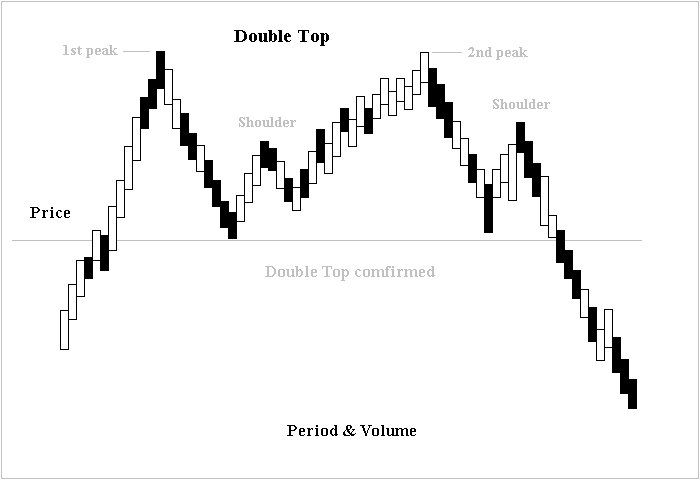
A double top is a bearish reversal where price rallies to a resistance level, pulls back, rallies again to roughly the same level, and then breaks lower. A double bottom mirrors this after a downtrend: two troughs at the same support, followed by an upside break. Both formations show that the prevailing trend has run out of buyers or sellers at a specific price. The two extremes should sit within about 3% of each other on daily charts; wider spacing weakens the pattern.
The pattern's reliability rests on three ingredients: a clear prior trend, symmetry between the two peaks or troughs, and volume behaviour that supports exhaustion. Volume typically fades into the second extreme and then expands on the neckline break. A double top formed after a three-month uptrend on a daily chart carries more weight than one printed inside a two-day range on a 5-minute chart. Traders treat the pattern as a structural signal, not a mechanical trigger: it works because it maps a shift in support and resistance at a tested level, not because the shape looks tidy on a screen.
These tools work best on good charting software: the best forex brokers.
How to identify the neckline and confirm pattern completion
The neckline is the horizontal line drawn through the reaction low between the two peaks (double top) or the reaction high between the two troughs (double bottom). It is the pivot that separates a two-touch consolidation from a completed reversal. Until price closes through the neckline, the pattern is only potential; the market can rally again, roll into a triple top, or morph into a rectangle.
Confirmation has two components. First, a close (not just a wick) through the neckline on the working timeframe. On a daily double top, that means a daily candle closing below the neckline; a five-minute spike that reverses does not confirm anything. Second, an expansion in volume on the breakout candle relative to the two prior swings. A break on thin volume is the single most common trap in this pattern.
Draw the neckline as a horizontal line unless the intermediate high or low sits at an obviously different level; a mildly sloped neckline is acceptable but should not exceed a few degrees. Once broken, the neckline often flips role: former support becomes resistance in a double top, former resistance becomes support in a double bottom. A retest of the neckline after the breakout, holding as new resistance or support, is the highest-quality entry signal the pattern offers, cleaner than chasing the initial break.
Entry and exit rules based on neckline breakout
Enter short on a double top when the working-timeframe candle closes below the neckline; enter long on a double bottom when it closes above. Two entry styles dominate. Aggressive traders enter on the close of the breakout candle to capture the full move. Conservative traders wait for a retest of the neckline: price returns to the broken line, fails to reclaim it, and then resumes in the breakout direction. The retest entry sacrifices some reward for a materially tighter stop and a lower false-signal rate.
The classical price target is measured by taking the vertical distance from the highest peak (or lowest trough) to the neckline and projecting that same distance from the breakout point. If a double top has a $10 pattern height and the neckline breaks at $95, the measured objective sits at $85. Treat this as a first target, not a fixed exit: many traders scale out half the position at the measured move and trail the remainder using a moving average or a swing-based stop.
Avoid market orders on illiquid instruments during the breakout candle; slippage can eat the risk-reward mathematics that made the trade attractive. On CFDs and forex, factor the spread (the gap between bid and ask prices, which is your immediate cost of entry) into the target: a two-pip spread on a 40-pip pattern is 5% of the intended move, and it compounds quickly across trades.
Volume analysis and false signal prevention

Volume is the single most useful filter for separating genuine double tops and bottoms from decorative shapes. In a healthy pattern, volume is highest on the first peak or trough, lower on the second, and then expands sharply on the neckline break. A second peak printed on higher volume than the first often precedes a breakout to new highs rather than a reversal, because it shows fresh buying, not exhaustion.
| Signal | Confirms reversal | Warns of false break |
|---|---|---|
| Volume on second peak/trough | Lower than first | Equal or higher than first |
| Volume on neckline break | Expanding, above 20-day average | Flat or below average |
| Close through neckline | Full-body candle, holds on next bar | Long wick, quickly reclaimed |
| Follow-through | Continues in breakout direction | Reclaims neckline within 1 to 3 bars |
The most common invalidation scenario is a bar closing back above a broken double-top neckline (or below a broken double-bottom neckline) within one to three candles. That reclaim tells you the sellers (or buyers) who forced the break could not defend it, and the pattern has failed.
A slow, grinding breakout without a volume expansion is the second warning: reversals rooted in genuine trend exhaustion usually break with conviction, because trapped traders are being flushed out of positions. When both flags appear together, thin volume and a quick reclaim, exit the trade rather than defending the original thesis. Volume-based filtering removes a meaningful share of the low-quality setups that produce the pattern's reputation for whipsaws.
Timeframe selection and pattern reliability
Double tops and bottoms are most reliable on daily and weekly charts, where each peak reflects days or weeks of order flow and represents real trend exhaustion. Weekly patterns on major indices and large-cap equities can define multi-quarter turning points. Daily patterns are the practical sweet spot for swing traders: enough structure to be meaningful, frequent enough to be tradable.
Intraday charts below the 1-hour timeframe produce far more shapes that look like double tops than genuine reversals. A 15-minute double top inside a strong daily uptrend usually resolves as a continuation, not a reversal, because the higher-timeframe context overrides the intraday pattern. If you trade intraday setups, use the 1-hour or 4-hour chart as your working timeframe and require alignment with the daily trend, or with a daily support or resistance level, before taking the trade.
Risk management and stop loss placement
Place your stop just above the second peak on a double top, or just below the second trough on a double bottom. The exact distance depends on the instrument's volatility: 5 to 15 pips beyond the extreme is typical on major forex pairs, while equities and indices often require a buffer sized to the average true range (ATR, the average daily price movement over a lookback period, usually 14 bars). A stop placed exactly on the peak or trough will be hunted; a stop placed a fraction beyond it survives the noise around the level.
Size the position so that a stop-out costs no more than 1 to 2% of account equity. On a $10,000 account with a 1% risk limit, that is $100 of risk per trade; if your stop distance is 50 pips on EUR/USD, that maps to roughly one mini lot. Calculate the risk-reward ratio before entering by comparing the stop distance to the measured target: reject setups that offer less than 1:2. UK retail clients trading these patterns through CFDs face FCA leverage caps: 1:30 on major forex pairs, 1:20 on indices, 1:5 on equities, and no CFD access on crypto. Position sizing against those caps ensures you stay within regulatory limits, not against the leverage a platform displays.
Double tops versus double bottoms and other reversal patterns
Double tops call the end of uptrends; double bottoms call the end of downtrends. The mechanics are symmetrical, but the market behaviour is not identical: bottoms often take longer to form because fear dissipates more slowly than greed, and volume signatures on bottoms are frequently less clean than on tops.
| Pattern | Structure | Reliability | Best use |
|---|---|---|---|
| Double top | Two peaks at resistance | Moderate | End of clear uptrend, daily chart |
| Double bottom | Two troughs at support | Moderate | End of clear downtrend, daily chart |
| Head and shoulders | Three peaks, middle highest | Higher, due to asymmetry | Major trend reversals |
| Triple top/bottom | Three tests of one level | Higher than double, rarer | Extended distribution/accumulation |
| Ascending/descending triangle | Converging trendlines | Continuation more often than reversal | Trend continuation setups |
If price breaks the tested level on the first attempt, the double pattern has already failed; do not wait for a second touch that will not come. Look instead for a breakout trading strategy that matches the new price action.
Psychological drivers and market behavior behind pattern formation
Double tops form because buyers who pushed price to the first peak cannot marshal enough follow-through to break resistance on the second attempt. Volume fades, momentum indicators diverge, and sellers who were waiting at the level regain control. Late buyers, drawn in by the second rally, become the fuel for the reversal: their stops sit just above the second peak, and their exits provide the selling pressure that drives the neckline break.
Double bottoms mirror this dynamic in reverse. Panic sellers exhaust themselves on the second test of support, buyers who had been sidelined step in at what looks like a confirmed floor, and short sellers begin to cover. Recognising which group is being trapped, and where their stops sit, is more useful than memorising the shape.
Frequently Asked Questions
How do you calculate the price target after a double top or double bottom breakout?
Measure the vertical distance from the highest peak (double top) or lowest trough (double bottom) to the neckline, then project that same distance from the breakout point in the direction of the break. If a double top has a $10 height and the neckline breaks at $95, the measured objective is $85. Treat this as a first target; many traders scale out half the position there and trail a stop on the remainder.
What is the difference between a double top and a head-and-shoulders pattern?
A double top has two peaks at roughly the same level; a head and shoulders has three peaks with the middle one (the head) higher than the two shoulders. The asymmetry of the head and shoulders tends to make it more reliable, because the failed higher high is a stronger sign of exhaustion. Use the double top when price tests the same level twice; use the head and shoulders when a higher high fails and price returns to the neckline.
Can double tops and bottoms be traded on intraday timeframes, or are they only reliable on daily charts?
They are most reliable on daily and weekly charts. Intraday patterns below 1 hour produce many shapes that resolve as continuations rather than reversals. If you trade intraday, use the 1-hour or 4-hour chart as your working timeframe and require alignment with the daily trend or a daily support/resistance level before entering.
What volume pattern confirms a genuine double top or double bottom reversal?
Volume should be highest on the first peak or trough, lower on the second, and then expand sharply on the neckline break, ideally above the 20-day average. A second peak on higher volume than the first often precedes a continuation, not a reversal. A neckline break on flat or below-average volume is the single most common warning of a false signal.
How do you distinguish a false breakout from a real neckline break in a double top pattern?
Real breaks close with a full-bodied candle beyond the neckline on expanding volume and hold on the next bar. False breaks show long wicks, thin volume, and a reclaim of the neckline within one to three candles. If the neckline is retaken quickly, exit the position rather than defending the original thesis; the pattern has failed.
About the authors


Put this into practice
Brokers we have reviewed
Scored on the same five dimensions. Here are three of them — the full list is on the brokers page.



Related articles

Fibonacci Retracement Explained: Levels, Setup, and Trading Rules
A working guide to Fibonacci retracement: how to draw it, which levels matter, and how to combine it with risk rules and other indicators without over-relying on the tool.

Head and Shoulders Pattern Trading: Structure, Entry, and Risk Management
A structural guide to head and shoulders pattern trading: identification, neckline breakouts, false-break filters, inverted variant, and position sizing tied to pattern dimensions.

How to Identify Market Trends: A Practical Technical Analysis Guide
A structured guide to identifying uptrends, downtrends, and ranges using price action, indicators, and multi-timeframe analysis, with risk rules and reversal cues built in.
0 comments