



10 Forex Trading Myths That Are Costing You Money
Forex trading myths are expensive misconceptions. For every trader who works out how the market actually operates, there's another who lost real money finding that out. This guide breaks down ten of the most persistent forex myths: where they came from, and what the reality actually looks like.
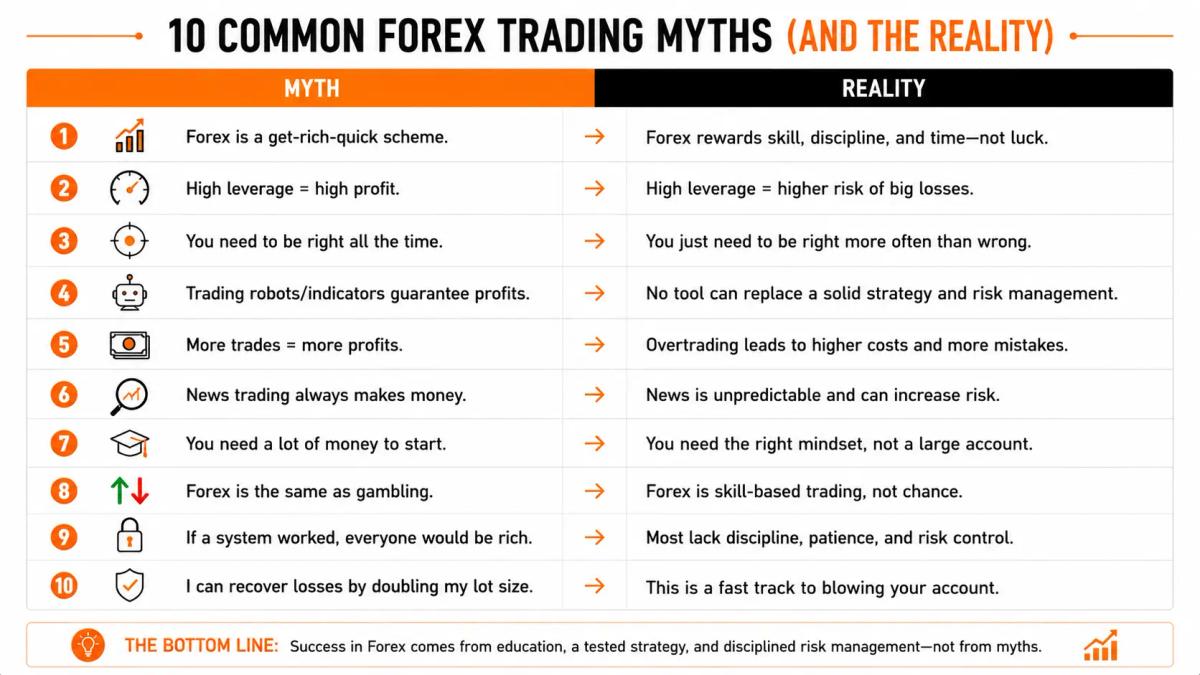
Why Forex Myths Are More Dangerous Than You Think
In forex trading, a myth believed deeply enough and acted upon with real money produces immediate, concrete losses. There's no soft landing.
The forex market is the largest and most liquid financial market in the world, with daily volume exceeding $9.6 trillion according to the BIS 2025 Triennial Survey. The scale creates a particular illusion: surely something this large and well-documented must be well understood by participants. In reality, the retail forex space is layered with bad information that has been circulating for decades, mutating slightly as it passes through forums, YouTube channels, and social media accounts.
Myths persist here because the feedback loop is slow and noisy. You might believe something wrong for months before you can definitively identify it as the cause of your losses rather than some other variable. By then, the myth is embedded.
Before your first trade, choose a regulated broker from our best forex brokers list.
Where These Myths Come From
Forex myths have a handful of reliable sources:
- Early retail forex marketing. When brokers first targeted retail clients in the late 1990s and 2000s, the advertising leaned heavily on accessibility and profit potential. Some of that messaging became background assumption.
- Signal seller and "guru" ecosystems. A significant industry exists around selling forex education and signals. It has a financial incentive to oversimplify and over-promise.
- Survivorship bias in communities. Online trading communities disproportionately feature winning traders. The majority who lost quietly exited without sharing what happened.
- Legitimate concepts distorted through repetition. Some myths started as genuine ideas that got simplified into misleading rules of thumb as they spread.
Understanding the origins helps you identify where the next myth is likely to come from.
Myth 1: You Can Make Consistent Money With Little Experience
The Reality
Forex trading is a skill. Like surgery or structural engineering, you cannot shortcut the experience curve with enthusiasm. The commonly cited statistic, that the majority of retail traders lose money, is real and documented in regulatory disclosures from EU and UK regulated brokers under ESMA requirements.
ESMA's own NCA analysis across EU jurisdictions found that between 74% and 89% of retail CFD accounts lose money. The specific figure varies by broker and period, but the pattern is consistent: most retail accounts lose money, and the accounts that lose the most are disproportionately new ones.
The myth exists partly because forex is genuinely accessible. You can fund an account with a few hundred dollars and start trading the same day. Accessibility is mistaken for simplicity. The barrier to entry is low. The barrier to profitability is not.
Consistent returns require, at minimum:
- A tested strategy with a positive expected value
- Disciplined risk management
- Enough psychological stability to execute both under real market conditions
None of those develop quickly.
Myth 2: High Leverage Means High Profit Potential
The Reality
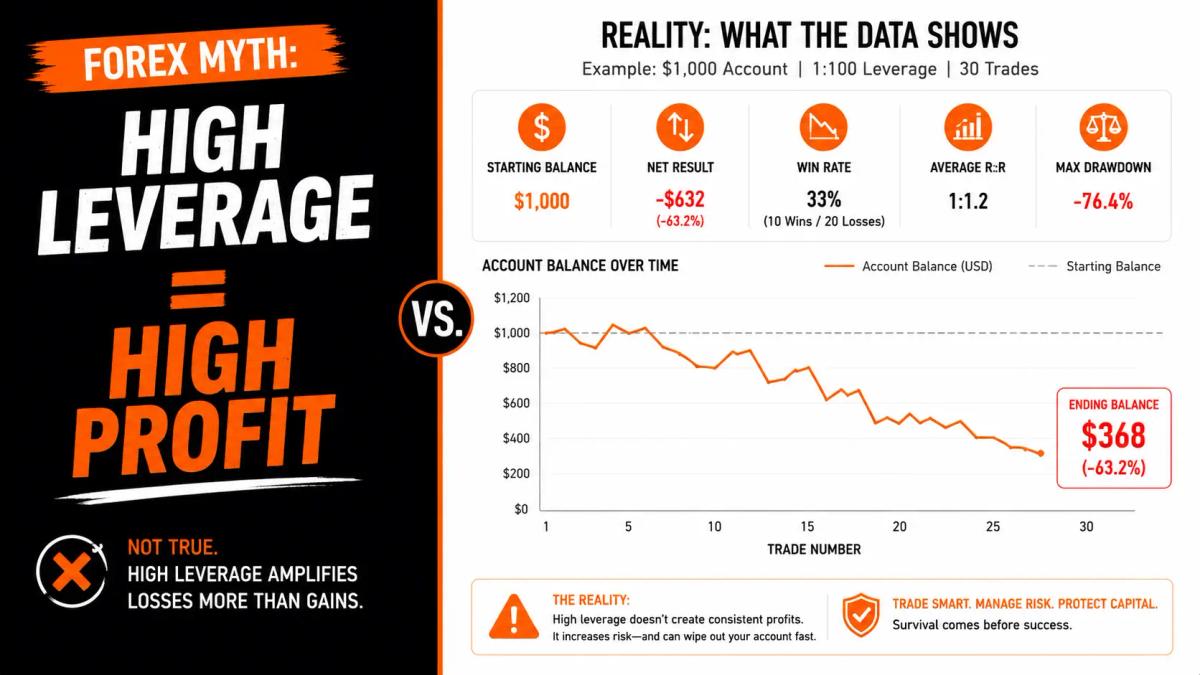
Leverage magnifies both sides of a trade equally. A 1:100 leverage position moves 100 times as fast against you as it does in your favour. The mathematics is symmetrical. The psychology and practical consequences are not, because losses beyond a certain threshold impair your ability to continue trading at all.
High leverage is a tool for specific, short-duration, high-precision trading strategies, typically executed by well-capitalised traders with sophisticated execution. For most retail traders, higher leverage correlates with faster account depletion, not higher returns. This is visible in the aggregated performance data from regulated brokers.
ESMA's leverage caps for retail clients exist precisely because the data showed that higher leverage led to worse retail outcomes.
Myth 3: Forex Markets Are Manipulated Against Retail Traders
The Reality
The forex market is not a coordinated conspiracy against your positions. The interbank market, where the actual volume is, involves major global banks trading with each other. Your retail position is several layers removed from that and is far too small to attract targeted manipulation.
What does exist is more mundane and more manageable. Brokers have varying execution quality, some have wider spreads than others, and in some cases, dealing desk models mean the broker takes the other side of your trade. These create conflicts of interest that can disadvantage retail traders in specific, identifiable ways. That's different from manipulation, and more importantly, it's something you can address by choosing a well-regulated, transparent broker.
The manipulation myth is dangerous because it provides an external explanation for losses that are almost always internal in origin. If you believe the market is rigged against you, you stop looking at your own process for improvements.
Myth 4: Win Rate Is the Most Important Trading Metric
The Reality
A trader with a 40% win rate can be significantly more profitable than a trader with a 70% win rate. Profitability is determined not by how often you win, but by the relationship between your average win size and your average loss size.
A strategy that wins 40% of the time but averages a 3:1 reward-to-risk ratio has a positive expected value. A strategy that wins 70% of the time but carries a 1:3 risk-to-reward ratio, meaning the average loss is three times the average win, loses money systematically. Expected value is the only metric that tells you whether a strategy is worth running: multiply the win rate by the average win, subtract the loss rate multiplied by the average loss, and check whether the result is positive.
Chasing high win rates leads traders toward strategies with small targets and large stops, exactly backwards from what builds sustainable profitability.
Myth 5: Brokers Make Money When You Lose
The Reality
This is partly true for some broker models and completely false for others. Conflating them causes traders to distrust all brokers equally, which isn't a useful position.
Market maker (dealing desk) brokers do take the other side of your trade in some cases, which creates a theoretical conflict of interest. Most regulated market makers hedge their net exposure, however, so they're not actively invested in any individual position failing.
ECN and STP brokers pass your orders directly to liquidity providers and make money on commissions or small markups on spreads. They have no direct financial interest in whether you win or lose on any given trade.
The practical answer: choose a well-regulated broker, understand their execution model, and direct your energy toward your own trading process rather than the broker relationship.
Myth 6: Signal Services Give You an Edge
The Reality
Signal services rarely deliver what they appear to promise, and the reasons are structural.
First, you cannot replicate someone else's signals with the same execution as the signal provider. By the time a signal reaches you and you act on it, price may have moved significantly. The entry price is not guaranteed, the stop level may already be compromised, and the risk-reward profile of the original setup is no longer the same.
Second, following signals builds no transferable skill. Even if a service is genuinely profitable, and a meaningful number are not, you have no way of knowing why the trades work, how to evaluate whether the edge is disappearing, or how to continue if the service ends.
Third, profitable signal providers have an obvious alternative: manage funds and charge performance fees. The ones selling signals to retail traders often have a better business model selling the signals than trading them.
Myth 7: Technical Analysis Is All You Need
The Reality
Technical analysis is a legitimate and useful framework. It is also routinely over-relied on by retail traders who treat it as a complete system when it's actually one component of a larger picture.
Price action reflects all available information, yes, but that information includes fundamental drivers that TA doesn't explain. A textbook support level holds until an unexpected central bank announcement breaks it instantly. A clean chart pattern completes beautifully until a surprise NFP reading inverts the move within minutes.
Traders who use TA effectively understand that it's a tool for identifying probable price paths based on past behaviour. Combining TA with awareness of the economic calendar and macro context significantly improves its reliability.
Myth 8: Volatility Is Your Enemy
The Reality
Volatility is the source of all trading opportunity. Without price movement, there are no profits to extract from the market. The discomfort with volatility is understandable. It is also, somewhat inconveniently, the mechanism by which your positions reach their targets.
Traders who fear volatility are really reacting to unmanaged volatility: moves larger than their position sizing anticipated, or that happen faster than their strategy accounts for. That's a risk management problem, not a market problem.
Certain volatility events, major economic releases, central bank decisions, and geopolitical shocks, do warrant caution, specifically because execution quality can deteriorate and spreads can widen sharply. Avoiding all high-volatility conditions, though, means avoiding many of the clearest trading opportunities available.
Myth 9: You Need a Sophisticated Strategy to Make Money
The Reality
Strategy complexity does not correlate with profitability. Many consistently profitable traders operate with straightforward systems: a single indicator for direction, a clear entry trigger, a defined stop, and a defined target.
What determines whether a simple strategy is profitable is whether it has a genuine statistical edge, and whether the trader executes it consistently enough for that edge to express itself over a large sample of trades. A complex strategy executed inconsistently is worse than a simple one executed with discipline.
The complexity myth is convenient for the education industry, which benefits from traders believing more sophisticated, and more expensive, knowledge is always required. In practice, the bottleneck for most traders is not their strategy. It's their execution of whatever strategy they already have.
Myth 10: Risk Management Is Just About Setting Stop-Losses
The Reality
Stop-losses are one tool in a broader risk management framework. Relying on stops alone misses the majority of what risk management actually involves.
Comprehensive risk management includes:
- How much of your account you risk per trade (position sizing)
- How many correlated positions you hold simultaneously
- How you respond when your account draws down by a certain percentage
- How you adjust position sizes after a losing streak versus a winning streak
- How you protect profits during a strong run
What to Do With This Information
Reading a myth-correction guide and actually changing your trading are different activities. The gap between them is where most improvement dies. Here is a specific process for making this useful.
Building a More Accurate Trading Foundation
Start with an honest audit of your current beliefs. For each myth above, ask yourself: have I been acting on this assumption, even partially?
Then work through these steps:
- Identify the myths you've believed. Don't skip the uncomfortable ones. The myths that feel most wrong are often the ones you've held most deeply.
- Trace your decisions back to the myth. How has this belief shaped your position sizes, your strategy choices, your broker selection, or your response to losing trades?
- Replace the belief with a testable principle. For example, replace the high-leverage myth with: "My effective leverage on any trade is determined by my position size and stop distance, and I will calculate that number before every entry."
- Review your recent trade history. Look at the last 20 to 30 trades and examine whether any of the myth patterns appear. Win-rate obsession, signal following, avoiding all volatile sessions: the evidence will be in your trade log.
- Pick one change to make this week. Trying to correct ten belief patterns simultaneously produces no change at all. Start with the myth that has cost you the most money.
The forex market is not forgiving of bad assumptions. Once you replace a bad assumption with an accurate one, it starts working for you instead of against you, and unlike the myth, the correction doesn't expire.
Frequently Asked Questions
What percentage of forex traders actually make money?
The most reliable data comes from regulatory disclosures that EU and UK regulated brokers are required to publish under ESMA requirements. ESMA's NCA analysis across EU jurisdictions found that between 74% and 89% of retail CFD accounts lose money. The remaining proportion are profitable to varying degrees, and a subset of those are consistently profitable over multi-year periods.
Is forex trading genuinely profitable for retail traders?
Yes, but for a much smaller proportion than the market is often presented as allowing. Retail traders who are consistently profitable over years tend to share common characteristics: disciplined position sizing, a well-tested strategy with positive expected value, strong emotional control, and realistic expectations about return rates. It's achievable, but it requires treating trading as a serious skill rather than a casual side income.
How long does it take to become a consistently profitable forex trader?
There's no fixed timeline, and the honest answer is that many traders never get there: not because they lack ability, but because they stop the learning process before their skills compound. Traders who dedicate serious study time and trade with a structured approach typically report that their first year is predominantly losses and learning. By year two or three, patterns begin to emerge. Professional traders often cite three to five years as the timeframe for developing genuine consistency.
Do forex brokers manipulate prices against retail traders?
Regulated brokers operating under FCA, ASIC, ESMA, or equivalent frameworks do not manipulate price feeds. Spot forex prices are derived from the interbank market and multiple liquidity providers, making them extremely difficult to manipulate at a retail level. Brokers can widen spreads during low-liquidity periods, which is legal and disclosed. Choosing a regulated broker with transparent pricing addresses the vast majority of legitimate concerns.
Is technical analysis actually useful or is it self-fulfilling?
Both, to some extent, and that's not a contradiction. When enough market participants follow the same technical levels, those levels attract real buying and selling activity, which makes them somewhat self-fulfilling. That's a feature, not a bug. The limitation is that no technical pattern is reliable 100% of the time, and fundamental developments can override any technical setup. TA is most useful as a probability framework, combined with risk management that accounts for the times it's wrong.
How do you find a forex strategy that actually works?
Start with strategies that have a logical basis: they work because of a repeatable market behaviour, not because a pattern looked good historically on one chart. Test the strategy on a demo account across a range of market conditions. Track results systematically: win rate, average win, average loss, maximum drawdown. Run enough trades (minimum 50 to 100) to get a statistically meaningful sample. If the expected value is positive and results are consistent across different market conditions, the strategy is worth testing on a small live account.
Should I trade forex with a signal service while I learn?
Using signals while learning creates a dependency that can slow your development considerably. You're outsourcing the analytical process that's central to building skill. A better approach is to use a demo account to develop your own analytical framework, even imperfectly, and treat signal services, if used at all, as a reference point to compare against your own analysis, not a replacement for it.
About the authors


Put this into practice
Related articles
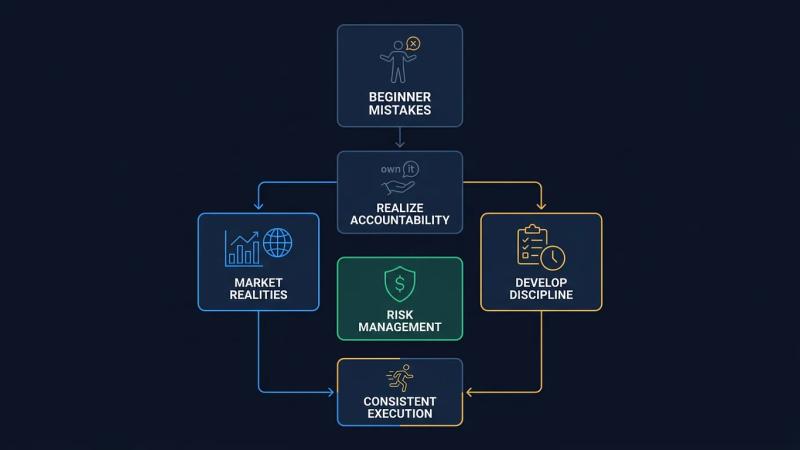
Beginner Trading Lessons: What 10 Years in the Markets Actually Taught Me
Ten years of trading, condensed into the lessons that actually cost something to learn. What beginners need to know before they fund a first account.
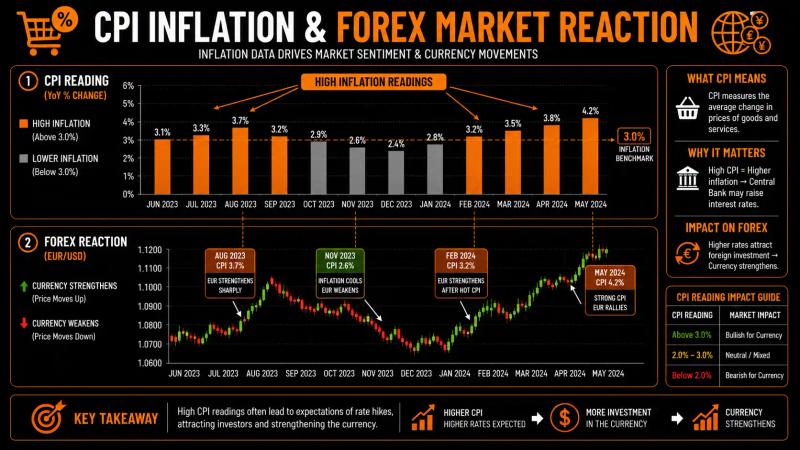
What Is Fundamental Analysis? How Economic Data Moves Currency Markets
Learn how fundamental analysis works in forex: how interest rates, inflation, jobs, and GDP data move currencies, and how to read the economic calendar.
Alternatives to TradingView: Charting Platforms Compared for Retail Traders
A practical comparison of the main alternatives to TradingView across charting, execution, pricing, backtesting and mobile trading, so you can match a platform to how you actually work.
0 comments